Verse 51847aabme;N
G3
1
only/emphatically that much distance do I have from my reality/essence
2 a
as much as I am in agitation from the illusion/fear of an Other
2 b
as much as I am in agitation from an alien/strange illusion/fear
'Essence (of a thing), essential property or quality; truth, reality, fact, true or real nature or state or circumstances or facts, gist, pith; —rightness, sincerity; —account, narration, relation, story, state, condition, explanation'.
'Distance, remoteness'.
'Thinking, imagining, conceiving (esp. a false idea) ;—opinion, conjecture; imagination, idea, fancy; —suspicion, doubt; scruple, caution; distrust, anxiety, apprehension, fear; —a superstition'.
'Other, another; different; altered, changed (for the worse); bad; strange, foreign; —another person, an outsider, a stranger, foreigner; a rival'.
| References | |
|---|---|
| Arshi, Imtiyaz Ali | Ghazal# 110 |
| Raza, Kalidas Gupta | 392-93 |
| Hamid Ali Khan | Open Image |
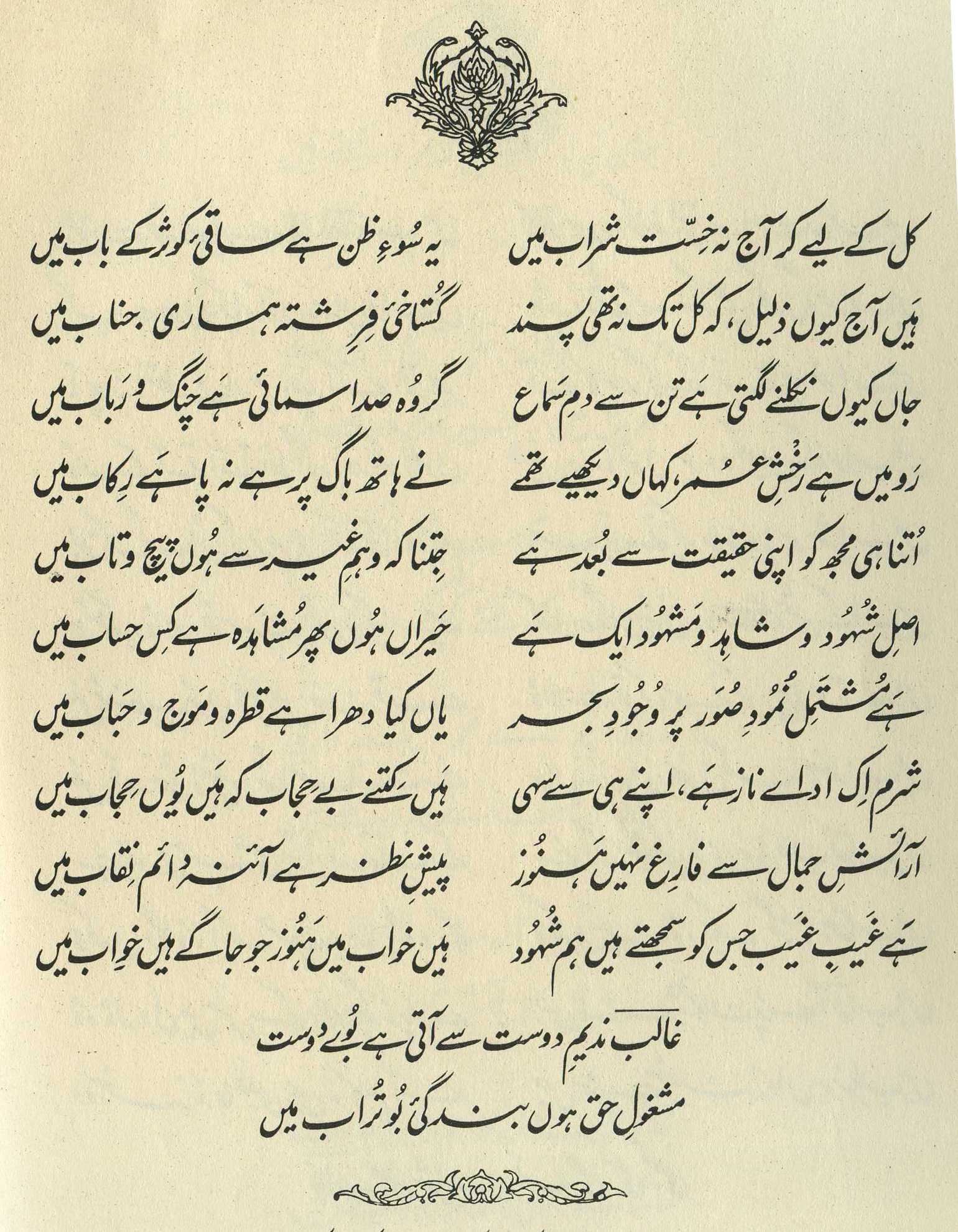
By 'Other' is here intended what exists besides Allah, which according to the Sufis is absolutely nonexistent. Because they consider everybody nonexistent except that Existent One. He says that to the extent that because of the illusion of existence besides Allah night and day I am restless, to exactly that extent I am distant from my reality, that is, my existence.
==Urdu text: Yadgar-e Ghalib , pp. 149-50
That is, to the extent that I consider the Other to be Other, to that extent I am alienated from myself. Thus the mystical knower is one who sees in the mirror of the face of the Other, his own face. (101)
== Nazm page 101

(1) I am in search of my own reality. (2) Through knowledge, I can attain understanding of reality when I place myself before others and seek out the points of comparison and difference. Because from the point of view of knowledge, I can only understand 'I' when a 'not-I' is present as well. (3) The meaning of this is that I can only place confidence in my own existence when I can place confidence in the existence of others as well. (4) Accordingly, my 'illusion' (assumption, opinion, doubt, mental error) is that others too are present, otherwise I would not be present. (5) But the difficulty is that the existence of others doesn't suit me, and it also doesn't please me that my existence should be dependent on them. I am in the 'agitation' [of wondering] who are those others? And why is my existence contingent? (6) As much as is my 'agitation' (controversy, argument, suspicion, restlessness, doubt), I am that much far off from my reality. Because (7) the real truth is that neither do I exist, nor do the others exist. We are creatures. Only that exists which is not created. (8) But the difficulty is that without the existence of the Other, I cannot prove my own existence. And since there is no existence of the Other at all, I too have no existence. For this reason my reality is nothing at all, only an 'illusion'. As long as I don't understand this, I will remain far from my reality.
There can also be this interpretation: that the 'Other' doesn't exist at all, and I am caught up in the 'illusion' that I am something and the Other is something else. That is, I consider my existence to be separate from the existence of others. The real case is that it's only an 'illusion' that anything exists apart from me. In the world whatever is, is one existence alone; there is no Other. As long as I remain caught up in the illusion that I am separate and the not-I is separate, then I won't be able to understand my existence, and I'll remain ignorant of my reality.
== (1989: 134-35) 2006: 155-57
What is this crucial ? Ghalib has made quite sure that we're offered a buffet full of choices. The guarantees us several possible relationships: an illusion created by an Other ? an illusion that itself is an Other? an illusion pertaining to an Other in some other way? Then there's the ambiguity of whether the illusion is one in the speaker's mind that concerns an Other, or one in an Other's mind that concerns the speaker; on these two possibilities, see 41,6 .
Then there's the doubleness of itself (see the definition above), which also adds to the array of choices: it can be not only a noun (2a), but also an adjective (2b), so that the construction can also be read as an adjective-noun sequence.
Then there's with its own possibilities: it can be restrictive (there's only that much distance, and not a bit more), or else emphatic (there's that much distance). In a verse as abstract as this one, the choice between these two readings can make a real difference in interpretation.
In short, this is a verse of wildly abstract philosophizing, with no doubt a certain free-floating charm as it drifts through the void.
But consider a suggestive case for comparison: 97,7 . It too has a , a display of , and a problematical Other lurking in the background. But in {97,7} the Other is the Rival , and the situation is not maximally abstract but maximally specific, since it directly concerns a 'union' that, it seems, might be actually taking place.
Ghalib's greatest verses lie between these two extremes. There should be enough specificity to give scope for not only wordplay (which both {97,7} and {98,5} do have) and preferably Ghalib's flashing wit (which neither has, in its sharp and vintage form), but also, above all, some movement from the more specific to the more abstract, and back, and forth, and back again. These two verses, both bolted firmly into place on their respective ends of the spectrum, have hardly any scope for such movement.
It makes me feel full of impatience and to read them. I'll take the haunting, memorable 98,4 any day. The presence of a real horse (well, somewhat real, anyway), perhaps with reins and stirrups flapping, running as he pleases, energizes that verse. Nothing energizes this verse. It is only complexly and unresolvably philosophical. From a poet like Ghalib, I want to ask for a bit more flash.
graphics/mirror.jpg