Verse 11847aabme;N
G3
1
for the sake of tomorrow, don't show stinginess with the wine today!
'Meanness, baseness, vileness; sordidness, stinginess, parsimony, avarice, penuriousness'.
'Evilness, badness, foulness, unseemliness (used, in Urdu, only in comp.)'.
zan>> : 'Thought, opinion, notion, idea, supposition, conjecture; suspicion, evil opinion; jealousy'.
| References | |
|---|---|
| Arshi, Imtiyaz Ali | Ghazal# 110 |
| Raza, Kalidas Gupta | 392-93 |
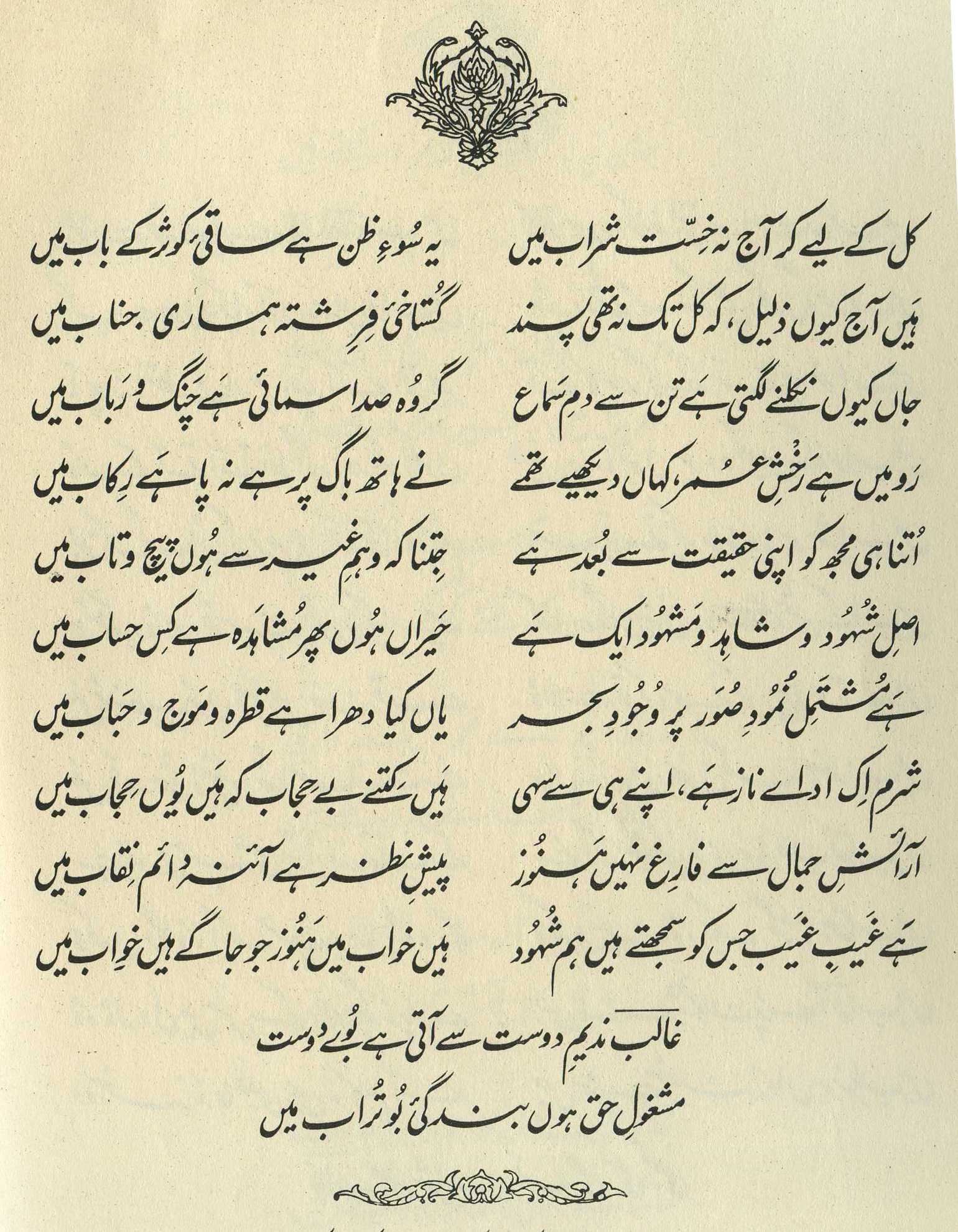
| Hamid Ali Khan | Open Image |
About wine, his witty remarks are very famous. One person in his presence vigorously denounced wine, and said, 'The prayers of wine-drinkers are not granted.' Mirza said, 'My friend, he who has been vouchsafed wine—what else does he need, that he would pray for?'
==Urdu text: Yadgar-e Ghalib , p. 73
That is, not to give wine today, out of fear that there might be none tomorrow, is to distrust the generosity of the Cupbearer of Kausar. ==Urdu text: Yadgar-e Ghalib , p. 147
That is, not to give wine today, out of fear that there might be none tomorrow, is to distrust the generosity of the Cupbearer of Kausar. ==Urdu text: Yadgar-e Ghalib , p. 147
On the part of the poet, the 'tomorrow' [] that is to come is Doomsday, and the 'yesterday' [] that is past is ['Am I not (your Lord)?', Qur'an 7:172]. And when the word 'above' appears, the thought will reach the heaven beyond all heavens; and with the word 'below', the mind will turn toward the depths of the earth. With 'cup', he'll create a picture of Jamshid , and with the word 'curl, twist' [], Plato will come to mind why? . If there was a 'staff', then it belonged to Moses alone [as in Qur'an 7:107]; if there is a 'coat of mail', then it is for David alone [as in Qur'an 21:80]. On a 'ring', only Solomon's name is engraved; and a 'mirror' [traditionally, made for him by Aristotle] is placed before Alexander alone. If there is any 'wall' in the world, it is the Wall of Alexander [Qur'an 18:96]; and if there's a 'throne', then it's the Throne of Cyrus [of the Shah-namah]. In short, the poet's subject of speech/poetry should be what is very famous. (100)
== Nazm page 100

He says, for tomorrow-- that is, for Doomsday-- don't stint on pouring wine. (It's well-known that whoever drinks wine in the world, will remain deprived of heavenly wine in the afterlife.) He [who stints on the wine] considers that the Cupbearer of Kausar won't give heavenly wine. This is a discreditable thought about the generosity of the Cupbearer of Kausar. Such a thing can't be-- that is, there too wine will certainly be given. (151)
By 'the Cupbearer of Kausar' is meant Hazrat Ali. By 'today' is meant in this life in the world. This verse, in a rakish [] taste, is peerless. And the foundation of this verse is on on this belief of Muslims: that 'the wine-drinker is hell-bound' []. He will not be replete with the wine of Kausar. As someone has said, 'If you drink today, you'll thirst there'.
Or else the Cupbearer has said, 'Will you drink everything right here? Put some away for there as well!', and this verse is in reply to that. (197)
This ghazal and the previous one, 97 , are formally identical. Some editions, especially older ones, treat this ghazal as a continuation of {97}; so do some (Nazm; Hasrat; Bekhud Dihlavi) among our commentators. But others (Bekhud Mohani; Baqir; Shadan; Josh; Chishti; Mihr) present them separately. As always, I follow Arshi. But they are certainly a kind of 'double ghazal' [], with the same meter and rhyming elements. For discussion of these issues, see 15,1 .
The pivotal phrase 'for the sake of tomorrow' [] occupies what I call, for want of a better description, a 'midpoint' position. It can obviously be read quite specifically, as modifying : 'When it comes to wine, be careful not to stint-for-the-sake-of-tomorrow!'. From this specific sense arise these possible readings:
=Don't stint on wine today because you fear a possible scarcity of wine tomorrow.
=Don't stint on wine in this world because you fear being punished for wine-drinking in the next world.
=Don't stint on wine in this world because you fear that there may be a shortage of wine in the next world.
Alternatively, the phrase can be read as a general adverb applying to the whole rest of the line: 'For the sake of your wellbeing tomorrow, I beg you-- be sure not to stint on wine today!' (That is, being stingy with wine is so reprehensible that you might actually suffer for it, since Hazrat Ali endorses generosity.)
On all of these readings, Hazrat Ali, the 'Saqi of Kausar', is invoked as a patron of wine-drinking, of generously enjoying life in this world and the world to come. For a verse quite overtly in praise of Hazrat Ali, see 141,5 . The whole 'rakish' [] strand in the ghazal universe, with its glorification of wine and intoxication at the expense of sobriety and prudence, has always been taken mystically by those who disapprove of its theological contrariness.
This verse and the next one, 98,2 , form a nicely juxtaposed set, with each exploiting one meaning of . This verse is about today in relation to a (cosmic) 'tomorrow'. The next verse is about today in relation to a (cosmic) 'yesterday'.
graphics/winecasks.jpg graphics/winecasks.jpg
