Verse 101847aabme;N
G3
1
it is the 'hidden of the hidden', that which we consider [to be] presence
2
we/they are in a dream still/now, who {have woken up / are awake} in a dream
'Absence; invisibility; concealment; anything that is absent, or invisible, or hidden (from sight or mental perception); a mystery, secret; an event of futurity; the invisible world, the future state'.
The being present; —adj. & s.m. Present; —one personally present'.
| References | |
|---|---|
| Arshi, Imtiyaz Ali | Ghazal# 110 |
| Raza, Kalidas Gupta | 392-93 |
| Hamid Ali Khan | Open Image |
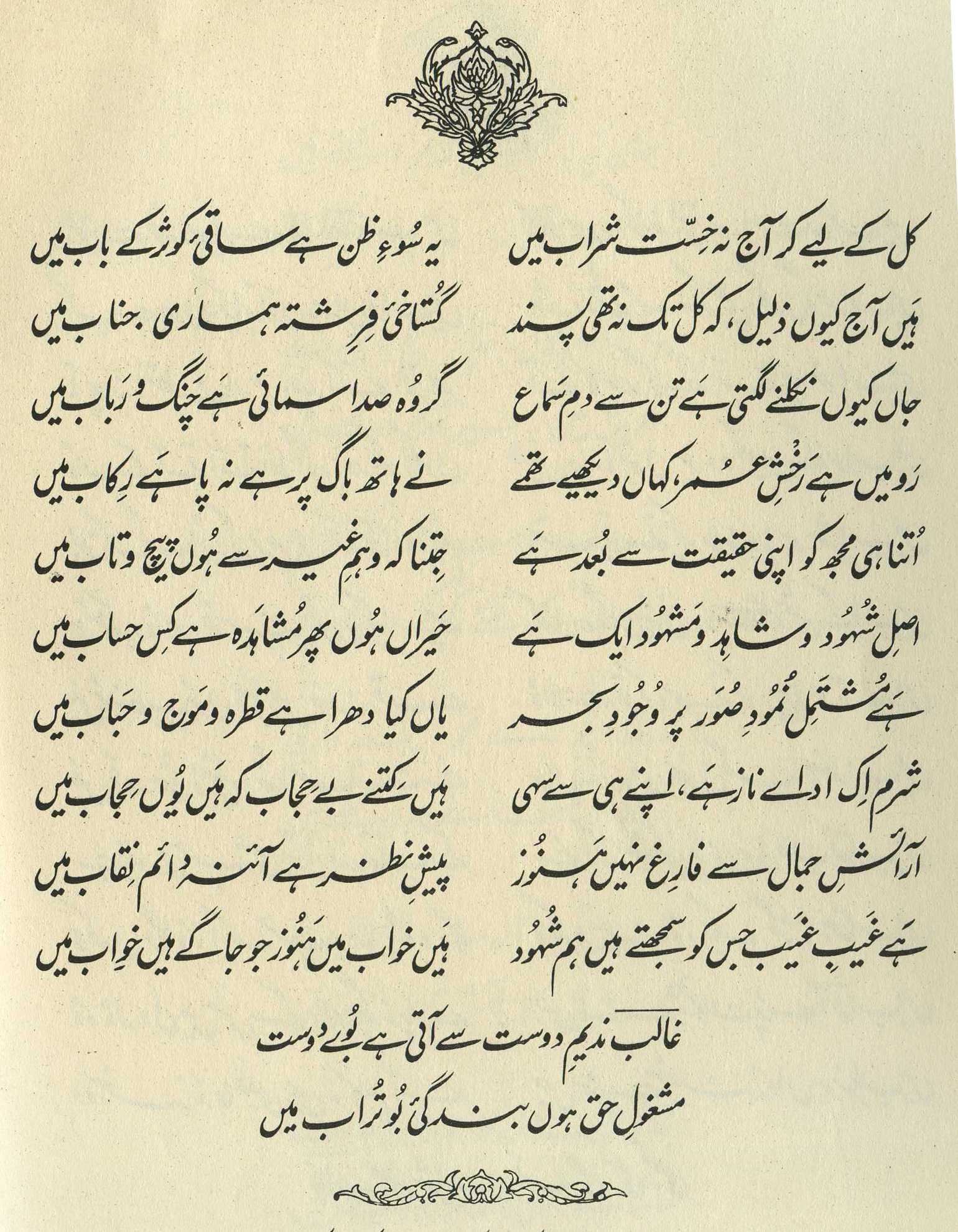
If to the [spiritual] traveler everything present in the world should look like nothing but God, we call that seeing []. And by 'the hiddenmost of the hidden' is meant the stage of the unity of being, which is utterly beyond the intelligence and the senses and the eye and vision. He says that what we consider to be seeing is in reality the hiddenmost of the hidden, and we erroneously consider it to be seeing. The illustration for us is that of someone in a dream who dreams that he wakes up. Thus although he considers himself awake, in reality he’s still in a dream. This illustration is entirely new, and for this theme there can be no better example than this.
==Urdu text: Yadgar-e Ghalib , p. 124
That is, if in a dream we are dreaming, then this is being 'hidden in the hidden'. (102)
== Nazm page 102

The peerless beauty of the metaphor in the second line has so enraptured all the commentators that little attention has been given to the first line, so that the interpretation of the line, and thus of the verse, has remained incomplete. The second line in fact supports the first line....
is a metaphor for the Divine Presence itself. When creation is not seen in the form of creation, but rather would seem to be Divinity alone, then this is called [as ibn ul-Arabi has indicated].... The meaning of cannot be [the divine] Presence.... Its meaning can certainly be the original/essential -- that is, pure , the way the meaning of is original/essential . In this way the first line seems to be saying that what we are considering to be is only the -- or, at the most, that appearance [] (that is, the curtain that has been spread over the ).
Thus in the first line it has been said that the state that we are considering to be , is only the workings of appearance. But what is itself? Even doesn't take us very far [as ibn ul-'Arabi has said]. Thus even seeing things in the form of Divinity alone does not bestow knowledge about the true Essence; rather, it only gestures toward that knowledge.
Now let's come to the second line. People who, in a dream, see themselves as awakened, are still in a dream (and asleep). When they consider that they have woken up, they are only in error. What kind of error is this? This error is not devoid of two aspects. The [first aspect is that the] sleeping individual has not had the experience of awakening. When he thinks that he's had this experience, he's only in error. In this way, to consider appearance and to be the experience of divine wisdom is an error. But this error is not entirely without reality. The way the experience of waking in a dream is a shadow of the real experience, in the same way knowledge of appearances is a shadow of knowledge of the Truth.
The second aspect is that the person who is at that time absorbed in a dream, will sometime or other wake up. Just as nonexistence is a proof of existence, in the same way sleep/dream is a proof of wakefulness. Thus the error of thinking one has awakened in a dream, can be part of the earliest awakening that happens when the dawn is at hand. The waking of daybreak is that waking of the spirit when one was in the embrace of the Truth, and the present life is only a sleep of heedlessness. When the spirit saw the Truth in the form of appearance and , then it was in error when it thought it had returned to the state of its primordial wakefulness, when it had knowledge of all things....
Knowledge of the Lord cannot be obtained from things-- not because he is superior to things, but rather because the existence of things is only notional/imaginary. That is, this verse not only denies the idea that we know the world and creation, but denies the world itself, from the beginning. In this single verse the whole of Plato's philosophy has been contained. After all, even from Ghalib's youth there's a verse on this subject: 223,6x .
== (1989: 138-40) 2006: 160-62
This brilliant verse genuinely succeeds in expressing the metaphysical through the techniques of poetry-- an attempt that many of the verses in this ghazal make, though with varying degrees of fruitfulness. The exploration of of course evokes 98,6 , and the rhythmic, punchy structure of the second line, with its powerful and strategically placed repetitions, is directly parallel to the second line of 98,8 .
The second line not only captivates everybody who reads it, as Faruqi observes, but also has some elegant little touches of ambiguity that deserve to be noticed. The use of , with its two meanings of 'still' and 'now', generates two possible time locations for the dream-state-- are we 'still' in a dream (as we have been all along), or are we 'now' in a dream (as perhaps at some earlier time we were not)?
Moreover, , which of course is a present perfect and thus means 'have awakened' (indicating a change of state), could also be a past participle with the colloquially omitted-- and would mean 'are in a state of having awakened' (not indicating a change of state). And what could be more appropriate for the world of a dream, than such a texture of uncertainties?
Then in the first line, what is ? Does it mean the 'hidden'-est of all 'hidden' things? Does it mean something that is 'hidden' within the realm of the 'hidden' itself? Could it mean that the fact of the 'hiddenness' of something is itself what has been 'hidden'? And of course, 'hidden' is just a place-holder-- which of the meanings of should be invoked here? As can be seen from the definition above, the various meanings create considerably different readings for the first line. Which itself, needless to say, is all too appropriate for a verse about the confusion and uncertainty in which we humans live. Like most of Ghalib's best verses, this one shows us colors that shift constantly, depending on what light we're seeing it in. For a lighter, less threatening color, see 169,13 .
As Faruqi suggests, compare the very early, unpublished 223,6x .
Compare Mir 's treatment of the same theme: M 104,2 .
graphics/eye.jpg