Verse 91847aabme;N
G3
1
[someone] is not free from the adornment of beauty now/still
2
before the gaze is a mirror, perpetually, within the veil
'Free from care, or anxiety; contented; free from labour or business; free, at leisure, unoccupied, unemployed, disengaged; — cleared, absolved, discharged; — ceasing (from labour, &c.), ending, finishing'.
is here spelled so it will fit the meter.
| References | |
|---|---|
| Arshi, Imtiyaz Ali | Ghazal# 110 |
| Raza, Kalidas Gupta | 392-93 |
| Hamid Ali Khan | Open Image |
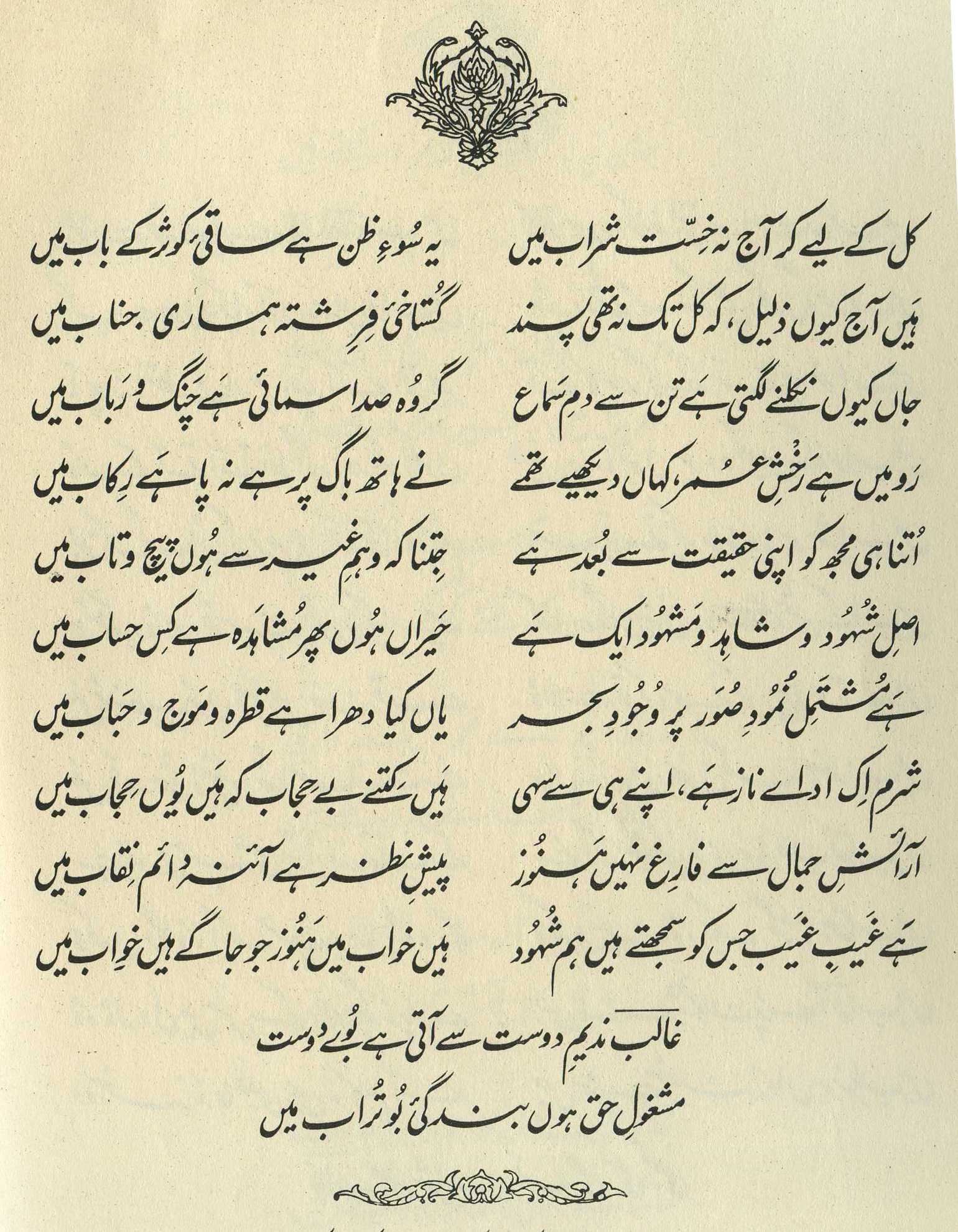
'Veil' is a metaphor for the Divine Veil, and in it is the knowledge of [Arabic] 'that which is, and that which is to come'. And 'to be finished with adornment of beauty' is a commentary on 'every day in new splendour doth he shine' (Qur'an 55:29). (102)
== Nazm page 102

Even now she is not finished with adornment of beauty. And even now, within the veil, a thumb-mirror [] is being used. That is, although she has finished adorning herself and a veil has been put over her face, to her, adornment is not finished.
[Nazm is wrong in his latter point.] This commentary is incorrect. For the meaning of is that there will never be a change in His glory. And adornment demands that there be greater and lesser degrees. (199)
That is, even with in the veil she constantly keeps on looking in the mirror. As if she were still not finished adorning her beauty. By 'veil' is meant the screen of divine veiling and purity, and by 'mirror' is meant creation, in which He keeps polishing the radiance/appearance of His beauty. (193-94)
[See his comments on Mir's M 1742,2 .]
Commentators often read this one mystically, and it's easy to see why; but of course we're under no compulsion to do so. If the (human) beloved can frown inside the veil, as in 97,9 , why can't she also look at her thumb-mirror? The two meanings of , 'now' and 'still', provide suggestively different perspectives on the beloved's behavior. Should the speaker be elated because all this self-adornment is carried on for his benefit, or dismayed because he doesn't seem to be part of her concern at all?
It's indeed a little dismaying at first glance-- not only is the beloved veiled from the lover's gaze, not only is the beloved paying no attention to him at all, but in fact the beloved's own gaze is 'perpetually' fixed on a mirror, so that the beloved sees only her (or His) own face. There's a strong suggestion of solipsism here. Although of course there's no hint whatsoever who's doing it, since the verse not only provides no subject, but also refuses to give any hint about whether the subject is singular or plural.
But othen, all creation can be said to be a mirror of the Divine, so we ourselves may be part of the mirror into which the beloved gazes so intently. In which case we are not only outside the veil (as we know all too well), so that we can't see the beloved's face-- but actually somehow also inside the veil (though we don't realize it), so that in a sense we, as part of the mirror, see nothing but the beloved's face.
And come to think of it, if all this is taking place inside her veil, how does the speaker even know about it in the first place? Is the desperate lover simply imagining it all? The metaphysical convolutions and possibilities are endless. Don't forget that all this comes from the creator of the even more extreme concept of the , the 'idol with a mirror-face', who sits before the lover in 208,6 -- and who, in 22,3 , never sits before anyone.
Compare an , or thumb-ring-mirror, verse of Mir 's: M 1330,2 .
Here's a modern ; in North India these were traditionally worn by coquettish women so that they could conveniently keep an eye on their looks under any circumstances (and also see behind them).
graphics/thumbring.jpg