Verse 7after 1821aajaa))e hai
G1
1
having heard of his/her party-adornings, here the afflicted heart
2
like the stamp/impression of {the Other 's / an 'other'} goal/purpose, 'sinks'
'A print; a carving, an engraving;... -- an impression; a stamp; a mark'.
'To make a strong impression (on); to establish (one's) rule or authority (in or over)'.
'To seat oneself, sit down, be seated, be unemployed or idle; to sit, brood, incubate;... to be laid out or expended;... to fall in or down (a house, wall, &c.)'.
is an archaic form of ( GRAMMAR )
| References | |
|---|---|
| Arshi, Imtiyaz Ali | Ghazal# 184 |
| Raza, Kalidas Gupta | 360-61 |
| Hamid Ali Khan | Open Image |
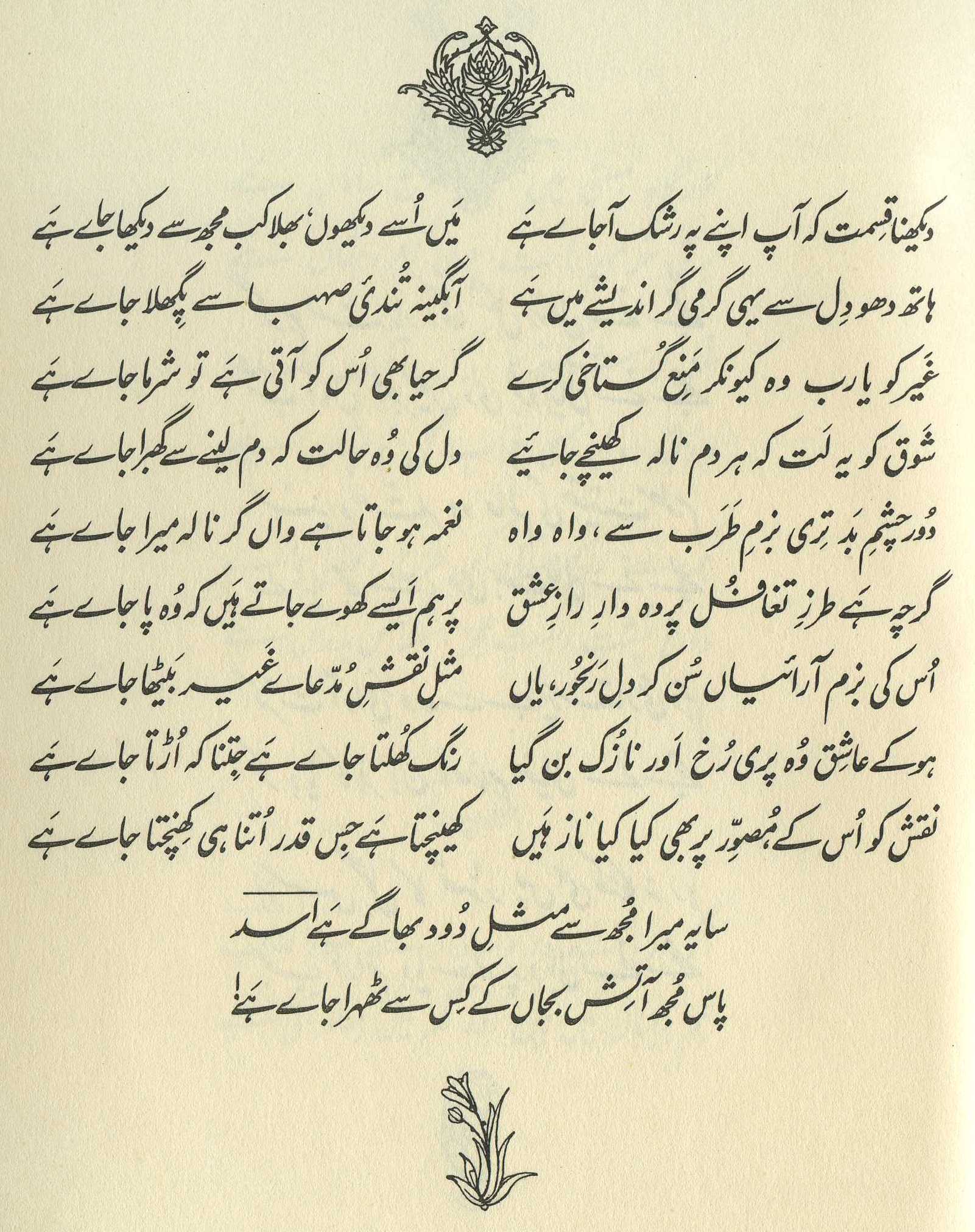
That is, in the way that the stamp of the Other 'sinks in' in the beloved's gathering, in the same way, hearing about that party-adorning, my heart 'sinks'. (165)
== Nazm page 165

Hearing news of her flirtatious gathering, here my sad heart 'is seated' (that is, becomes hopeless) the way the Rival 's stamp of faithfulness has impressed ['seated'] itself on her heart. (221)
[See his comment about this verse in his discussion of 111,3 .]
Repeatedly hearing that nowadays the Rival's fortune is on the ascendant, and very fine parties are happening, my heart sinks and is melancholy to the same extent that the 'stamp of the purpose of the Other'-- that is, the success of the Rival-- is taking place. (297)
As Bekhud Mohani observes in his discussion of 111,3 , the present verse too is based entirely on wordplay. Fortunately, we have English idioms that can at least approximate the effect. For one's heart to 'sit down' [] is for it to 'sink'. And for a stamp or an engraver's die to make a strong impression [] is for it not to remain on the surface, but to 'sink in' firmly and embed its mark in the material being stamped.
Thus, as Nazm points out, when the speaker hears about her parties, his heart sinks. And how does it sink? It sinks just the way the Other's 'stamp' makes an 'impression' (another parallel English idiom) at her parties, by 'sinking in' and 'impressing' itself firmly into the heart. In classic mushairah -verse style, the crucial, idiomatic verb used simultaneously for both effects is withheld until the last possible moment. This delay doubles its effect, since the whole 'punch' of the verse is unavailable until we hear that final verb; then the thing hits us all at once. Enjoyably of course, but still this is a distinctly one-dimensional verse.
We've seen the 'party-adornings' before, in 111,2 -- and we've seen how this pluralized abstraction offers a range of interpretive possibilities. In the present verse, the could refer, semi-sarcastically, to the Other (he's the life of the party, the beau of the ball) as well as to the beloved (she takes pains over her parties, she appears at her flirtatious best, etc.). Meanwhile, the poor lover isn't even invited, but only 'hears about' these social events.
Note for grammar fans: what is the exact analysis of ? It's formally equivalent to , that much is clear. So are we to consider it a passive made from an intransitive verb? If so, it's unusual, though not unheard-of (the example I've seen cited is , used as a prohibition, which isn't exactly parallel). Or is it based on an idiomatic use of the past participle , with the colloquially omitted, thus meaning something like 'goes on being in a state of having been seated'? My colleague Dr. Aftab Ahmad proposes (September 2014) that it's really a colloquial shortening of , 'goes on seating itself'.
graphics/heartsinks.jpg