Verse 10after 1821aajaa))e hai
G1
1
my shadow, like/resembling smoke, flees from me, Asad
2
near 'fiery-lifed' me, who can bear to remain?
and are archaic forms of and ( GRAMMAR )
| References | |
|---|---|
| Arshi, Imtiyaz Ali | Ghazal# 184 |
| Raza, Kalidas Gupta | 360-61 |
| Hamid Ali Khan | Open Image |
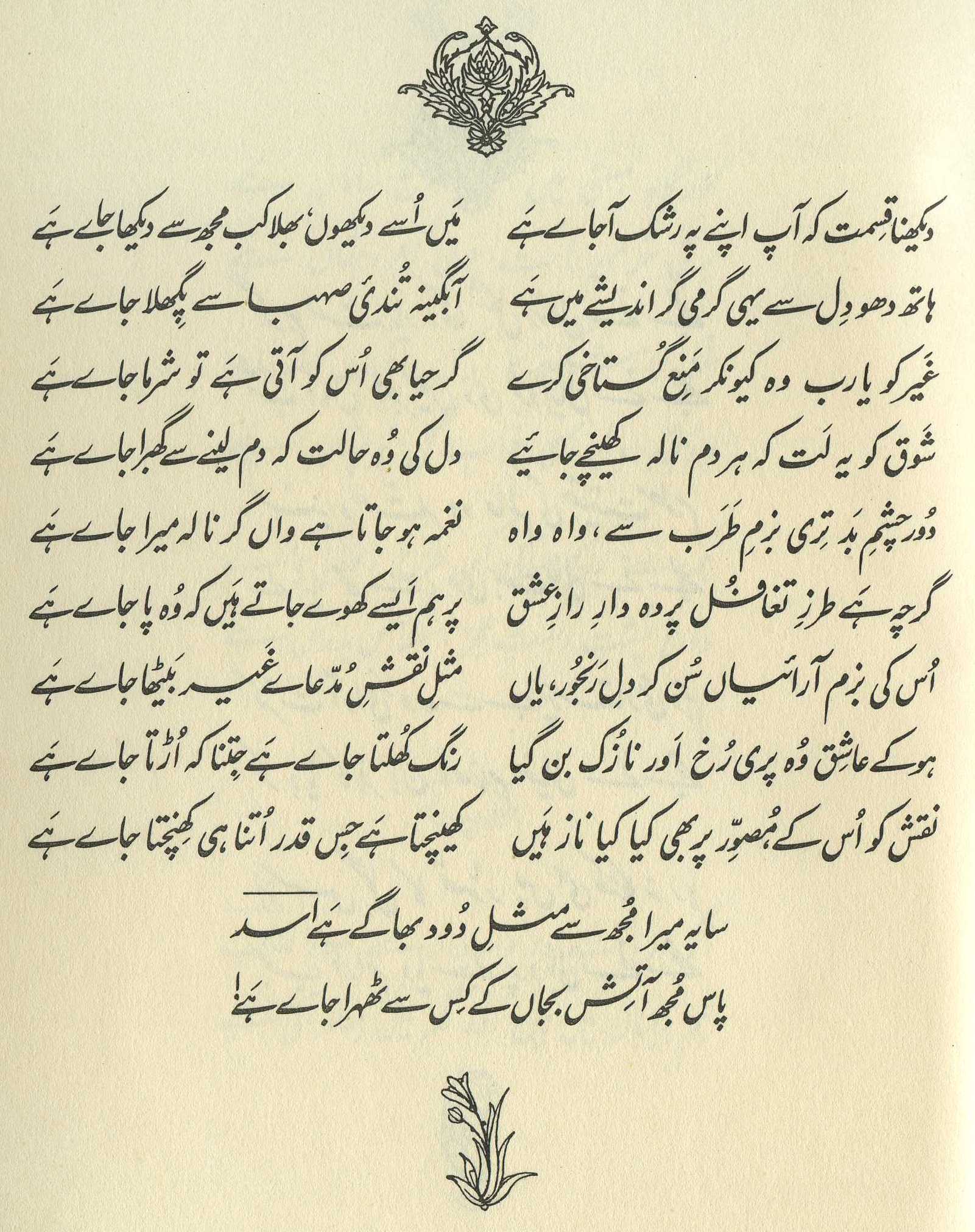
That is, I'm in such a condition that not even a shadow stays with me. This whole theme is an idiom, but the author has made it colorful with simile s. He has called himself 'burning-to-death'-- that is, he has given for his restlessness and agitation the simile of the writhing of a person who has fallen into fire, and he has given for his shadow the simile of smoke. In addition to the similes, in this verse the explanation that he has declared the rising of the smoke to be a fleeing from fire, has given great enjoyableness. (165)
== Nazm page 165

He says, 'Oh Asad, thanks to passion I am ensnared in such difficulties that even my shadow flees from me. That is, the way smoke ascends from a fire and rises high, in the same way, through fear of the burning in my liver, my shadow flees far from me, as if it is the smoke of the flame of the liver, not a shadow.' He's written an extraordinarily enjoyable closing-verse . (221-22)
The way smoke flees from a fire, in the same way my shadow flees from restless me. The simile of smoke and shadow is extremely eloquent []. (297)
Compare 190,3 . (269)
'Fiery-lifed' is really not very satisfactory for , but the phrase is exceptionally hard to convey in English. Nazm takes it to mean someone who's burning to death, and of course it can very well have this sense. But it can also refer to someone with 'fire in the life', who's living in a condition of suffering caused by a constant inner fire. This condition would be as appropriate as the burning-to-death one for the fine wordplay about smoke and shadow that the commentators praise. And it seems more plausible as a source of the verse, since someone in the act of burning to death might not have the leisure to observe and discuss the fleeing of his shadow.
To say that the shadow flees 'like smoke' could mean that the shadow vanishes or diffuses into the air the way smoke does. Or it could mean that the shadow flees 'in the semblance of smoke', playing nicely on the darkness and ungraspability shared by both. Or it could also imply that the smoke itself is fleeing, unable to bear the heat of the fire within the lover's heart.
Arshi is right to suggest 190,3 as a very similar treatment of the same theme. And 1,5 , which also plays with idioms about fire, is surely a sort of distant cousin.
Note for grammar fans: In the second line, is, literally, 'by whom is remaining done?!' Unusually, an intransitive verb has here been made into a passive. The idiomatic sense is a strongly negative rhetorical question.
graphics/flamesmoke.jpg