Verse 4after 1821aajaa))e hai
G1
1
ardor has this trick/whim/vice, that at every breath/moment one should go on drawing a lament/groan
2
the heart is in that state, that it is agitated/alarmed about taking a breath
'A trick; a bad habit, a vice; a whim, whimsey; blameworthiness, faultiness'.
'To be confused, confounded, flurried, or flustered...; to be perplexed, bewildered...; to be perturbed, disturbed in mind, agitated, disquieted, distracted; to be alarmed, scared, dismayed'.
is an archaic form of ( GRAMMAR )
| References | |
|---|---|
| Arshi, Imtiyaz Ali | Ghazal# 184 |
| Raza, Kalidas Gupta | 360-61 |
| Hamid Ali Khan | Open Image |
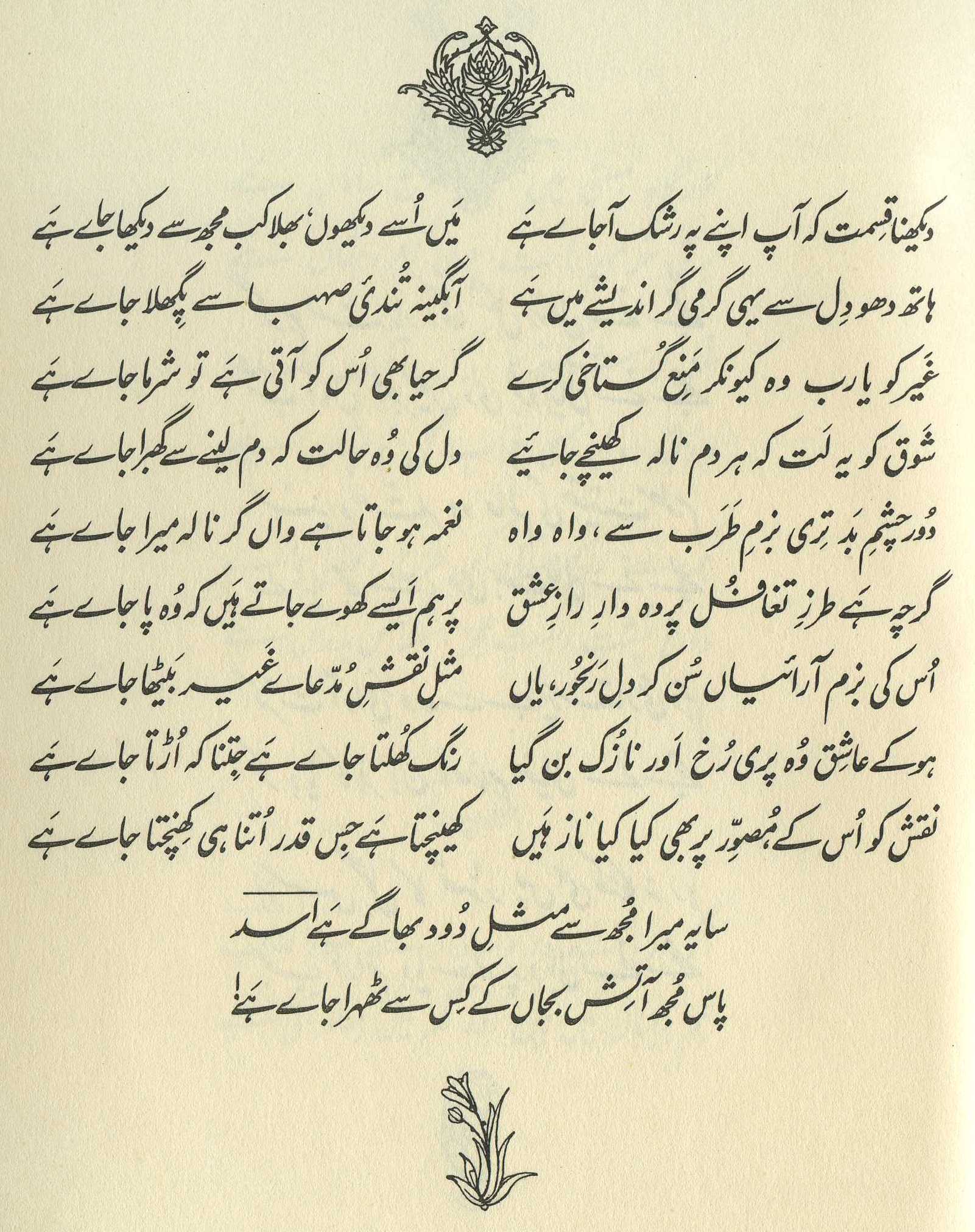
Ardor has fallen into the habit of lamentation; and the heart is in such a delicate state that it doesn't want even to take a breath. By saying the intention is 'a bad habit, an undesirable form of behavior'. This word is not free of obscenity, and this is not the place for its use, but the author had in mind a 'rhyme' [] with . (164-65)
== Nazm page 164 ; Nazm page 165


He says, ardor has fallen into such a habit of lamentation that it never at all tires of sighs and complaints. And the situation of the heart has become so dire that it doesn't even wish to take a breath. The meaning of is a bad habit, as when they say, 'he has the of playing dice games'. (220)
The gist of it is, how would I fulfill the claims of ardor for lamentation, when because of the weakness of the heart, it's becoming difficult for me even to take a breath. (296)
The two lines are really remarkably full of parallelisms. In both lines, the second word begins with . The third word in the first line is 'this'; in the second line, 'that'. The fourth word in the first line is ; in the second, , which ends in . The fifth word in both lines is . The seventh word in the first line, and the sixth word in the second line, is . Finally, the first line ends in , the second line in the semi-echoing .
The wordplay of -- meaning both 'moment' and, literally, 'breath'-- is excellent. But as Nazm observes, it's the pair and that really stand out, because is such a casual and even vulgar word. To come upon it in a ghazal is an enjoyable little shock that adds spice to the line. It's another example of the power of a ' fresh word '.
The two lines are simply presented in their deadly parallelism, as a sort of 'here versus there' case. The poor lover is doomed to suffer, no matter what he does. His ardor (or even a personified Ardor) constantly goads him into groaning and lamenting; meantime, his heart, in its suffering, shies away from even taking a breath. So how can he moan and groan, without taking a breath? The breathlessness and the lamentation are two symptoms of the same disease, but they fight for possession of the poor lover's life, and their combat doubles his misery.
It's easy to see why 'ardor' wants to groan and lament. But why exactly does the heart feel agitated or fearful or reluctant about taking a breath? Because it's so weak that it's not sure it can make the heroic effort of taking one more breath? Because it's in such burning pain that every breath will fan the flames and aggravate the misery? Because the suffering is so great that death seems preferable to life, so that every breath seems an undesirable prolonging of the agony? We are left to decide for ourselves. We also have to choose a tone for the verse, since we are given no hint whatsoever of how the lover feels about what he's reporting.
Note for grammar fans: It seems that is short for ('go on being in a state of having lamented'). The polite imperative is used here in an abstract sense, not in its literal meaning.
graphics/heart.jpg