Verse 5x1816aa-e;xandah hai
G1
1
{although / to such an extent} the self-sellings of Existence are an occasion for a smile/laugh
2
in every cheapening/'breaking' of the price/value of a heart is the echo/sound of a smile/laugh
'Breaking, breakage, fracture; a breach; defeat, rout; deficiency, loss, damage'.
'Price, value, worth'.
'Echo; sound, noise; voice, tone, cry, call'.
| References | |
|---|---|
| Arshi, Imtiyaz Ali | Ghazal# 167 |
| Raza, Kalidas Gupta | 264 |
| Nuskhah-e-Hamidiyah | 254 |
| Asi, Abdul Bari | 261-262 |
| Gyan Chand | 380-381 |
| Hamid Ali Khan | Open Image |
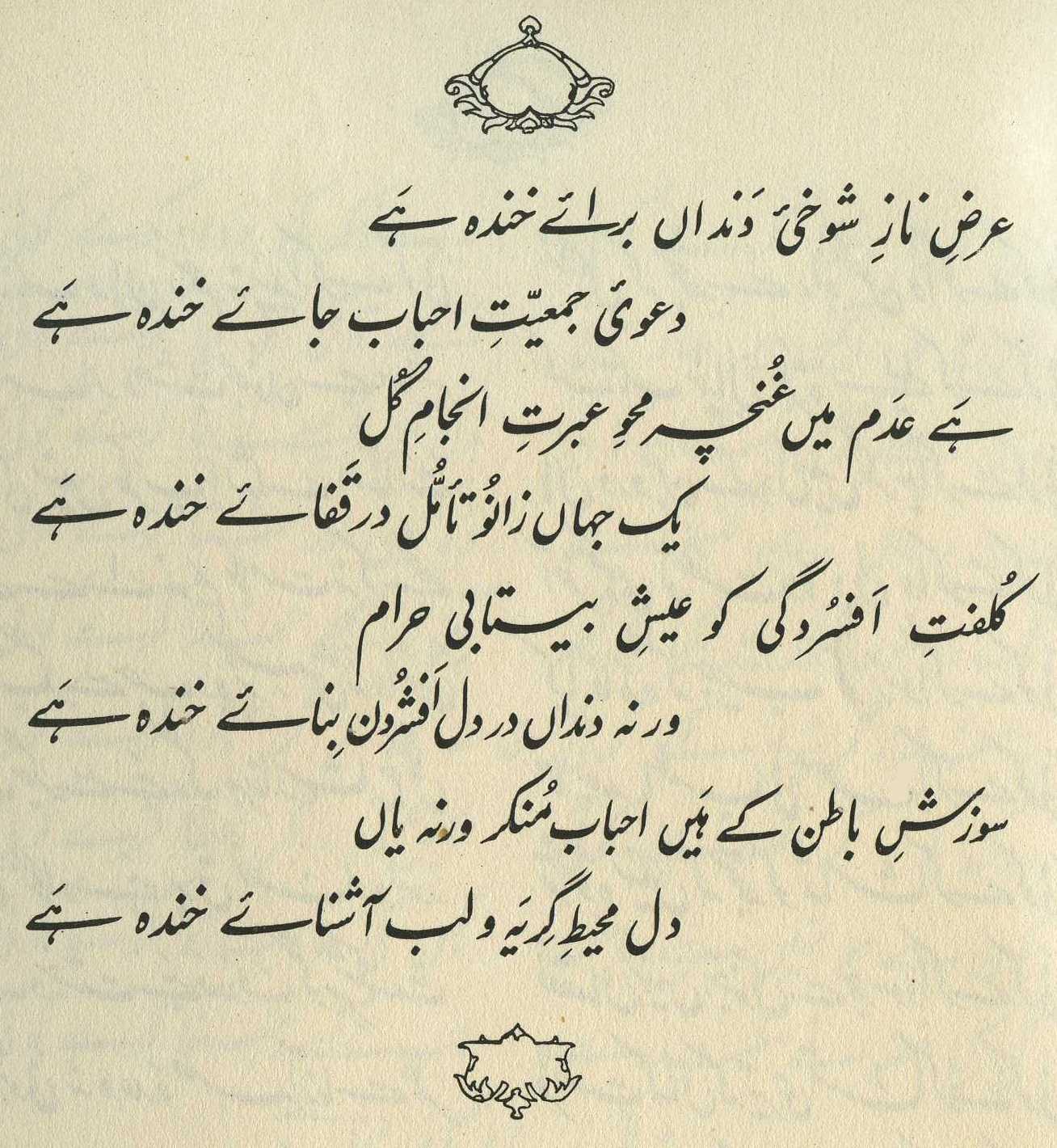
Since the self-showings and self-sellings of existence are laughable; thus that sound too that comes from the cheapening of the prices of the heart has the aspect of a smile/laugh of contempt. And the sound of the cheapening of price of both seems to be forced laughter.
== Asi, p. 262
= self-showing, self-praise. That is, since the world's 'self-sellings' are laughable, even/also the sound of the cheapening of a heart has the effect of laughter. In this verse too he has settled for instead of , just as he did in 21,10 .
The meaning of is for the price to decline, for the merchandise to become worthless. Here, there's no occasion for the heart's price to decline and for it to become worthless.
== Zamin, p. 376
In a state of heedlessness, man sells his existence or his heart/mind [] into the hands of others. But every such action is an occasion for laughter. At the time when a man sells himself, the value of his self, which he diminishes-- that too is an occasion for regret. One meaning of is 'to make the price less' [], and the other meaning is for something to break. The sound that comes at the time of breaking, he has called the sound of laughter. By the price of the heart is meant the price of life itself.
== Gyan Chand, p. 380
For background see S. R. Faruqi's choices . For more on Ghalib's unpublished verses, see the discussion in 4,8x .
The 'self-sellings of Existence' provide one more example of Ghalib's love both for pluralized abstractions (on these, see 1,2 ) and for abstract personifications . It would seem that after existence had sold itself once, it shouldn't have been able to sell itself again. (Readers of the Mahabharat will remember Draupadi's clever-- and successful-- argument along these lines during the famous dice-game scene.) Or perhaps the 'self-selling' deals themselves were a kind of heartbreaking (and heartbroken) scam to begin with, and that's what made them laughable?
As so often, both senses of work beautifully, in their different ways, with the second line. The 'although' reading contrasts a general claim (all the self-sellings of Existence are, in principle, laughable) with a particularly extraordinary and extreme instance (the cheapening/breaking of the price of a heart actually makes the sound of a laugh). And of course the 'to such an extent' reading presents the first line as a claim, and the second line as a proof or illustration of it.
For another verse that evokes the and (the possibility of) a , see 21,10 . That verse also includes discussion of the range of meanings of .
graphics/glassheart.jpg