Verse 11816aa-e;xandah hai
G1
1
the presentation/petition of the coquetry of the mischievousness of the teeth is for the sake of a smile/laugh
2
the claim/suit of the gathering/unity of companions is occasion/place for a smile/laugh
'Presenting or representing; representation, petition, request, address; ... Breadth, width'.
'Playfulness, fun, mischief; pertness, sauciness; coquetry, wantonness; forwardness, boldness, insolence'.
'For the sake of, for (= ); --on account of, because of, by reason of; for the purpose of, in order to'.
'Laughing, smiling; a laugh; laughter'.
'Pretension, claim; demand, suit; plaint, action at law, lawsuit; charge, accusation; contention, assertion'.
| References | |
|---|---|
| Arshi, Imtiyaz Ali | Ghazal# 167 |
| Raza, Kalidas Gupta | 264 |
| Nuskhah-e-Hamidiyah | 254 |
| Asi, Abdul Bari | 261-262 |
| Gyan Chand | 380-381 |
| Hamid Ali Khan | Open Image |
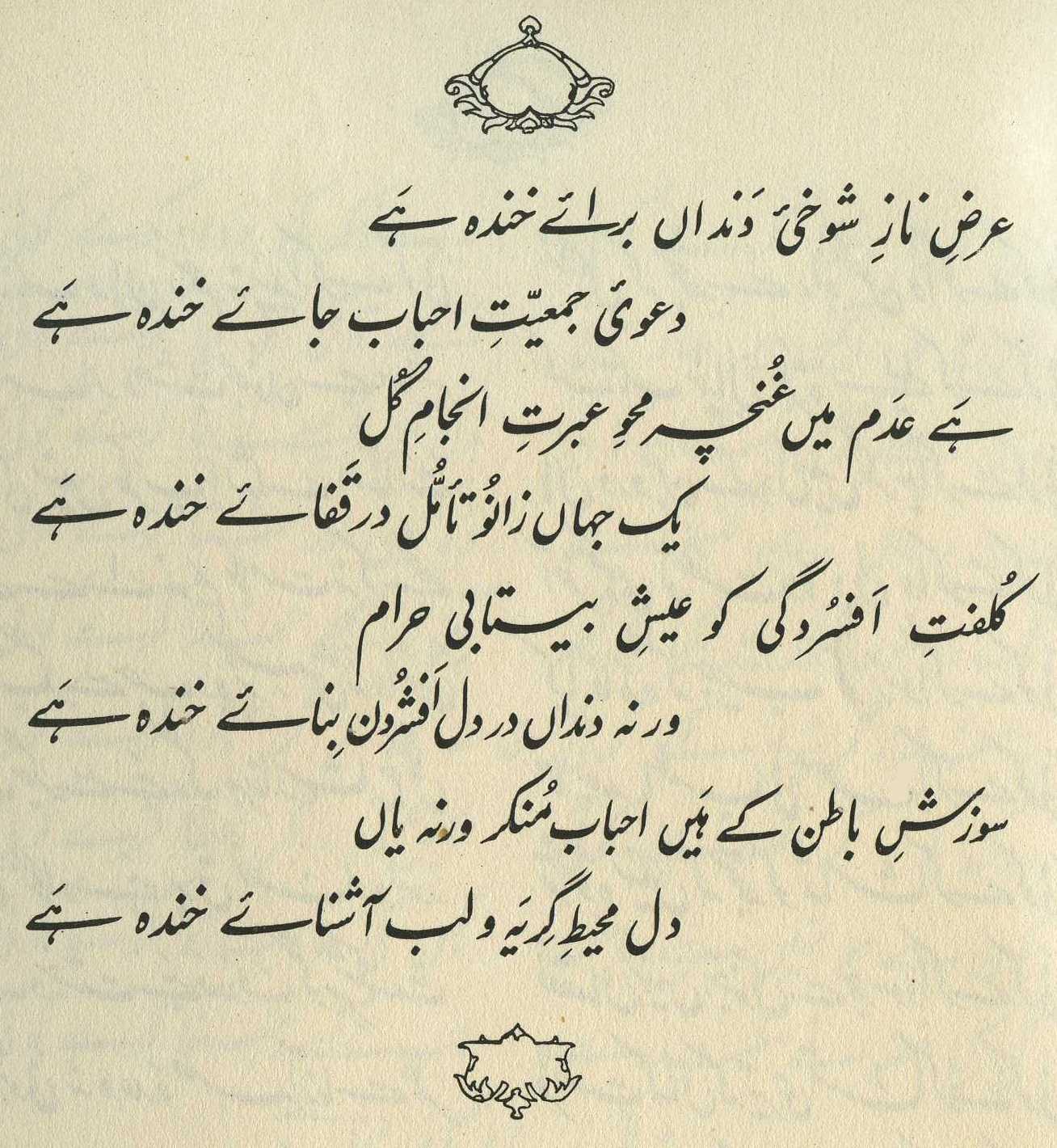
He says, the pride in their mischievousness and fineness felt by the teeth-- the expression of it is all for the sake of a laugh/smile. The meaning of it is that at the time of smiling, the teeth are revealed. This is the meaning of the first line. The meaning of the second line is that to have trust in the gathering and coming together of companions is worthy of laughter. And the connection is that poets always give as a simile for the gathering of friends, the four front teeth []. This verse is full of multiple sequences and minute elaboration; 'mischievousness of the teeth' is an extremely undesirable [] expression. The author's mischievousness of temperament considered 'fineness' [] an obvious word and omitted it; otherwise, it would have been better. (240)
== Nazm page 240

The meaning is that the way in old age age the teeth become separated from one another, in the same way among friends too separation always comes about. (299)
[Disagreeing with Nazm:] The Lord knows what elaboration the worthy commentator finds in this verse that he declares to be 'minute'. If shaping both lines in the mold of harmony, and bringing out for the listener an aspect of musicality [], can come under the rubric of minute elaborations, then so be it. And if it is not thus-- and it is absolutely not thus-- then the worthy commentator ought to repent of this rash view.
The 'mischievousness of the teeth' Hazrat the Commentator calls not merely vulgar and undesirable, but 'extremely undesirable'. The reply to this is that as important a task as it is to depict 'subtle thoughts' and 'subtle moods', it's equally important to understand this task. For at the time of smiling/laughing, from the moist teeth something emerges that flashes like a bolt of lightning. In order to express this mood, the late author said 'mischievousness of the teeth'. What connection does 'fineness of the teeth' have with this situation? 'Fineness of the teeth' is not only bland, but in this situation incorrect as well. (430)
[Nazm] Tabataba'i had perhaps forgotten that lightning is used as a simile for the teeth, and one quality of lightning is mischievousness as well....
Undoubtedly, there's not a lot of meaning in the verse. And if Tabataba'i's hostility was actually on this basis, then to an extent his claim was correct, but it's also not the case that there's a complete dearth of meaning in the verse. Consider the word . Its real meaning is 'that indifference of the beloved by means of which she arouses the lover's ardor to greater heights' (from ). That is, it is not only pride or a lack of affection, but rather that manner in which through showing pride and lack of affection she makes the fire of ardor burn brighter. Another meaning of is 'delicacy, attractiveness' (Steingass), and 'attraction of the lover' ( ) is also to our purpose. Now the interpretation of the first line emerges that when the beauty of the teeth expresses , then it's so that people would be happy. That is, that seeing the beloved smile, people would smile too, and in their hearts more attraction toward the beloved would arise. That is, when the beloved smiles with a show of indifference, even then people smile with happiness, and consider that this is not without meaning, but rather is for them.
In the second line the apparently unrelated idea has been expressed, that if the claim would be made that there is togetherness (that is, unity) among friends, then this is only a cause for smiles/laughter, not worth believing. The beloved's smile becomes equipment for for all of them. Everyone considers that this smile is for himself. In such a situation, to claim that all the friends are one at heart, and unified, is only frivolity. The truth is that they all have their own agendas.
== (1989: 334-34) 2006: 362-64
This ghazal originally had two opening-verse s; first came 212,5x (in Raza 1995), followed by the present verse.
Like its predecessor 211 , this ghazal has a powerful refrain that is bound to give some semblance of shape and coherence to the verses. Everything in that ghazal was in some sense about a 'melody'; everything in this ghazal is about a 'laugh'-- or a 'smile'. Since can mean both (see the definition above), it's hard to separate them as clearly as we do in English. (Though Urdu does also have , which means only 'to smile'.) It's notable that almost all the laugh/smiles in this ghazal are wry or ironic.
This verse is a tough and lumpy one all right, and no 'click' of real satisfaction is likely to emerge. Faruqi's reading can't account for the centrality of the teeth themselves, as opposed to just the smile. Since this is such an unusual feature of the verse, surely we must make use of the teeth somehow. Nazm's reading, in which the four front teeth, revealed in a smile, are likened to a 'gathering of friends', is the only one that offers real connection between the lines. But then it seems to drag along in its train the distasteful image of the beloved quickly losing her teeth (since the claim of their 'togetherness' is seen as an occasion for laughter). It's true that the second line can be read as referring to actual human 'friends', so that it is the brevity of their time together that is ludicrously brief, and then the wordplay of the loss of teeth can be pushed into the background. But even in the background, it surely threatens the verse with what I call 'grotesquerie'.
There's one striking piece of wordplay: the first word in each line is a legal term: a 'petition' or 'representation' in the first line, and a 'complaint' or 'accusation' or 'lawsuit' in the second line. So we might say that the idea of the beloved's smile as any kind of 'petition' or 'request' is ludicrous, is laughable-- her teeth form a mischievous smile only to show their own beauty, only to cause further torment to her lovers. Equally laughable is the idea that the lovers have any kind of a class-action 'claim' or 'lawsuit' that they can bring to bear.
But both of these legal procedures are, as usual, carefully complexified: can introduce either a cause or an effect (see the definition above), which greatly increases the available interpretive range. Moreover, the in means that the 'claim' can be made 'by' the gathering/unity (so that their claim, whatever it is, might be against the beloved), or 'about' the gathering/unity, etc. (In the latter case, the wistfully optimistic claim might be that friends are able to come together and remain together-- a claim so absurd that it can only provoke laughter.)
Nazm singles out the 'mischievousness of the teeth' [] as a particularly undesirable [] expression. Upon reflection, I think he's right. For 'mischievousness' and 'naughtiness' and the other meanings of are always full of willed, even wilful, human agency (see the definition above); and to personify the teeth somehow feels inherently a bit grotesque.
We can always blame Ghalib, as Nazm does, but the challenge remains. What if there's something there after all, something strange and suggestive, and we're just not getting it?
Compare 123,12x , another verse that uses the imagery of a smile/laugh as a flash of dazzlingly white teeth.
graphics/teeth.jpg