Verse 7x1816aa-e;xandah hai
G1
1
an occasion for derision is the sociability-striving of existence, Asad
2
dawn and dew/'night-wetness' are the leisure/occasion for the growth and flourishing of a smile
'Laughing at; derision, scorn, scoff; jest, joke'.
'Social or familiar intercourse, pleasant and familiar conversation, society; pleasure, enjoyment, mirth'.
'A time, opportunity, occasion; freedom (from), leisure; convenience; relief, recovery; respite, reprieve; rest, ease; (local) leave'.
'Intoxication, drunkenness; exhilaration (from wine, &c.), hilarity'.
'Growing; increasing; rising; growth; increase; rise'.
'[In Persian] Growth and increase'. (Steingass p.1404)
| References | |
|---|---|
| Arshi, Imtiyaz Ali | Ghazal# 167 |
| Raza, Kalidas Gupta | 264 |
| Nuskhah-e-Hamidiyah | 254 |
| Asi, Abdul Bari | 261-262 |
| Gyan Chand | 380-381 |
| Hamid Ali Khan | Open Image |
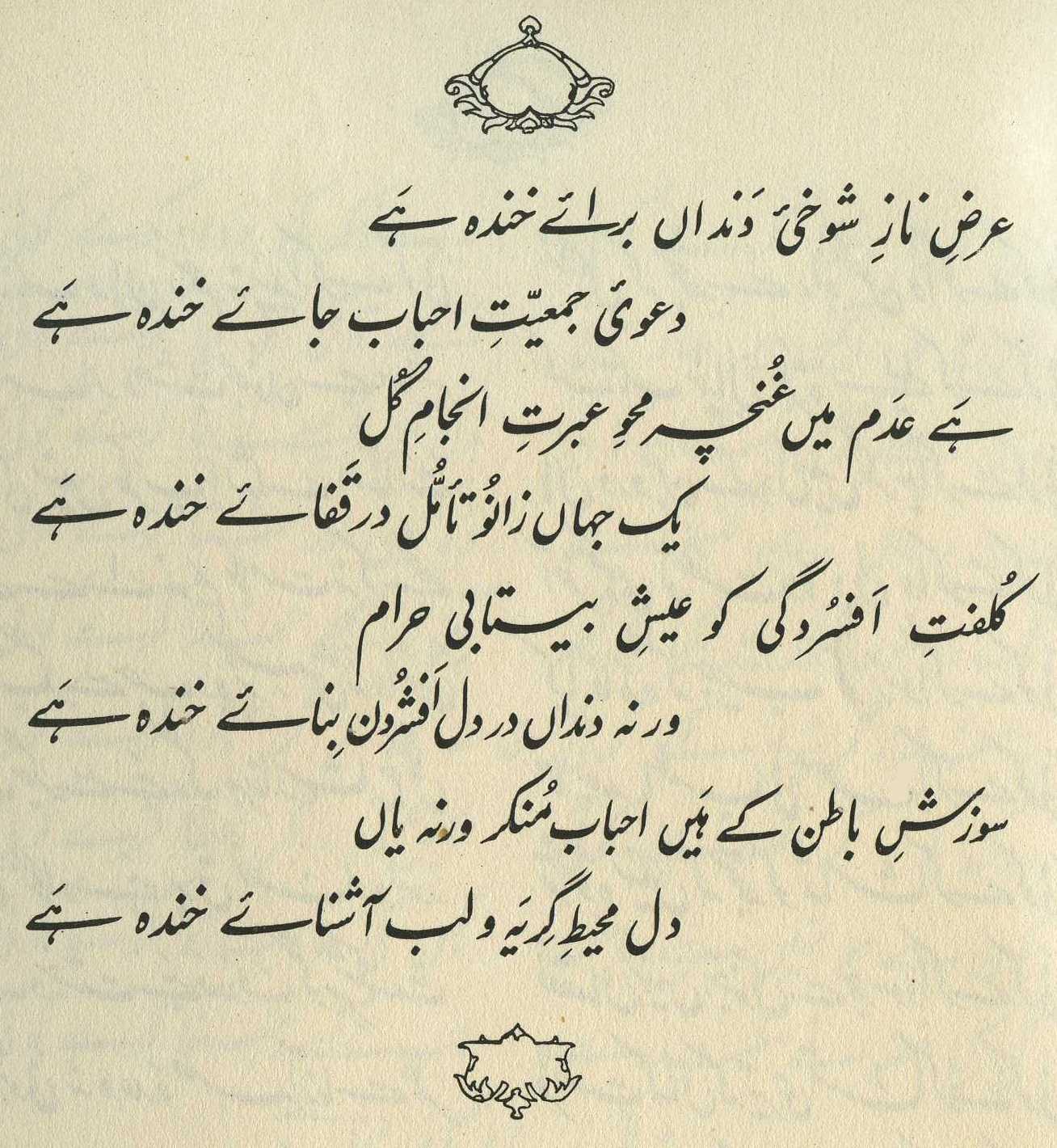
Oh Asad, the world's, or existence's, sociability-striving is fit to be laughed at and mocked. You know what this dawn and dew are. The dawn has the leisure/interval of a smile/laugh, and so does the night. That is, every day the dawn, with the aspect of derision, all at once always laughs at the world's sociability-striving, and so does the night. The 'smile of the dawn' [] is accepted among the poets; he has said 'smile of the dew' because the simile of white teeth is used for dewdrops. For this reason he has called the dew the 'laughter of the dew'.
== Asi, p. 262
The 'smile of the dawn' is a recognized metaphor . And he has called the dew a smile/laugh perhaps because of the affinity that the drops of dew have a similitude with teeth, or because they enhance the beauty and freshness of the rose. In any case, the smile/laugh of the dawn and the appearance of the dew have been given as a simile for the period of leisure of the time of the sociability of existence.
The meaning is that in the world, to long for luxury and sociability is a cause for laughter, for the dawn and the dew themselves laugh at their brief lives. Or this: that their laughter causes others to laugh, so that they laugh at their speed, and show their teeth [in laughter].
== Zamin, p. 377
In life, the attempt at enjoyment is an occasion for laughter. At dawn, the dew apparently feels enjoyment, but it is as brief as the interval between the time when laughter wells up and when it ceases. There is also an affinity with the smile of the dawn.
It's my opinion that the dawn and the dew should be taken together and considered to be a symbol of the dew's attempt at happiness at dawn. Asi has taken the two to be separate. The dawn is itself an attempt at happiness, and the dew an attempt at happiness. He has used for both the similitude of a smile. The dawn is a smile in itself; since the dew is like pearly teeth, it too is a smile. (381)
== Gyan Chand, p. 381
For background see S. R. Faruqi's choices . For more on Ghalib's unpublished verses, see the discussion in 4,8x .
The commentators point out the imagery of the verse: the 'crack of dawn' is like a smile, while the dewdrops can be seen as pearly teeth (which may be revealed in a 'teeth-baring smile'). For more on these images, see 67,1 .
The efforts made by humans-- or indeed, by 'existence' itself-- to achieve sociability and conviviality are an occasion for sarcastic laughter. Such laughter could be that of an outside observer, or even that of the participants themselves, in the course of their doomed attempts at enjoyment. After this broad generality, we have to wait (under mushairah performance conditions) and hope for illumination from the second line.
Then the second line appears-- as perhaps an echo, an illustration, or an explanation of the first line. There could be other relationships as well; in an 'A,B' verse like this, it's left up to us to decide. But certainly the word (see the definition above) creates at least two possible kinds of smile/laughter. If we take to mean 'leisure', then in their doomed 'sociability-striving', people hardly have any time at all to produce and cultivate even a smile or a laugh. The amount of time they have is like the interval between the sun rising and the dew disappearing-- that is to say, almost no time at all.
And if we take to mean 'occasion', then the smile is on the lips not of the people who seek sociability, but of some (Sufistically?) thoughtful observer, whose melancholy knowledge that after sunrise the dew evaporates almost instantly causes him to smile compassionately (or derisively, or both) at these impossible, doomed aspirations.
graphics/dawndew.jpg