Verse 31816aa-e;xandah hai
G1
1
to the vexation/distress of melancholy, the enjoyment/luxury of restlessness is forbidden
2
otherwise, 'to press the teeth into the heart' is the foundation of a smile
'To bear patiently'. (Steingass, p.537)
'Building, structure, edifice; foundation, basis, base; ground, footing, motive; root, source, origin; beginning, commencement'.
| References | |
|---|---|
| Arshi, Imtiyaz Ali | Ghazal# 167 |
| Raza, Kalidas Gupta | 264 |
| Nuskhah-e-Hamidiyah | 254 |
| Asi, Abdul Bari | 261-262 |
| Gyan Chand | 380-381 |
| Hamid Ali Khan | Open Image |
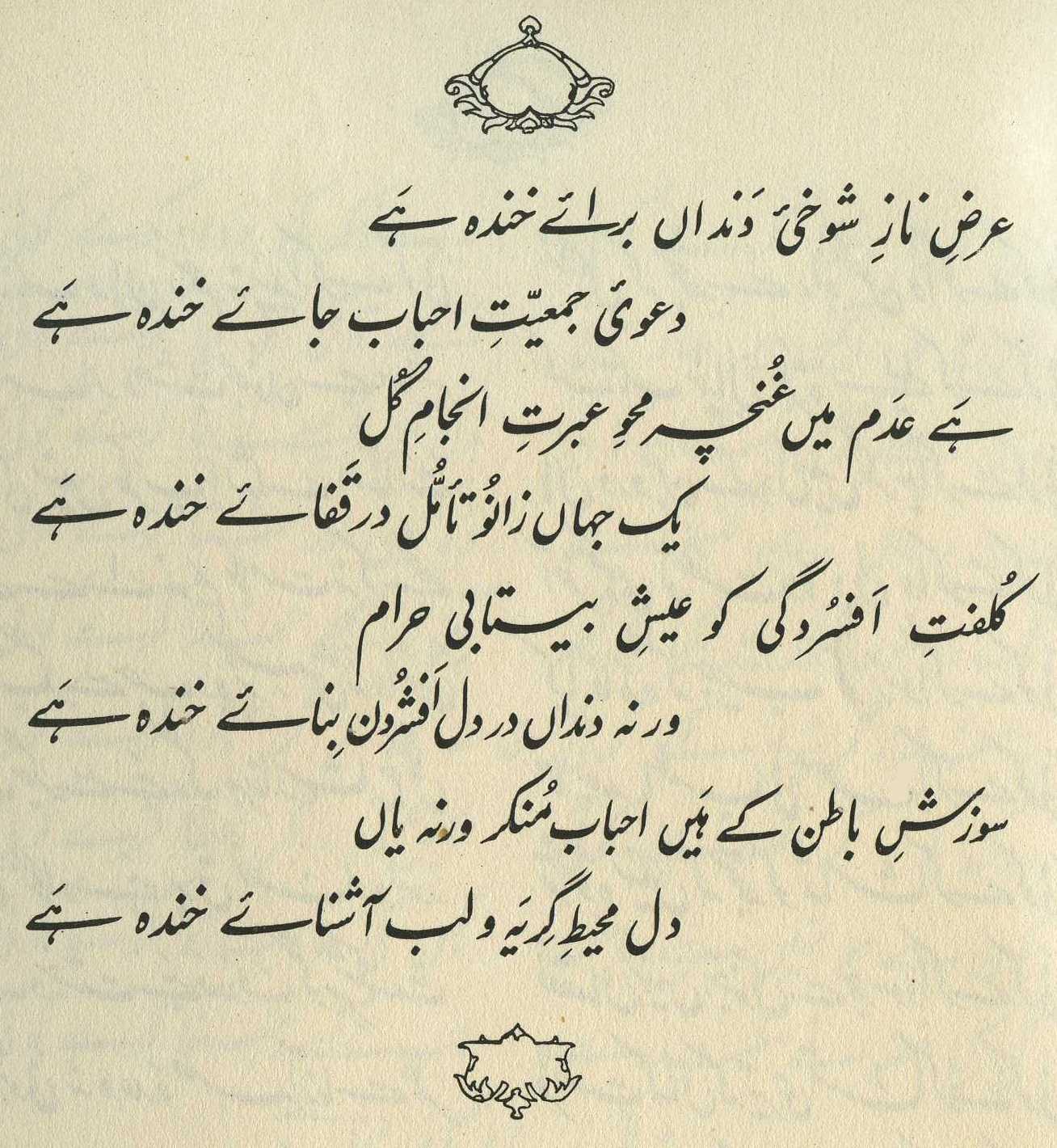
In the heart's state of sadness and melancholy and misery and wretchedness, it is forbidden for it to show restlessness and impatience. Otherwise, if he would become restless and chew up the heart, then all its wretchedness would depart.... In this verse, he has declared that in comparison to sadness, restlessness is enjoyment; that is, in sadness is such misery that compared to it, restlessness is enjoyment. (240-41)
== Nazm page 240 ; Nazm page 241


The meaning is that melancholy of temperament is such a difficulty that in comparison to it restlessness and impatience have, so to speak, the status of enjoyment. (299)
[Disagreeing with Nazm:] The dictionary meaning of is to endure difficulties, not to chew up the heart. The Lord knows what Janab Tabataba'i is pleased to say! Then in the end to say that there's such misery in sadness that in comparison to it restlessness is enjoyment, is certainly an attractive thing, but between it and the author's meaning is a vast difference. The author says very clearly that to the vexation of sadness the enjoyment of restlessness is forbidden. That is, he (the author) is referring to the restlessness of passion or the stress and agitation of worldly affairs, which in reality are called 'life', and not saying that he considers restlessness better than sadness. (432)
The 'pressing of teeth into the heart' to mean 'enduring difficulties' is a terrific idiom, and the fact that it's Persian rather than Urdu wouldn't have given Ghalib pause for even a moment. Apparently Nazm doesn't know this idiom, which illustrates the riskiness of Ghalib's unabashed incorporation of Persian into the Urdu world.
But equally to the point, the physical shape of a row of teeth pressed into flesh is a semicircle, and thus the 'foundation of a smile'. It might also be the 'foundation of a smile' in a metaphorical sense as well: it might cause so much pain to the heart as to momentarily distract the lover from the greater suffering of passion, and thus cause him almost to 'smile' with relief.
Or perhaps, even more grimly, this is the only way the lover can imagine ever shaping a 'smile'at all: his 'smile' might be the objective correlative of his teeth pressed into his heart in gallant endurance and a pretence of good cheer. The Spartan boy with the wolf eating his vitals under his clothing comes to mind. Also, think of 'clenching the teeth' and 'gritting the teeth' as similarly evocative in English. The string of six 'dental' (!) sounds in the second line contributes to the toothy effect.
And how bleak is the lover's state, how harsh the discipline of the 'religion of passion' [], that even this much 'restlessness', the purely inward gesture of teeth pressed into the heart, is to him. And how faithful a votary the lover is, as he strictly enforces this discipline on himself. The resonance of (for the lover's general condition) and (for the lover's 'pressing' of his teeth into his heart) adds to the effect.
What contrast is that creating? The second line attributes to the speaker what would 'otherwise' be the makings of a smile. Why can't a (grim?) smile emerge? Several possibilities present themselves:
=The vexation of melancholy doesn't allow the lover to (appear to) enjoy his restlessness, by smiling.
=The vexation of melancholy doesn't allow the lover to smile even at his own hopeless, morbid situation.
=The vexation of melancholy doesn't allow the lover even to restlessly press his teeth into his heart to help him endure the misery.
=The vexation of melancholy doesn't allow the lover to smile for any reason at all; otherwise, in his heart-embedded teeth he has all the foundation there ever is for a smile
In this verse we can use the 'smile' in excellent, enjoyable, complexly satisfying ways. We can do with it all the things that we unfortunately can't do with the 'teeth' in 212,1 .
graphics/teeth2.jpg