Verse 11816uumujhe
G1
1 a
I, the desert-wanderer, am becoming to such an extent retired/'foot-with-garment-hem'
1 b
although I, the desert-wanderer, am becoming retired/'foot-with-garment-hem'
2 a
the thorns of the feet are polish-marks on the mirror of the knees, to me
2 b
the polish-marks on the mirror of the knees are thorns of the feet, to me
'To court retirement; to bear patiently; to be contented'. (Steingass p.228)
| References | |
|---|---|
| Arshi, Imtiyaz Ali | Ghazal# 148 |
| Raza, Kalidas Gupta | 236 |
| Nuskhah-e-Hamidiyah | 212-213 |
| Gyan Chand | 346-348 |
| Hamid Ali Khan | Open Image |
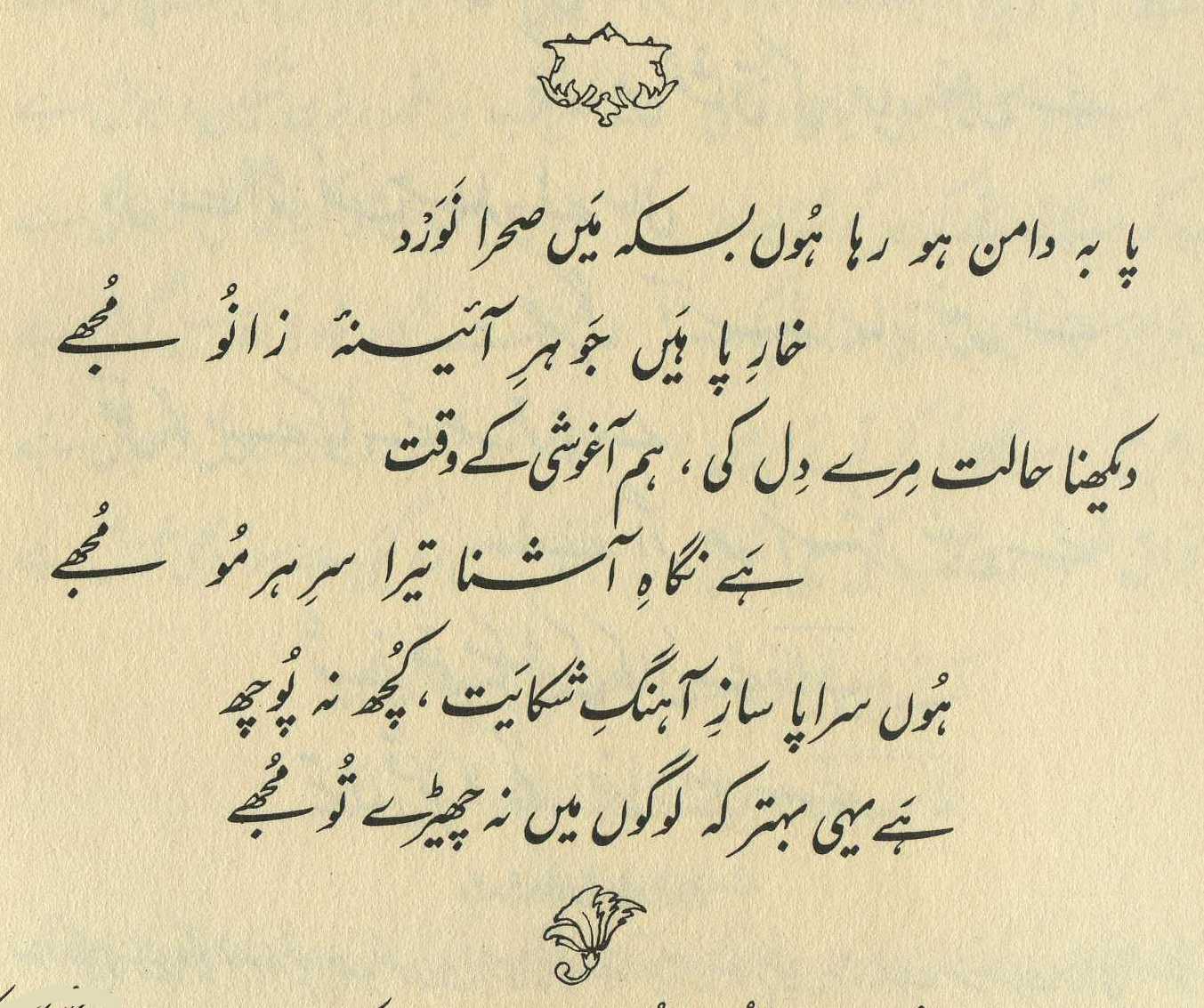
That is, when the feet are brought close to the knees, the thorns that are lodged in the feet have become the polish-marks of the mirror of the knees. In this verse too, except for the simile , there's no pleasure in the meaning. (192)
== Nazm page 192

A lover of desert-wandering is, because thorns have lodged in his feet, deprived of desert-wandering. Having placed his feet on his knees, he looks at the thorns lodged in his feet and says, because of these wretched things a desert-wanderer like me is sitting here with curled-up feet! He looks at them and is irritated.
[Or:] My practice was desert-wandering. Now that I have abandoned desert-wandering and remain ensnared in my thoughts, these very thoughts have become thorns for my feet. That is, the way that when thorns are lodged a person cannot walk, in the same way, in the incompleteness of these thoughts I am deprived of desert-wandering.
[Disputing Nazm:] The meaning that has been mentioned [by him] is reversed. Now there remains the pleasure of the meaning: about this I have to say that to people who are mad for work, sitting on the ground is torture. Mirza has captured a picture of such an individual: 149,1 . (336)
The meanings of are: (1) to withdraw into seclusion; (2) to endure something with patience; (3) to content oneself with something (Steingass). [Other similar citations are provided.] Thus the meaning of is to abandon coming and going, to adopt seclusion. has two meanings: (1) , that is, now there's no expection of changing this state; and (2) , that is, formerly there was one state, now there's another state. This change could be deliberate, or involuntary....
'Mirror of the knees' actually means 'kneecap' (Steingass).... This meaning is so rare that I've only seen it in two other places: [a verse by Nasikh , and Tilism-e Hoshruba]....
He's called the kneecap the 'mirror of the knees', then assumed the mirror to be a mirror in which the face is seen. Now when from being bone it has reached the stage of being a mirror, then he has assumed polish-marks in the mirror as well....
In the light of the above discussion, the interpretation of the verse becomes this: I was a desert-wanderer. Desert-wandering is a cause of madness. In such a state, when I was wandering aimlessly around, who had the leisure or opportunity to look at his face in a mirror, and ascertain his condition? Now I've renounced desert-wandering, and I sit leaning my head on my knees. The reason for the renunciation of desert-wandering can be anything at all-- a lack of madness, weariness, despair, etc. I sit leaning my head on my knees, as though I am looking at my face in the mirror of the kneecaps. The excellence of a mirror is in its polish-marks. They often give for the polish-marks of a mirror the simile of thorns. Ghalib himself has a verse: 56,2 .
Now when I look at the mirror of the knees, I feel that the thorns that lodged in my feet in the state of desert-wandering are the polish-marks on this mirror. That is, this mirror has become worthy of being looked into because thorns had lodged in my feet. Now neither do thorns lodge in my feet, nor do I sit like this with my feet curled up and my head leaning on my knees because I'm able to see my face in the mirror of the knees. Because of desert-wandering, the mirror of my knees became polish-marked. And now, when desert-wandering has been renounced, even then the thorns are showing their qualities []. It's a verse in Ghalib's special style.
== (1989: 302-04) 2006: 325-29
This verse makes good use of the complex possibilities of , which can mean either 'to such an extent' or 'although'; needless to say (this being Ghalib), both senses work excellently with the second line. On the first reading, the speaker is so inactive now that even the thorns lodged in his feet from his old desert-wandering days have now become polish-marks on a mirror-- and his knees, which he no longer uses for any other purpose, have become the mirror itself (1a). On the second reading, even though he's now inactive and reclusive, he still has his souvenirs of the old days of desert-wandering-- but now he makes use of the thorns and of his knees in new ways, to serve new purposes (1b).
Why are the knees like a mirror? Because as the speaker sits passively in a corner, his downcast, lowered gaze is always fixed on them, the way one might gaze into a mirror-- as he contemplates the nature of life, death, madness, and wandering. Why are the thorns like polish-marks? Because they are short lines, violently ground into a surface, and because they both create, and testify to, the proper functioning of that surface. The thorns verify that the mad lover has wandered barefoot in the desert; the polish-marks verify that the mirror has been scraped free of verdigris and highly polished.
And then, through the rule of 'symmetry', there are also two readings of the second line. We can read 'A is B', 'thorns are polish-marks', as everybody does; but we can equally well read 'B is A', 'polish-marks are thorns': even though (or else because) the lover has given up desert-wandering and sits staring at the 'mirror' of his knees and feet, the speaker still feels and remembers, like thorns in his feet, the ordeals and sufferings and wild madness of the road. Perhaps he's now so frail that even looking down at his knees is as painful as wandering barefoot over thorns; or perhaps he's such an incurable desert-wanderer that even when sitting helplessly in a corner he still imagines himself to be traversing a thorny road.
As Faruqi points out, it's not clear whether the lover's abandonment of desert-wandering was deliberate (he no longer wishes to practice it) or took place under some kind of compulsion (he's too worn out for it). And beyond that, we don't know whether the verse exults in this new condition (he now seeks inner insight instead of mere outer vistas), grieves over it ('Alas, I can no longer wander-- I'm left with nothing to contemplate but my own face!'), or simply reports it neutrally, as another development in life.
Then, the 'to me' at the end calls the whole thing into question-- would anybody else agree with him? Or is the speaker simply making up a fantasy of some kind, to console himself or rationalize his behavior?
There's also a crazed or playful aspect of sheer hyperbole (and of course wordplay) in the impossibly contorted-sounding position of the speaker's knees and feet. Is he sitting? Or squatting? Or cross-legged? Or seated (see 32,2 )?) Such a position might be similar to the hunched-over one also imagined-- equally extravagantly-- in 171,1 . Needless to say, Ghalib himself probably didn't even bother to sort out the exact nature of such implausibly weird positions; he was after wordplay and meaning-play, not anatomical accuracy. It's still fun to speculate, but it's irrelevant fun.
In any case, the speaker is now so immobile (through meditation or despair) that his head and eyes are always cast down to the maximum degree possible. As he looks down, his knees are (literally or metaphorically) so close to his feet that they seem to be joined or assimilated with them, since the thorns in the feet can appear as polish-marks in the mirror of the knees. And his gaze is so fixed downward that he stares absorbedly at his knees the way people look into a mirror. Too much elaborate interpretive work, for too little reward; I almost agree with Nazm.
Note for grammar fans: Faruqi observes, in effect, that what looks to be the present progressive '[I] am becoming' [] could also be read as '[I] became, and have remained' [ , with the colloquially omitted], though he explains these forms in other idiomatic terms. He then discusses the somewhat different implications of the two readings. For more on this idiomatic pattern, including examples, see 58,7 . Certainly the present progressive reading is so completely obvious and natural that the possibility (or desirability?) of another reading never even occurred to me until I read Faruqi's commentary. In any case, in this highly abstract verse it doesn't really seem to make much difference.
graphics/hermit.jpg