Verse 11833aatme;N aave
G13
1
in that gathering in which you, with pride/coquetry, would enter into the conversation
2
life would enter into the figure/frame of the face/aspect of the wall
is an archaic form of ( GRAMMAR )
'The body (of a man or animal); the frame; the heart; --figure, form, mold, model'.
| References | |
|---|---|
| Arshi, Imtiyaz Ali | Ghazal# 206 |
| Raza, Kalidas Gupta | 383 |
| Hamid Ali Khan | Open Image |
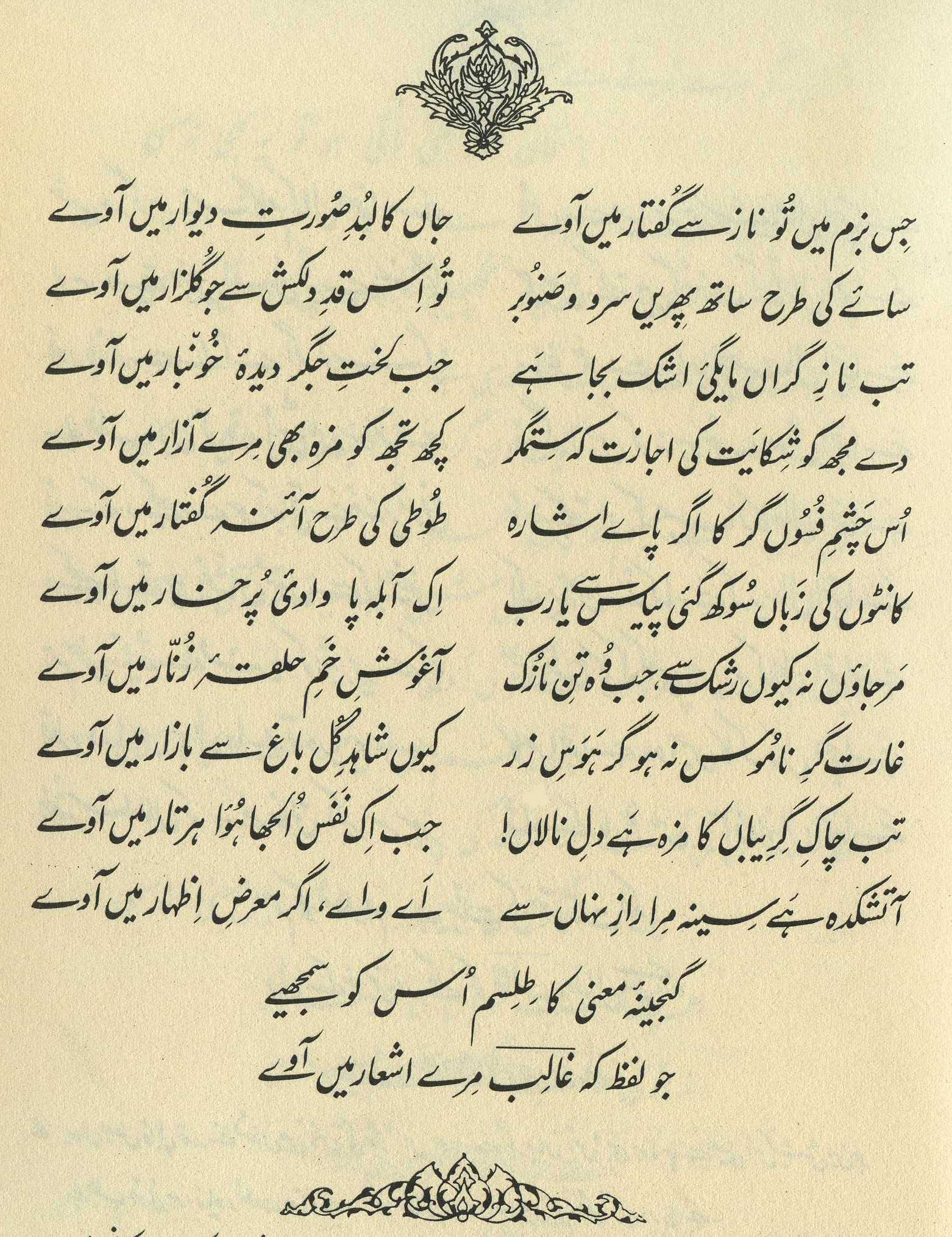
The theme is very famous among the poets, that in the beloved's lip and mouth is the quality of life-bestowingness. For this reason, if through her conversation life would enter into the aspect/face of the wall, it wouldn't be strange. with the meaning of 'to converse' is not the idiom of Urdu, it's a translation [from Persian]. (193)
== Nazm page 193

He says, 'The gathering in which you converse with airs and graces-- the pictures that hang on the walls of that house come to life.' (249)
Having seen in himself the life-giving power of the beloved's words, the lover says, if you would begin to converse coquettishly in a gathering, then life would enter into the pictures painted on the wall. (337)
The second line has two possible readings. The first is the one the commentators spell out: that life would enter into the 'face' or aspect of the very wall. But then-- that meaning hardly requires . What other possibilities does open up? Since it can mean 'model', right there we've got it. One's life would assume the form of, would take as a model or pattern, the wall. In other words, the listeners would be petrified, dazed, entranced by the beloved's dazzlingly flirtatious conversation. They'd be frozen in place, as immobile as a wall; probably their love-crazed faces would be pale and blank, like a whitewashed wall, too. Needless to say, there's plenty of precedent for such a reaction: just consider 116,8 , in which the pattern for human behavior in the beloved's street is the prostrate, open-mouthed 'stupefaction of a footprint'.
So: the wall comes alive, and/or the people are petrified into walls. Life and death bounce back and forth, when the beloved is around. Really, aren't two meanings more than twice as enjoyable as one? This is Ghalib, after all. He was a genius poet in this genre, and he knew it. His verses are twisty rivers full of rapids and whirlpools, not prosy shipping canals that convey a single fixed load of meaning from point A to point B. Sorry for this rant; I am just sounding off.
graphics/festivity.jpg