Verse 61833aatme;N aave
G13
1
the tongue of the thorns has dried up from thirst, oh Lord --
2
may a single/particular/unique/excellent blister-footed one come into the thorn-filled valley!
is an archaic form of ( GRAMMAR )
| References | |
|---|---|
| Arshi, Imtiyaz Ali | Ghazal# 206 |
| Raza, Kalidas Gupta | 383 |
| Hamid Ali Khan | Open Image |
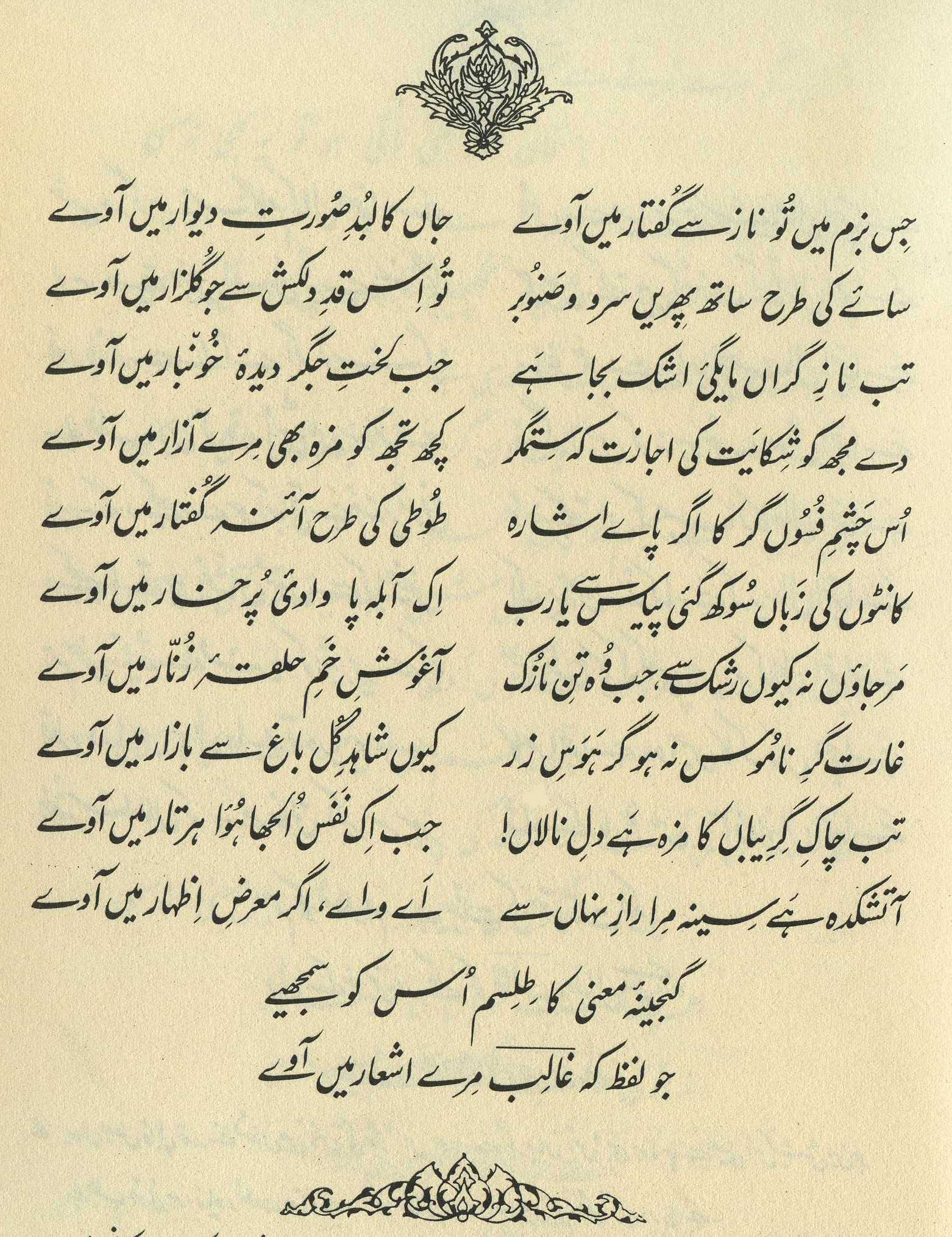
If they would pierce the blisters, then their thirst would be relieved. (193)
== Nazm page 193

He says, the dry-tonguedness of the thorns is because of thirst. If the water from the blisters would be obtained, then their thirst would vanish. (249)
The destroyedness of the desert of madness is an unbearable sight. So send someone with Majnun -like qualities. [Or:] He sees that he himself has blistered feet, and says, the thorns are in this state through thirst; oh Lord, if you permit, then I would fill them up. (339)
The tips of thorns are their 'tongues', a nice bit of wordplay that permits them to be thirsty (since they live in the desert) and also justifies their being so sharp and narrow (they have dried up from thirst).
At the end of the first line 'oh Lord!' [] sounds like a commonplace exclamation; only when we get to hear the second line do we realize that it works as an actual vocative addressed to the Lord, so that the second line becomes a kind of prayer. The speaker feels compassion for the thirsty thorns, and appeals to the Lord to have suitable refreshment sent to them. The 'midpoint' position of 'oh Lord!' encourages us first to register it casually, then-- after we've been allowed, under mushairah performance conditions, to hear the second line-- to augment our understanding.
Above all, the word 'one' [] energizes the verse. It makes it clear that a single blister-footed person would be a sufficient supply for the whole thirsty valley full of thorns-- which means that that person's feet would be simply two big blisters, and also that that person wouldn't waver or turn back, but would definitely traverse the whole valley. Obviously, this 'one' person should be a very special one-- perhaps, thanks to the well-deployed multivalence of , a 'particular', 'unique', or 'excellent' one.
But who would that 'one' person be? Bekhud Mohani mentions two possibilities. It could be a famous lover-- Majnun , or someone like him. But it could also be the speaker himself, who is too refined and modest to volunteer for the job more overtly. Either way, the mystical and sacrificial overtones resonate with Sufi notions of the 'path', and so on.
This is also what I call a verse of 'grotesquerie'-- one in which the vivid physical imagery that it evokes is so morbid as to damage its larger allegorical effects. Do we really want to imagine somebody's feet covered with such gigantic blisters that they could saturate a whole valley-full of thorns? Do we really want to envision those huge serum-filled cushions of flesh being pierced into ribbons by hundreds of thorns? Do we want to imagine how that would feel to the owner of the feet? Yet if we don't take the imagery seriously, don't we vitiate the energy of the verse?
graphics/thorns.jpg