Verse 51833aatme;N aave
G13
1
from that spell-casting eye, if it would obtain a sign/gesture
2
like a parrot, the mirror would enter/'come' into speech
'Enchantment, incantation, fascination'.
'Sign, signal; beck, nod, wink, nudge, gesticulation; pointing to, indication, trace, mark; allusion, hint, clue'.
is an archaic form of ( GRAMMAR )
| References | |
|---|---|
| Arshi, Imtiyaz Ali | Ghazal# 206 |
| Raza, Kalidas Gupta | 383 |
| Hamid Ali Khan | Open Image |
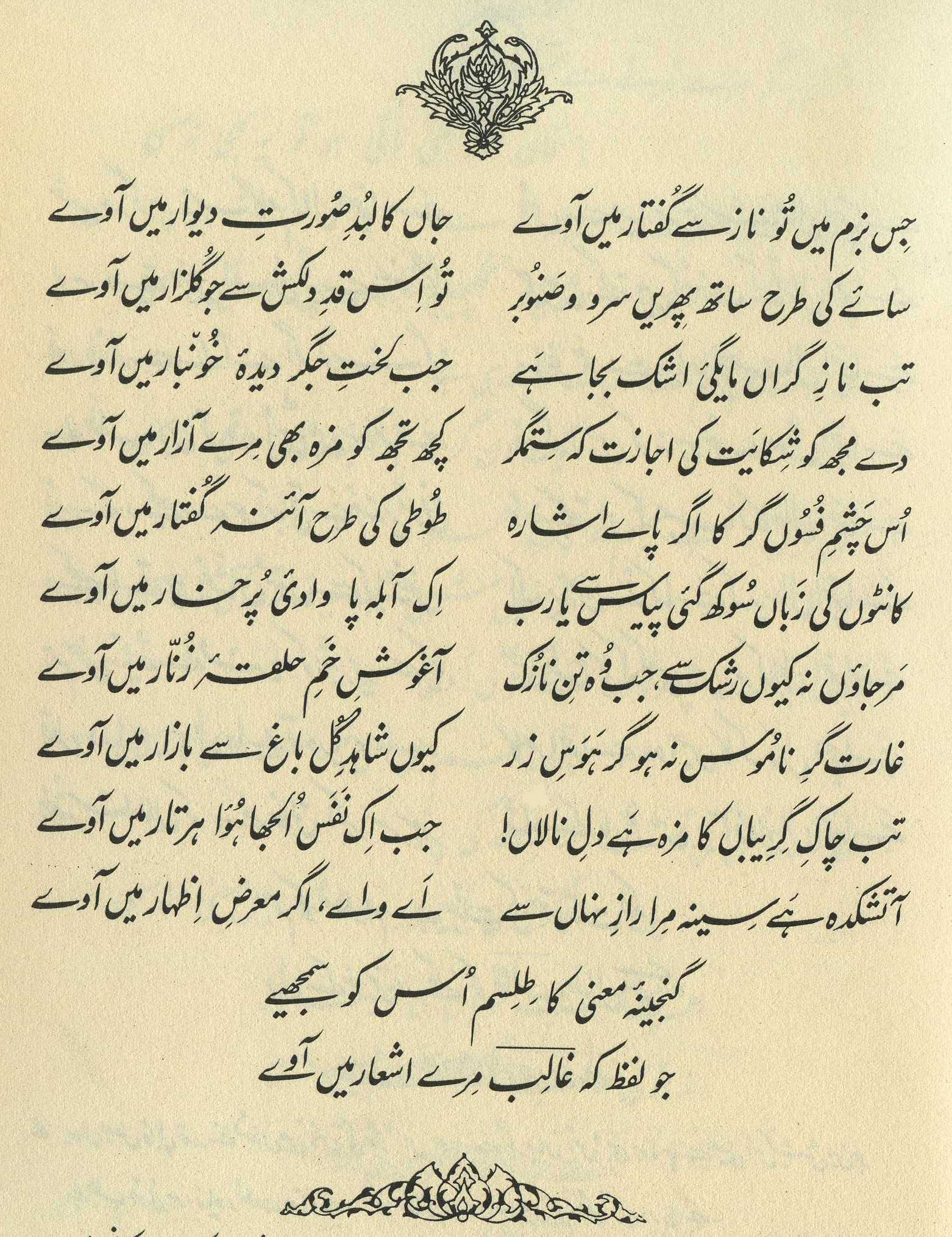
The beloved's eye famously has the quality that it would speak through a sign/gesture. So when that sign/gesture would be visible in the mirror, the mirror too will speak like a parrot. Here the author has rejected the word 'speaking' [] in favor of 'spell-casting' because for a mirror to speak is unusual and magical. (193)
== Nazm page 193

He says,'If it would obtain a sign/gesture from her spell-casting eye, then the mirror too, like a parrot, would begin to speak'. (249)
First of all, the association of parrots with mirrors is well-known; often they put a picture of a parrot on the back of a mirror. The second meaning is also that when she speaks in signs/gestures, then those with understanding consider that a sweet-speaking parrot is warbling. (338)
Bekhud Mohani says that people often put a picture of a parrot on the back of a mirror. And pet owners (and experimenters) often provide parrots with mirrors, to see how the birds will react. (Do they recognize themselves? Do they talk to the mirror-parrot as to another bird?) So parrots and mirrors have their own relationship already. For more on such parrot-and-mirror verses, see 29,2 .
The mirror is a passive, dead reflector, while the parrot is an active, living, sound-producer, so the two are radically different. Yet there's a strong similarity as well: the mirror is an imitator of one's appearance; the parrot is an imitator of one's voice. The beloved's smallest sign or gesture is so potent that it overrides the boundaries between the two: when the mirror perceives/reflects the beloved's gesture, it begins to speak.
Does it begin to speak 'just as a parrot would begin to speak'-- that is, in response to the same stimulus? Or does it begin to 'speak like a parrot'-- that is, babbling and repetitively echoing? Whether the adverbial 'midpoint' phrase 'like a parrot' describes the act of beginning to speak, or the nature of the speech, is left up to us to decide.
In either case, what might be the nature of the , the 'sign/gesture', that inspires the mirror to begin to speak?
=It could be simply that the irresistible beauty of the beloved's every eyelash-flicker moves the mirror to transcendence. Her gesture, though reflected in the mirror, might not even have been aimed at the mirror in the first place.
=It could be that the beloved has given a particular sign of command to the mirror: 'Speak!' After all, this event is hypothetical anyway, and all the verbs are in the subjunctive. Her imperiousness and powers of command would at once compel the mirror's obedience.
=It could be that the beloved is a magician, and has deliberately enchanted the mirror, and the sign is a magic invocation of some sort. This wouldn't be at all surprising, either metaphorically (in English too, we use 'enchanting' for beauty), or literally-- for though magic is forbidden to good Muslims, we know that the beloved is an 'idol' (or sometimes an 'infidel'). Who if not she would have access to all the powers of 'enchantment, incantation' (the literal meaning of )?
graphics/parrot.jpg