Verse 31853oto kyuu;Nkar ho
G9
In this meter the next-to-last long syllable may be replaced by two shorts.
1
when/if there's courtesy, and only/emphatically this {tension/tug-of-war}, then what would/could be done?
2
when/if there's shame/shyness, and only/emphatically this equivocation/hesitation, then how would [it] occur/be?
is an archaic form of the passive subjunctive ( GRAMMAR )
'Shame, sense of shame, modesty; pudency; shyness, bashfulness'.
| References | |
|---|---|
| Arshi, Imtiyaz Ali | Ghazal# 125 |
| Raza, Kalidas Gupta | 438 |
| Hamid Ali Khan | Open Image |
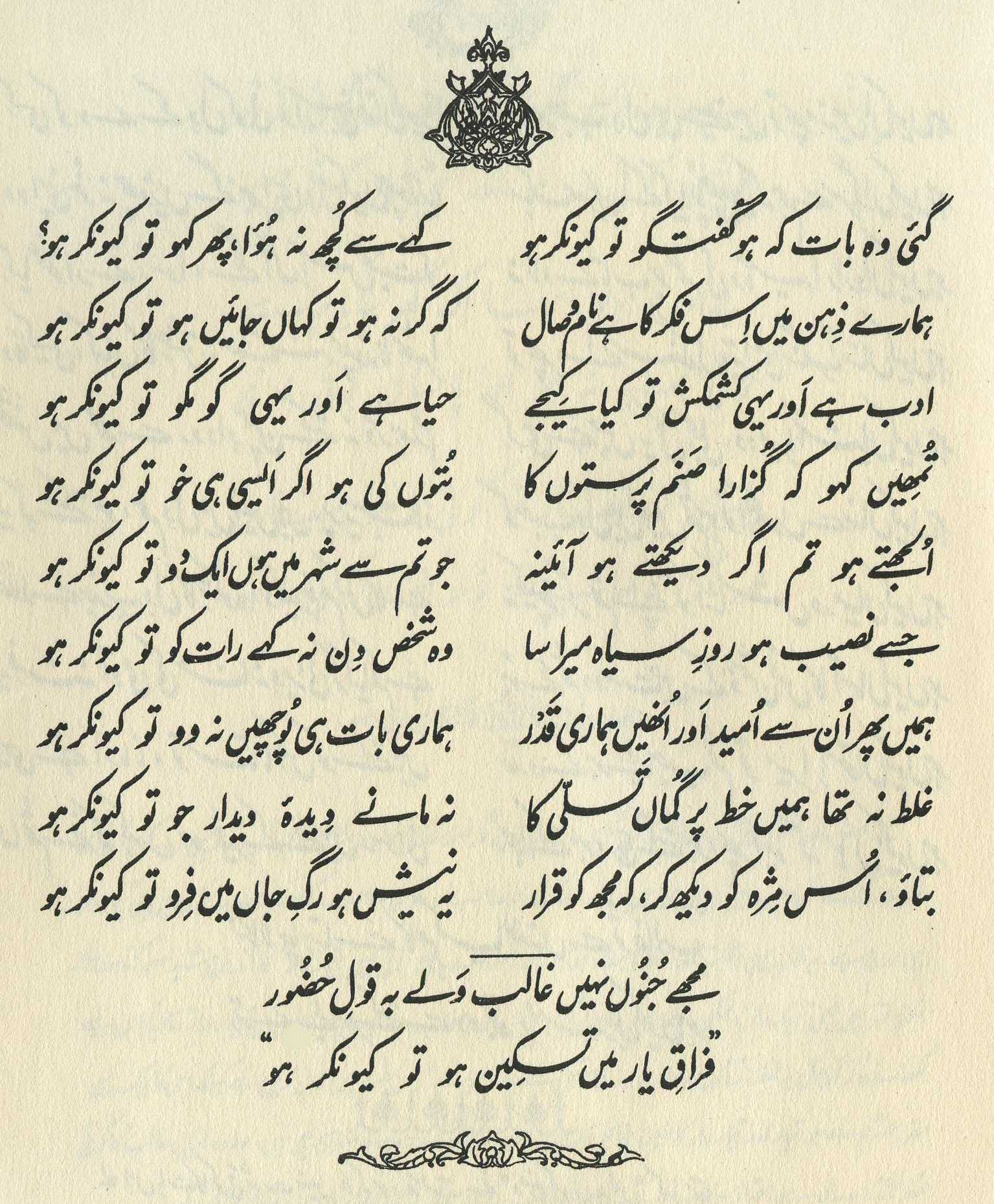
In this verse, instead of , is in the idiom. That is, a tug-of-war with courtesy has held me back; and a tug-of-war with shame has held the beloved back; so then how would the thing get done []? (134)
== Nazm page 134

He says, desire, ardor, longing-- these all compel us to obtain the wish of our heart. But courtesy stops them, and a tug-of-war occurs between these two sides. Her shame doesn't let her give a clear reply; from his side, the speech falls into equivocation. Now if there would be success, then how would it occur? (188-89)
The beloved is beside us, she is silent from shame. We are silent from shame. Emotions of ardor boil up, but courage is lacking. To ourself, or to the beloved, we say, if things remain like this, then we'll remain unsuccessful. That is, neither ought we to show courtesy, nor ought you to show shame. (252)
On the ambiguities of , see 125,1 .
The lines are a study in parallelism, right down to the word level: there are enjoyable similarities between the two Persian constructs (literally 'pull / not-pull') and (literally 'speak / not-speak'). Parallelism, as we've seen in so many verses, invites us to ask about the relationship between the two lines. Do they describe different, independent situations, as the commentators generally have it? Or do they both describe the same situation, in slightly varying ways? Both alternatives seem quite possible in the present verse.
The commentators are quite sure which attributes belong to whom, though it's not clear how they can know. After all, the verse has been carefully structured to give no information whatsoever about how many, and which, attributes belong to how many, and which, persons. The commentators assume that shame is a quality of the beloved's. But it's also easy to find verses in which diffidence and shame are qualities of the lover's, as in 102,1 ; and we all know that shamelessness is one of the beloved's trademarks ( 24,2 , 116,3 , etc.).
In the present verse, it's perfectly possible that all four attributes belong to the lover, who is lamenting his own diffidence and irresolution. Or all four could belong to the beloved, as the lover laments her constant shilly-shallying behind an impenetrable mask of refinement. Other possibilities can be generated in quantity (for a limit case of such multivalence, see 4,4 ). Does he have 'courtesy' and 'shame', while she has 'tension' and 'equivocation'? Does he have 'courtesy' and 'tension', while she has 'shame' and 'equivocation'? And so on. Since 'courtesy' and 'shame', 'tension' and 'equivocation/hesitation', are all (by careful arrangement, needless to say) such broad and multifarious terms, they lend themselves readily to a wide range of imagined situations. And since Ghalib has carefully deprived us of signposts, who but we can do the imagining?
Moreover, the clever use of ensures that the range of our imagining is as broad as possible. Is the restrictive ('only this'), so that the quality in question dominates or supplants all others? Or is it emphatic ('this!')? And if it's emphatic, is it pointing to something that's the final element in a series ('this level of tension, greater than other tensions'), or to something that's in a class by itself ('this particular, specific, unique tension')?
And to what does the implied 'it' in the final phrase refer? The verse leaves us absolutely to our own devices, in this regard as in so many others.
graphics/kashmakash.jpg