Verse 41853oto kyuu;Nkar ho
G9
In this meter the next-to-last long syllable may be replaced by two shorts.
1
only/emphatically you [must] say: the living/livelihood of idol-worshippers--
2
if idols would have only/emphatically such a disposition, then how/why would [it] occur/be?
[of which is a variant spelling]: 'A passing, passing over, crossing; a passage; passing of time or of life; living, subsisting; --stay, abode'.
| References | |
|---|---|
| Arshi, Imtiyaz Ali | Ghazal# 125 |
| Raza, Kalidas Gupta | 438 |
| Hamid Ali Khan | Open Image |
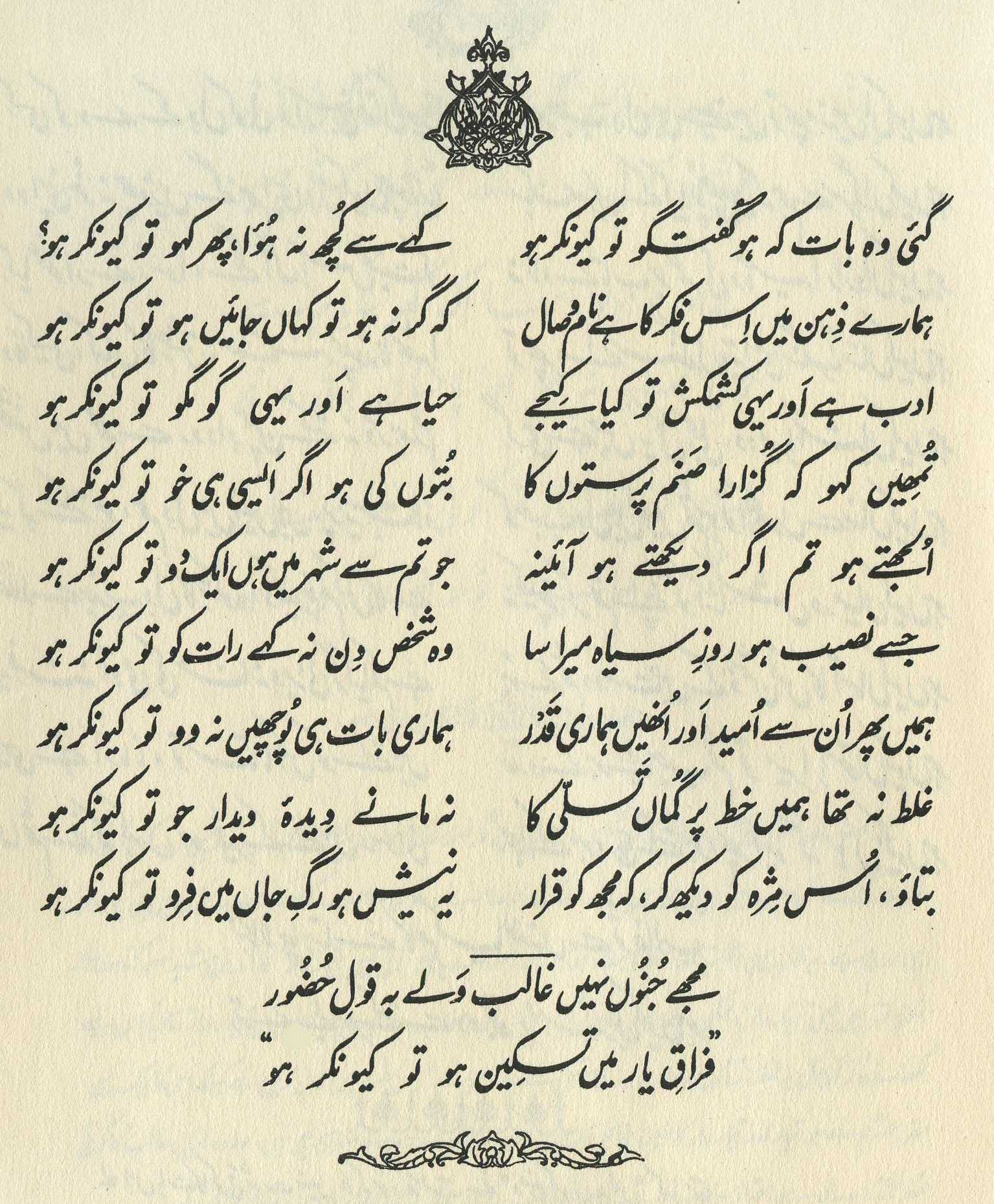
That is, if idols would have a temperament like yours, then how would their worshippers have a living/livelihood? (134)
== Nazm page 134

If beloveds would have such a temperament-- that is, if they, like you, would be frivolous, faithless, treacherous, pitiless, cruel-- then you yourself do justice: how would a lover's life exist? That is, everybody would be finished off. However many qualities the beloved may have, in the phrase all of them are comprehended. (253)
But where's the necessity in this verse that we should turn the suggestion of 'idol' and 'idol-worshippers' toward beloved and lover alone? A new strength enters the verse when it is considered to be addressed not by the lover to the beloved, but by the servant to the Lord.
== ( 1973: 190 )
An idol is made of stone; sighs and laments have no effect on it. It is motionless, and its heart (if it even has a heart) is devoid of the feeling of compassion. But despite this, idol-worshippers don't die of despair; rather, somehow or other they manage to pass their lives. Thus it's been proved that no matter how indifferent an idol may be, it can't be as cold-hearted and indifferent as you. You don't even let any of your lovers stay alive. If idols had a temperament like yours, then it would show itself on the lives of the idol-worshippers.
== (1989: 235) 2006: 257-58
On the pronunciation of as , see 125,1 . On the ambiguities of , see 125,1 .
An enjoyable verse; the various commentators point to some of its complexities. If the lover can talk to his 'idol', he can appeal for justice: 'you yourself must say!'. But an idol who is capable of listening to such a plea, who is approachable enough to make such a plea worthwhile-- can that idol really be so stony-hearted, stonier than a stone image? Maybe so; this is the universe of the ghazal after all, and the lover is accustomed to getting the worst of all possible worlds. Or is the idol really stone, or stone-hearted, so that no reply at all is possible? That wouldn't necessarily stop the self-deluding lover from making his urgent, intimate appeal.
At the heart of the complexity is our uncertainty about whether the group of 'idols' mentioned in the second line includes the beloved (why is she crueler than all the other idols?), or is contrasted to the beloved (why is she crueler even than idols?). And of course, as Naiyar Masud points out, the verse could be addressed by any servant to any master. Then there's an additional layer of uncertainty about the speaker: is he included among the idol-worshippers, or contrasted with them?
A further layer of multivalence, as Bekhud Mohani observes, is provided by the excellently emphatic phrase 'a disposition just such as this' [], which is elastic enough to include all possible cruelties of commission (tyranny, anger) or omission (neglect, indifference). Thus our power to imagine the beloved multifariously is not at all circumscribed, but is even enhanced.
Note for translation fans: Why the '[must] say', when the Urdu familiar imperative is quite straightforward? It's actually a problem of English: 'you say' looks to an English reader like a finite verb, rather than an imperative. For the kind of 'crib' translation I'm making here, maximum possible clarity in conveying the Urdu is the chief goal.
graphics/idol.jpg