Verse 101853oto kyuu;Nkar ho
G9
In this meter the next-to-last long syllable may be replaced by two shorts.
1
I'm not mad, Ghalib, but, in the words of His Majesty
2
'in separation from the beloved, if there would be peace/comfort, then how would [it] occur/be?'
'Calming, stilling, tranquillizing, appeasing, soothing, allaying, assuaging; consolation, comfort, mitigation, rest, assurance, peace (of mind'.
| References | |
|---|---|
| Arshi, Imtiyaz Ali | Ghazal# 125 |
| Raza, Kalidas Gupta | 438 |
| Hamid Ali Khan | Open Image |
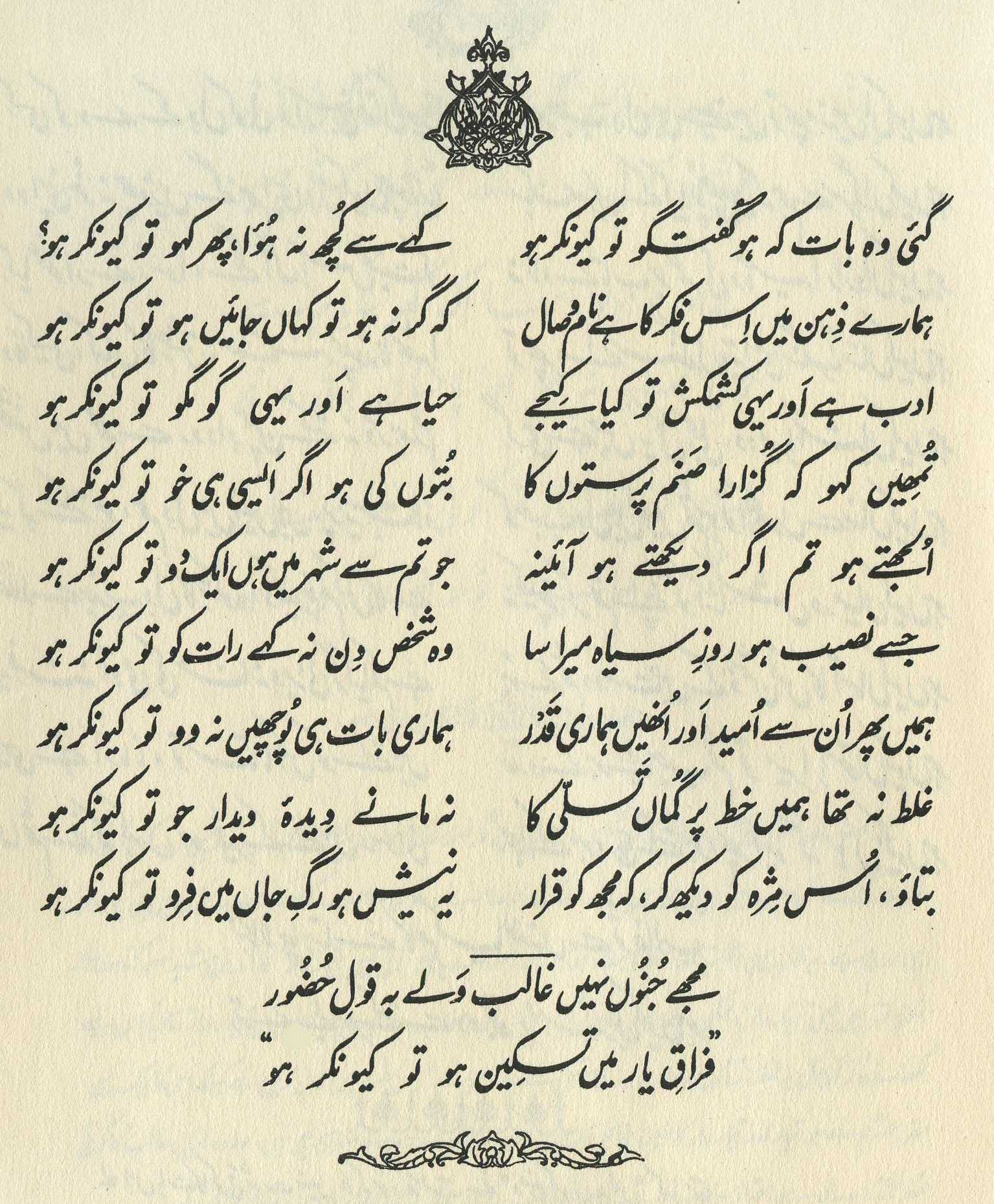
The second line is Huzur's, and the ground is a commanded [] one in which rhyme s are lacking. The author has achieved a wonder: he fulfilled the command in this ground. But it should be remembered that for an accomplished Ustad , everything is all right []. Otherwise, it's better to avoid rhymes like [the ones in this ghazal]. (135)
== Nazm page 135

He says, 'Oh Ghalib, I am not insane, that I should willy-nilly remain restless and agitated! But in the words of Huzur (Huzur refers to the Shadow of God, Bahadur Shah II, with the pen-name of Zafar, the last king of Delhi, and this second line is his), in separation from the beloved, no means for peace comes to mind-- if there would be peace, then how would it be?' (190)
Don't think that my restlessness is a sign of madness. I haven't gone mad. But I'm separated from the beloved. How would I not writhe in pain? (254)
This [second] line is Bahadur Shah Zafar's; probably some mushairah had been held with this as a pattern-line . In Ghalib’s first line refers to the King, Zafar. (249)
On the ambiguities of , see 125,1 .
There's not much to be said about this one, is there? It forms a graceful frame for Zafar's line. I tracked down Zafar's original opening-verse (p. 412 in the 4th vol., 'Kulliyat-e Zafar' (Delhi: Bismah Kitab Ghar, 2002)):
na.siib-e va.sl tumhaaraa kaho to kyuu;Nkar ho
firaaq-e yaar me;N taskiin ho to kyuu;Nkar ho
[the destiny of union with you-- tell me, how would [it] occur/be?
in separation from the beloved, if there would be peace, then how would [it] occur/be?]
Although Nazm makes a point of how difficult and intractable this ground is, Zafar has not only the 11-verse ghazal cited above, but also
=a 9-verse one in the same meter (G5) (p.248 in the 2nd vol.), rhyme ; refrain
=a 9-verse one (p.251 in the 2nd vol.) in meter G2, rhyme ; refrain =an 8-verse one (p.578 in the 2nd vol.) in meter G2, rhyme ; refrain =a 9-verse one (p.582 in the 2nd vol.) in meter G5, rhyme ; refrain
=a 7-verse one (pp. 582-83 in the 2nd vol.) in meter G2, rhyme ; refrain
These were the ones I found in a cursory search (the book has no index). The obvious point is that Zafar, a fine poet in his own way, apparently had no trouble working with this meter and these rhyming elements. So why would Ghalib have any trouble? Very often such alleged difficulties seem to exist only in the eye of the (much later) beholder.
graphics/zafar.jpg