Verse 81853oto kyuu;Nkar ho
G9
In this meter the next-to-last long syllable may be replaced by two shorts.
1
it wasn't erroneous, our doubt/notion of comfort/satisfaction from the letter
2
if the 'vision'-seeking gaze would not {agree / be persuaded / go along}, then how would [it] occur/be?
'Doubt, distrust, suspicion; surmise, conjecture;... notion, supposition'.
'Consolation, comfort, solace; assurance; contentment, satisfaction'.
'Sight, vision (= ); look, appearance; face, countenance, cheek; interview'.
| References | |
|---|---|
| Arshi, Imtiyaz Ali | Ghazal# 125 |
| Raza, Kalidas Gupta | 438 |
| Hamid Ali Khan | Open Image |
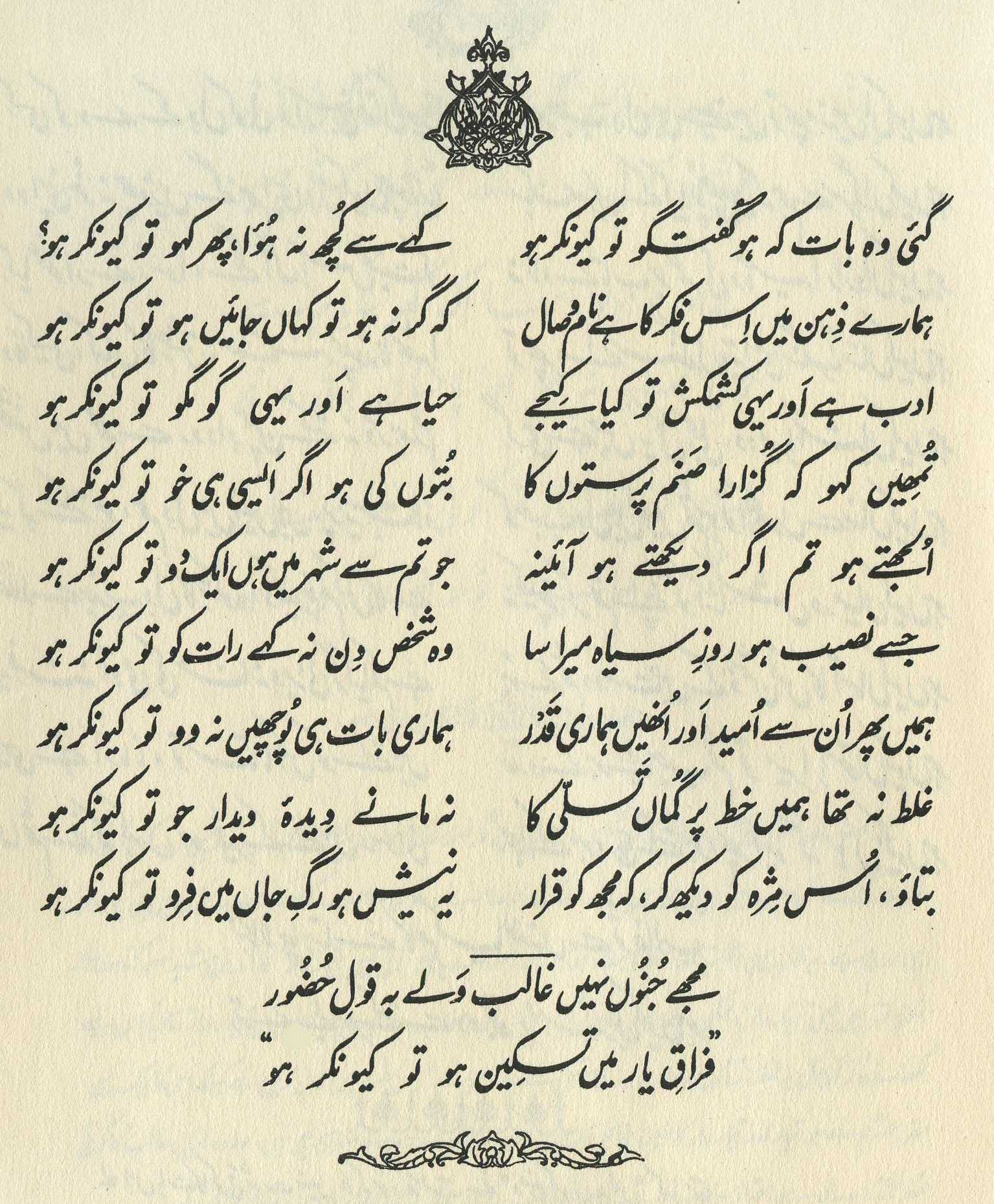
That is, we considered it a cause for comfort that a letter came from her. But if the vision-seeking gaze would not agree, then how would it be a comfort? (135)
== Nazm page 135

He says, 'Our suspicion was not erroneous that from her letter comfort would come to our heart.... But here, through ill-fortune the vision-seeking gaze dug in its heels even more than the restless heart. That wretch simply wouldn't in any way be diverted by her letter, and went on insisting that it would see the vision of her for itself. Now, if there would be comfort, then how would it be?' (189)
Our opinion was not erroneous that when the letter came, then the heart would be comforted. But the eyes are compelled by ardor-- the gaze doesn't agree. That is, the heart was comforted, but the eyes are restless in this way. In one other place he has said the mirror-image of this verse: 152,6 . (253)
Compare 152,6 . (249)
On instead of , see 125,1 . On the ambiguities of , see 125,1 .
What a brilliant choice the word is for the purposes of the verse! It either can have a markedly negative slant ('doubt, suspicion, distrust'), or can remain entirely neutral ('surmise, notion, conjecture'); see the definition above. Needless to say, the second line picks up on either possibility without missing a beat. Here are two readings:
=The lover was not wrong to think/surmise that the letter would be a comfort-- in fact, it was a comforting letter. But his 'vision'-seeking gaze-- which insisted on a sight, an appearance, even a meeting with the beloved-- would not agree to be comforted by any mere letter, so how could it really be a comfort (such as it rightfully should have been)? How could the heart be content, even if comforted by written words, while the eyes remained unsatisfied? (For a verse in which the eyes are satisfied but the heart is not, see 152,6 .)
=The lover was not wrong to have doubt/suspicion/distrust about whether the letter would be a comfort. For in fact, it turned out not to be a comfort. His 'vision'-seeking gaze refused to be persuaded of its comfortingness, and held out for a sight, an appearance, an interview. So how would or could the letter be a comfort?
And then, to what does the implied 'it' in the last clause refer-- the 'notion' of the letter's comfortingness, the 'doubt' about the letter's comfortingness, or the letter's 'comfortingness' itself?
Then in addition, can be not only transitive (to agree to something specific) but also intransitive (to go along, to be tractable and cooperative). As usual with Ghalib, either sense works wonderfully well here. And of course makes for enjoyable visual, aural, and semantic effects.
graphics/letter.jpg