Verse 51853oto kyuu;Nkar ho
G9
In this meter the next-to-last long syllable may be replaced by two shorts.
1
you become perplexed/embroiled if you {see / look into} a mirror
2
if in the city there would be one or two like you, then how/why would [it] occur/be?
'To be engangled, ravelled, twisted, entwined; to be complicated, made intricate; to be perplexed;... to fall foul (of, ), dispute or wrangle (with); to interpose, interfere; to demand a reason'.
is, here, a short form of .
| References | |
|---|---|
| Arshi, Imtiyaz Ali | Ghazal# 125 |
| Raza, Kalidas Gupta | 438 |
| Hamid Ali Khan | Open Image |
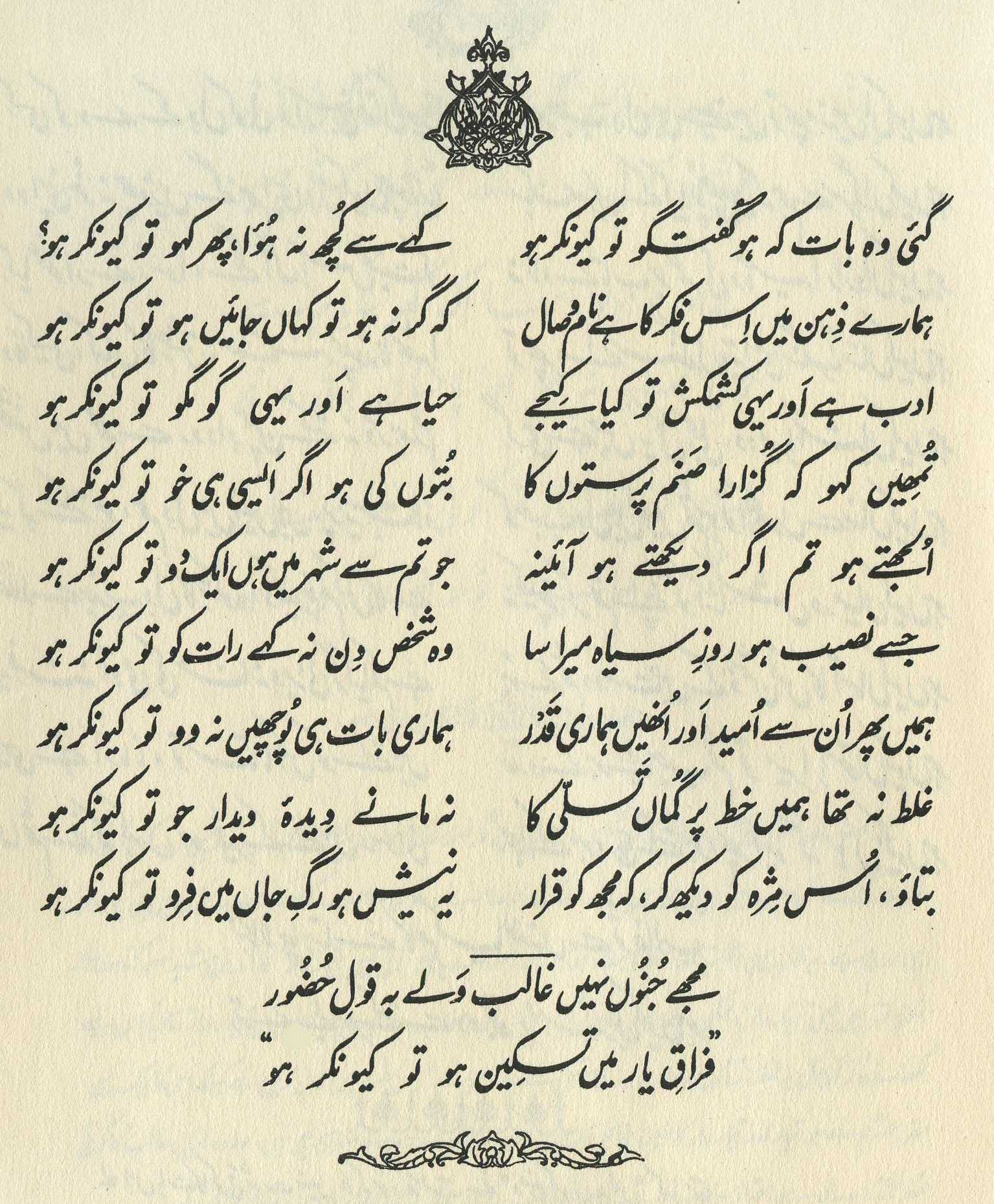
One meaning of it is that if there might be one or two more temperamental people like you in the city, then what shape would the city be in? And another meaning is that when it doesn’t please you that even your reflection is like you, then if in fact one or two as lovely as you were present in the city, then what kind of tumult would you raise?
==Urdu text: Yadgar-e Ghalib , pp. 132-33
That is, having seen your reflection in a mirror, you become perplexed/embroiled. If in the city there would be one or two beautiful ones with your face, then how would it be []? Here too [as in 125,3 ], the author has used in place of . (134)
== Nazm page 134

Seeing your own face in a mirror, you become angry. If there were one or two beloveds like you in the city, then what would happen? That is, you wouldn't let them remain alive. (253)
On the ambiguities of , see 125,1 .
Here even the versatility of assists in the multivalence: unlike English, Urdu doesn't offer a choice between 'to look at (or into)' and 'to see'. Does the beloved's eye casually fall on a mirror, and she becomes angry because even the thought of anything that could hold or capture a beauty like hers is unacceptable to her? Or does she deliberately look into the mirror, and see her own beauty reflected there, and resent the glimpse of the 'rival' she sees in it? Or does she see on the street another irresistible beloved, someone whose beauty is a 'mirror' of her own?
And of course, which sense of the many relevant meanings of (see the definition above) best captures her reaction to the mirror? Is she angry? Perplexed? Or even somehow captivated by the sight of her own beauty, such that she becomes entangled or entwined with the wonderful face in the mirror? We're left to fill in her situation, and her reaction to it, for ourselves.
Here, as so often, the relationship between the two lines is left unspecified. The second line contains two subjunctive phrases that are spoken by a meditative observer (presumably the lover). But do those phrases seek to describe thoughts in the beloved's mind (suggesting that she's actively on the lookout for rivals, in order to blow them out of the water)? Or are they only observations by the lover (marvelling at her inimitable, unique confusion, perplexity, wrath, etc.)?
And as so often in this ghazal, the final can mean either 'how would it come about that there would be one or two like you in the city?'; or 'if there would be one or two like you in the city, then how would it be?' (that is, what would that state of affairs be like?). Both questions are somewhat rhetorical: the answer to the first is surely 'impossible, such a thing could never be!'; and to the second, 'it would be a disaster!'.
graphics/image.jpg