Verse 21853oto kyuu;Nkar ho
G9
In this meter the next-to-last long syllable may be replaced by two shorts.
1
in our mind, the name of that thought/concern is 'union'
2
that if [it] would not be, then where would we go?; if [it] would be, then how would [it] occur/be?
'Thought, consideration, reflection; deliberation, opinion, notion, idea, imagination, conceit; counsel, advice; care, concern, solicitude, anxiety'.
| References | |
|---|---|
| Arshi, Imtiyaz Ali | Ghazal# 125 |
| Raza, Kalidas Gupta | 438 |
| Hamid Ali Khan | Open Image |
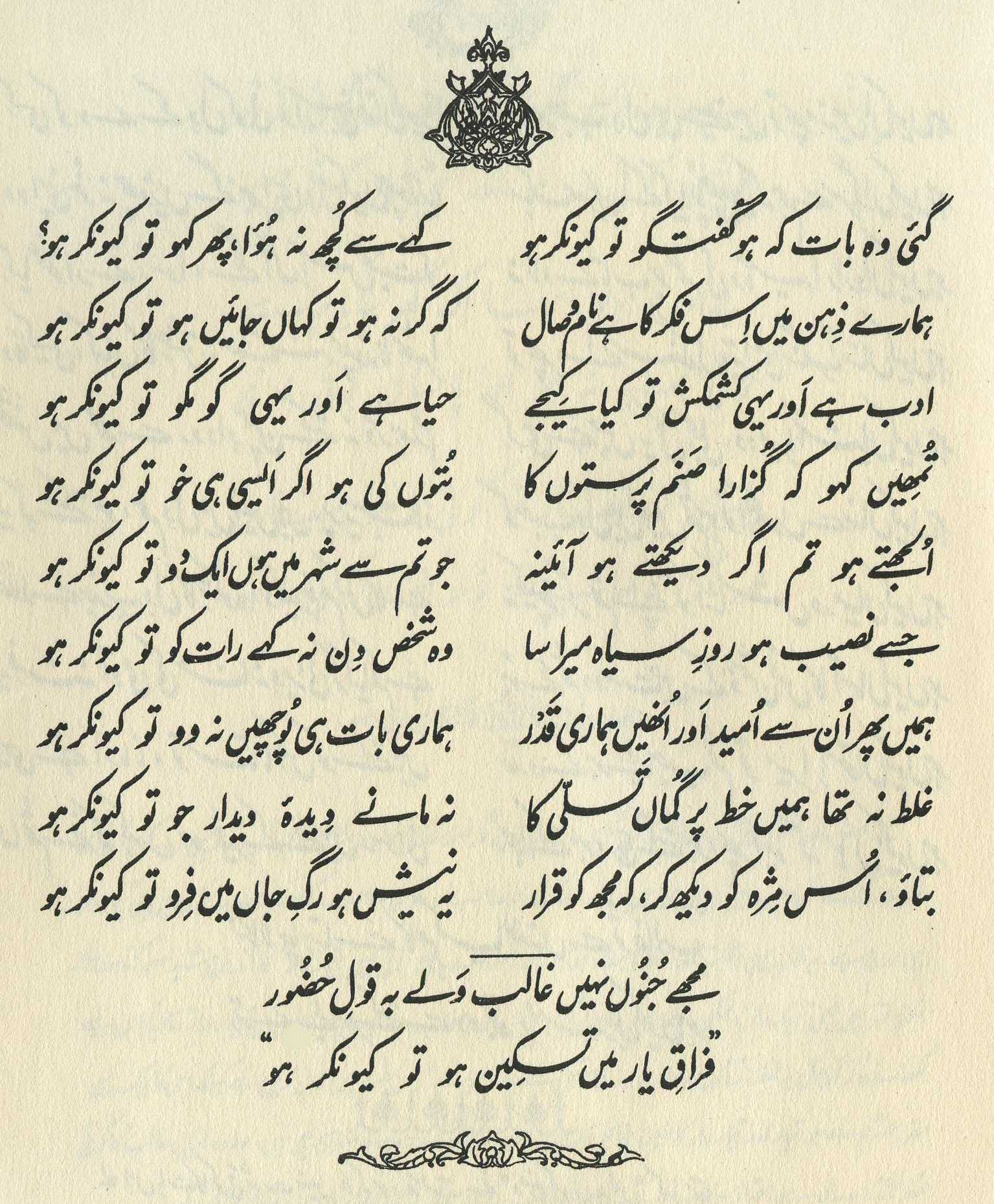
That is, we remain happy with that very thought; union never takes place. (134)
== Nazm page 134

According to us, 'union' is the name for sitting and thinking for hours that if union with the beloved would not (God forbid!) be vouchsafed, then what will we do? Where will we go? And if it takes place, then how will it be? What equipment ought there to be for it? What kind of effort ought to be made? (188)
In this verse, a vision of union has been portrayed. And it's been said that neither has union yet been vouchsafed to us, nor can any prospect of union be seen. Nevertheless, day and night we remain absorbed in the thought that if union doesn't take place, then what will we do, and where will we go? And if by the grace of fortune it would take place, then how will it be, and what schemes will we have to adopt for it? Through this mental concern of ours we obtain the imaginary pleasures of union, and we constantly think about this and are happy. (252)
On the ambiguities of , see 125,1 .
For the speaker, 'union' is the name of a --with its admirably wide range of meanings (see the definition above). The commentators have emphasized the main point: that all the speaker knows of 'union' with the beloved is an abstract mental experience of his own. And even then, it's apparently an experience fraught with uncertainty, doubt, apprehension. For the question 'where would we go?' implies that if it would fail to come about he can't even imagine any recourse, any refuge; while the rhetorical-looking question 'how would it be?' (how would it come about?) suggests that he can't in fact see much prospect of its ever really taking place.
Nazm, backed up for once by Bekhud Mohani, insists that the lover is happy, or at least content [] with this state of affairs. This is not really puzzling; Nazm and Bekhud are simply relying on an alternative sense of . In his commentary on the previous verse, 125,1 , Faruqi enumerates all three senses that this excellently multivalent expression can have. Basically, these are (1) 'what would it be like?'; (2) 'how would it be brought about?'; and (3) 'how could it ever happen at all?!' (as a negative rhetorical question or exclamation). Nazm and Bekhud Mohani, relying on reading (1), allow the lover the luxury of fantasizing about the unknown joys of union; and perhaps also, relying on reading (2), allow him the pleasure of creating intricate plans and schemes that might, he imagines, procure this state of bliss. Thus they consider him happy in his fantasy world-- or at least happy part of the time, since even they can't remove the distraughtness of . Nor, of course, can they remove the grim and colloquial energy of reading (3).
graphics/union.jpg