Verse 11862aan((aziiz
G11
In this meter the first long syllable may be replaced by a short; and the next-to-last long syllable may be replaced by two shorts.
1
how/why would I hold my life dearer than that idol?
2
what-- to me, is faith not dear/precious?!
'By what means? In what way? how? in what manner? why?'.
'Dear, worthy, precious, highly esteemed, greatly valued, honoured, respected, beloved'.
'Faith, religion, creed; conscience; good faith, trustworthiness, integrity'. (Platts p.115.
| References | |
|---|---|
| Arshi, Imtiyaz Ali | Ghazal# 71 |
| Raza, Kalidas Gupta | 477 |
| Hamid Ali Khan | Open Image |
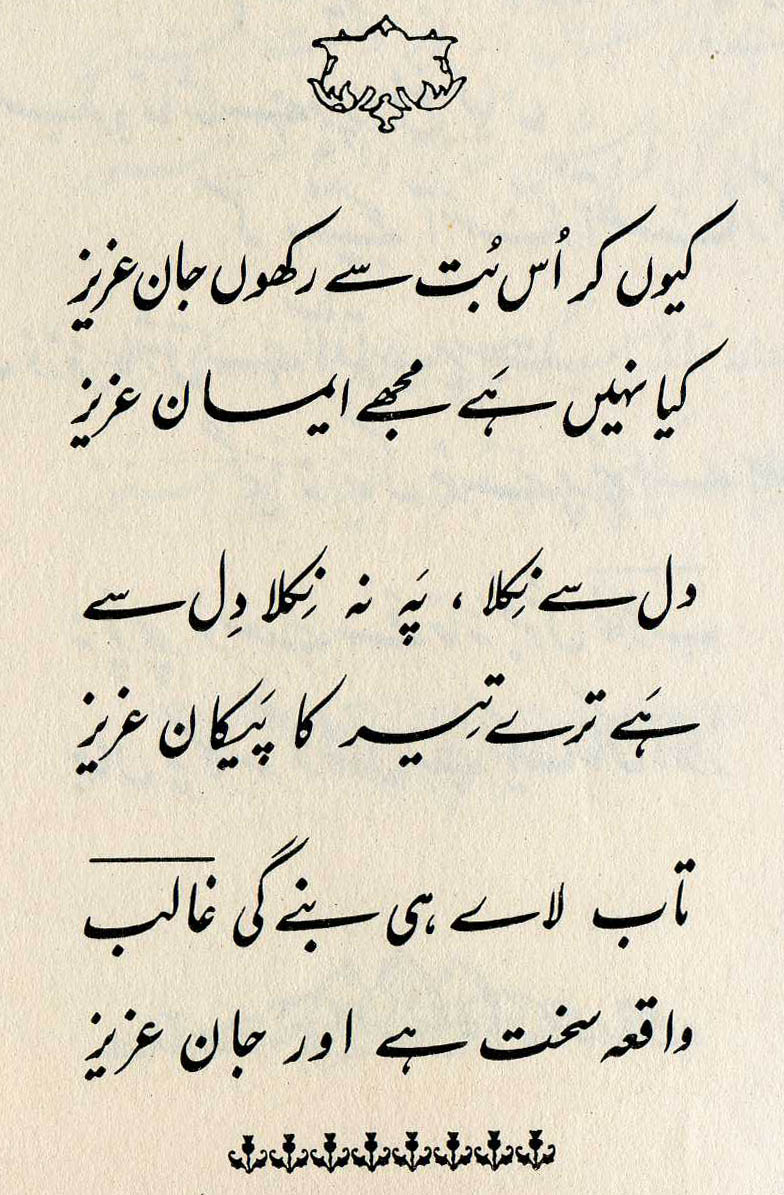
The apparent meaning of this is that if I hold my life dearer than she, then she will take away my faith; therefore I don't hold my life dear. And the second, delightful meaning is that to sacrifice one's life for that idol is exactly what faith is, so then how can life be held dearer than she?
==Urdu text: Yadgar-e Ghalib , p. 131
That is, in the religious sect of passion, to hold one's life dearer than the beloved is ingratitude/heresy []. (70)
== Nazm page 70

That is, to sacrifice one's life is exactly [proper to] faith. Or this: that idol is my faith, therefore one's life is sacrificed for faith.
Only two ghazals from the period after 1857 made it into Ghalib's printed, established [] divan . The first one, composed in 1858, was 216 (for discussion, see 216,1 ); the present ghazal, composed in 1862, was the second. The last of the four editions of his published divan was printed in 1862, so nothing he composed afterward could have made it into the divan anyway.
Bekhud Dihlavi marks this little ghazal as a verse-set (p.116). The verses do have a general unity of tone, but nobody else so marks it. Short ghazals with semantically meaningful refrain s are especially likely to strike people as resembling a verse-set.
How rich and amusing the second line is, after the complex buildup of the first! (On the ambiguities of , see 125,1 .) What-- how can you think that I would value my life more than that idol []? Do you think I have so little regard for my own faith []? Here, 'faith' can refer to at least three things: (1) the speaker's personal integrity as an honorable man; (2) the 'faith' of passion, in which he worships that 'idol'; and (3) the 'faith' of Islam, which would be violated if he went back on his pledged word (in this case, of devotion to her).
As the commentators point out, the enjoyableness of invoking one's toward a energizes the verse, especially in view of the indignation in the lover's tone: he's addressing somebody who's on the verge of challenging his (good) faith, and he's properly scornful of the imputation. And as the lover knows very well, the jealous and vengeful 'idol' herself is likely to pose the greatest danger to his life.
graphics/goddess.jpg