Verse 11821aalhai
G3
1
if from silence is the advantage of invisibility/concealment of the situation/state
2
I'm happy/fortunate, that to understand my speech/idea is impossible/absurd
'Rendering invisible; concealment'.
'State, condition, circumstance, case, predicament, situation; existing or present state (as of revenue collections, &c.); a state of ecstasy, frenzy, or religious transport; —present time'.
'Absurd; impossible; that cannot be'.
| References | |
|---|---|
| Arshi, Imtiyaz Ali | Ghazal# 138 |
| Raza, Kalidas Gupta | 343-44 |
| Nuskhah-e-Hamidiyah | 189 |
| Asi, Abdul Bari | 219 |
| Gyan Chand | 335 |
| Hamid Ali Khan | Open Image |
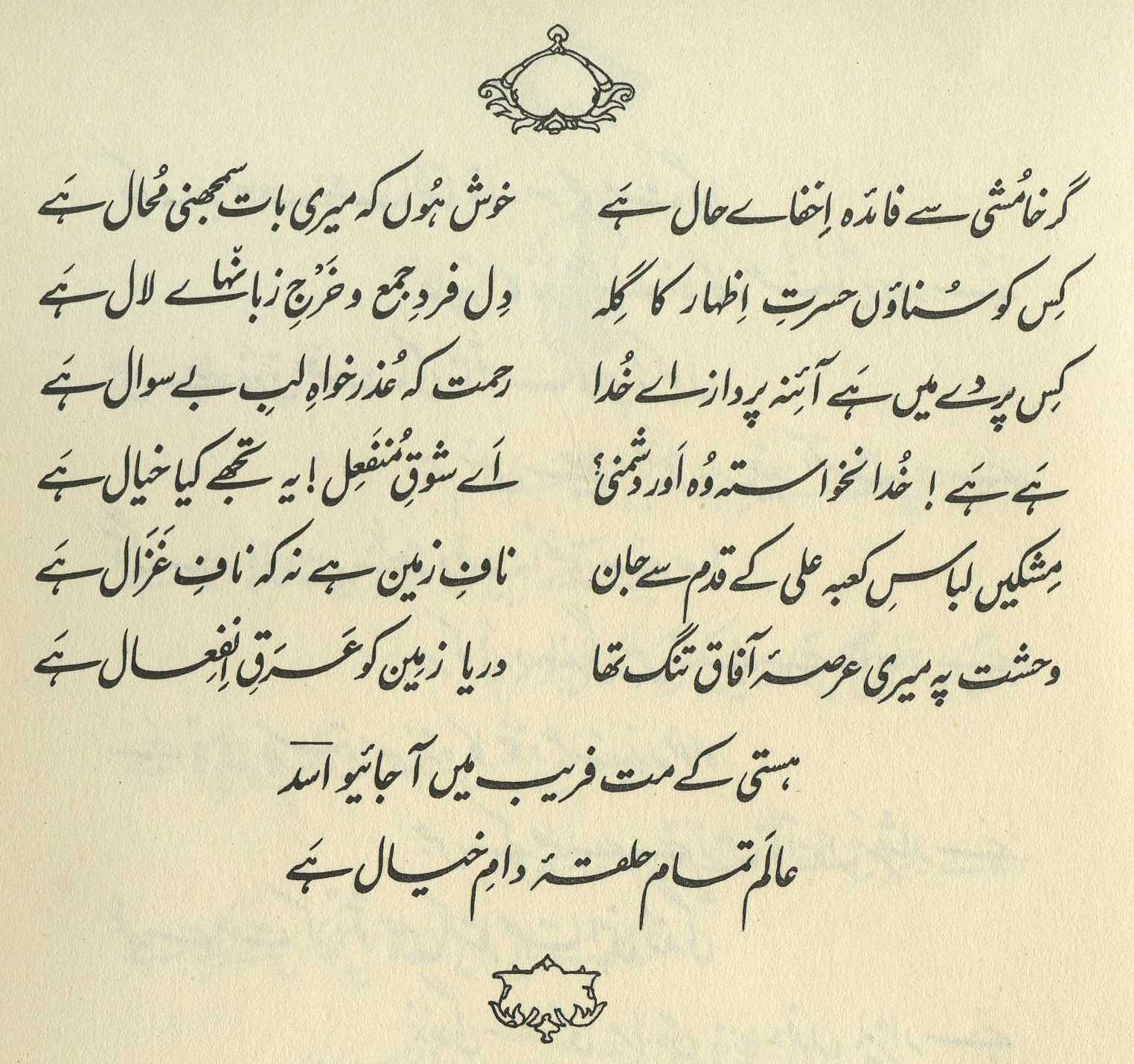
That is, if in silence is the advantage that the state of the heart does not become manifest, then I am happy that my speech too gives the benefit of silence itself; because my speech/poetry [] isn't understood by anybody. (112-13)
==Urdu text: Yadgar-e Ghalib , pp. 112-13
[See also his comments on 175,6 .]
That is, if I am such a madman that it's impossible to understand my words, then I have obtained the advantage of silence without being silent. And by 'situation' is meant events of the heart. (151)
== Nazm page 151

My words have become so esoteric that no one can understand them, and the secret of the heart remains hidden. To this there can be the objection that when no one understands, then what's the need of saying anything? The answer to it is that I can't bear not to speak. When I am compelled by the claims of the heart, then I can't help but say something.
[Or:] In the madness of passion, the situation of the heart and the beloved come to the tongue. But thanks be, that my style of speaking is so arranged that people don't even understand it: 215,5 . (276)
Ghalib's critics famously complained that his verse was incomprehensible. Hali observes that 'Mirza has here and there, in his Urdu and Persian divan s, alluded to this kind of nit-picking'; as examples, he cites the present verse and 175,6 ( Yadgar-e Ghalib , p. 112). Azad echoes these complaints (pp. 494-97, Ab-e hayat ). I've discussed the alleged incomprehensibility of his poetry in an article .
Another comment on the subject by Ghalib takes the form of a very famous quatrain (Hamid 218, Arshi 339; also in Sarvar, p. 120 ):
[my poetry is quite sufficiently difficult, oh heart
repeatedly hearing it, accomplished poets
request me to speak/compose easy [verses]--
'If I speak/compose, it's difficult; and if I don't speak/compose, it's difficult'
'I speak/compose the difficult; otherwise, I speak/compose with difficulty']
The fourth line, in Persian, is framed with an uncapturably clever twist; its double translation reflects two ways of reading (as either 'and if not' or 'otherwise'). Needless to say, in speaking about his difficult poetry Ghalib was also speaking about it in a difficult way.
In its scope the present verse could apply to all the speaker's speech, since , my 'idea' or 'words' or 'utterance', is not a concept limited to poetry. And it certainly works that way as a witty or desperate observation by the lover on the inexpressibly dire straits in which he finds himself. But Hali's observation is plausible, and it's certainly easy to imagine this verse as a wry reaction to a group of particularly obtuse and uncomprehending critics.
As a final elegant touch, both and come from the three-letter Arabic root , 'to become altered or changed'.
graphics/gibberish.jpg