Verse 7after 1826uurnahii;N
G5
In this meter the first long syllable may be replaced by a short; and the next-to-last long syllable may be replaced by two shorts.
1
cruelty, practice cruelty, if kindness/affection would be repugnant/vexatious!
2 a
in indifference/negligence, you are not excused by any means
2 b
in indifference/negligence, you are not excused from [showing] any style/manner/'color'
'Denial, refusal; repugnance, disinclination; regret, sorrow, vexation, grief'.
'Unmindfulness, heedlessness, forgetfulness, neglect, negligence, inattention, inadvertence, indifference, listlessness'.
'Excused; --excusable; --exempted (from); ... --helpless, powerless'.
| References | |
|---|---|
| Arshi, Imtiyaz Ali | Ghazal# 103 |
| Raza, Kalidas Gupta | 371 |
| Gyan Chand | 492 |
| Hamid Ali Khan | Open Image |
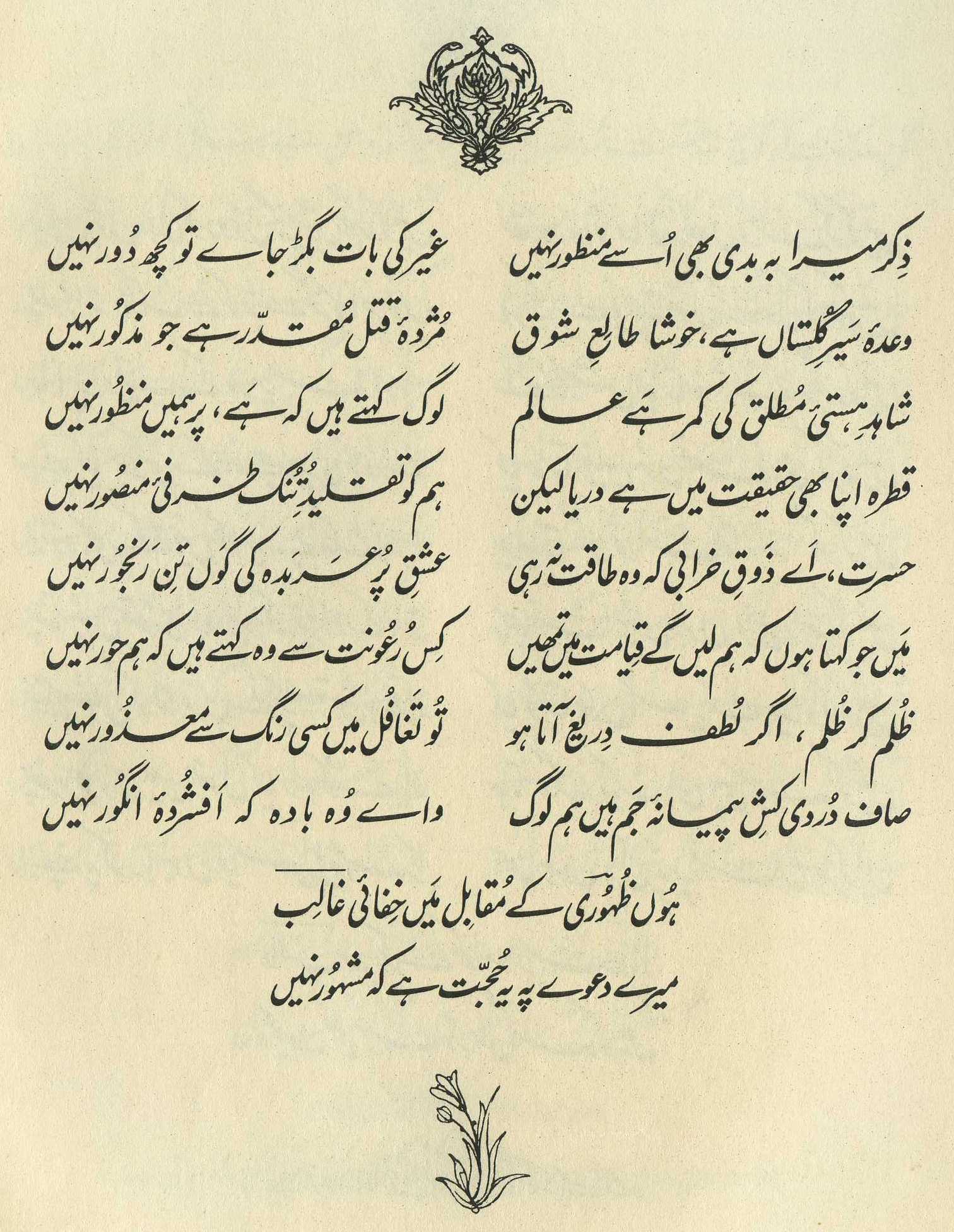
That is, indifference/negligence is merely nonacquaintance; how would this be acceptable to me? (106)
== Nazm page 106

That is, if you don't practice kindness, then practice cruelty! Under no circumstances practice indifference/negligence....
-- that is, your profession is tyranny, I don't like even indifference/negligence. (89
He says, if you don't consider me worthy of kindness, then I insist that you practice cruelty on me, cruelty! Indifference/negligence would only be fitting in a case in which you were excused from cruelty. (157)
The beloved is enjoined to practice cruelty, if kindness would seem repugnant or vexatious [] to her. But a person who had such an attitude would surely already be inclined to cruelty. So why urge such a cruelly-inclined person so forcefully (with a repetition of the operative word) onward to more cruelty? Isn't it unnecessary, and even undesirable?
Not considering the alternative, which is indifference/negligence []. The word also has a slightly stronger and more wilful overtone, more like the English 'heedlessness', which can also be deliberate (see the definition above). As the commentators point out, the lover can bear anything more readily than to be ignored. (Thus the truism that the opposite of love is not hatred but indifference.) So the lover doesn't merely implore or urge, but actually commands the beloved to practice cruelty instead.
All the commentators read the second line as (2a): the beloved is sternly warned that she will not be excused 'by any means' or 'under any circumstances' [] if she insists on showing indifference. Instead, she must show cruelty. She is thus being warned sternly and even threateningly about her behavior-- the risk of 'not being excused' (on Judgment Day?) is held over her head, as if by someone with authority. Yet these intimidating words are being said by a person who obviously has no power over her, and who is in fact desperate to receive any reaction from her at all. Does the lover have some secret power that we don't know about? Or is he simply trying to goad her into a show of resentment, and thus into hostility and cruelty, so as to dislodge her from her indifference?
But there's also the enjoyable second reading (2b): in her manifestation of indifference, the beloved won't be excused 'from any style/manner' [] of the behavior. In other words, within the larger category of 'indifference', negligence is no doubt one aspect, while cruelty is another. And from the logical structure of the first line, it would seem that kindness is yet another. What a wonderful notion! Wouldn't the indifferent beloved's casual, random kindness really be a highly refined form of cruelty (since it would be like the absent-minded pat on the head given to a puppy)?
In either case, the beloved is being held to some obligation that we don't understand-- she must go through all the permutations of her proper beloved-like behavior. But why must she? This is the question that lingers. The lover's urgent, authoritative, peremptory tone is the real fascination of the verse.
graphics/indifference.jpg