Verse 41821ilbaa;Ndhaa
G5
In this meter the first long syllable may be replaced by a short; and the next-to-last long syllable may be replaced by two shorts.
1
the theme s of the thirst of ardor did not become versified/'bound', Ghalib
2
although [I/we/they] {unrestrainedly / 'having opened the heart'} versified/'bound' even/also the sea as a 'shore'
'That which is included or comprised (in a thing); the contents (of a writing or letter), what is implied (in a writing, &c.), import, sense, signification, meaning, tenour; —subject-matter, subject'.
| References | |
|---|---|
| Arshi, Imtiyaz Ali | Ghazal# 8 |
| Raza, Kalidas Gupta | 321-322 |
| Nuskhah-e-Hamidiyah | 41-42 |
| Asi, Abdul Bari | 56-57 |
| Gyan Chand | 73-78 |
| Hamid Ali Khan | Open Image |
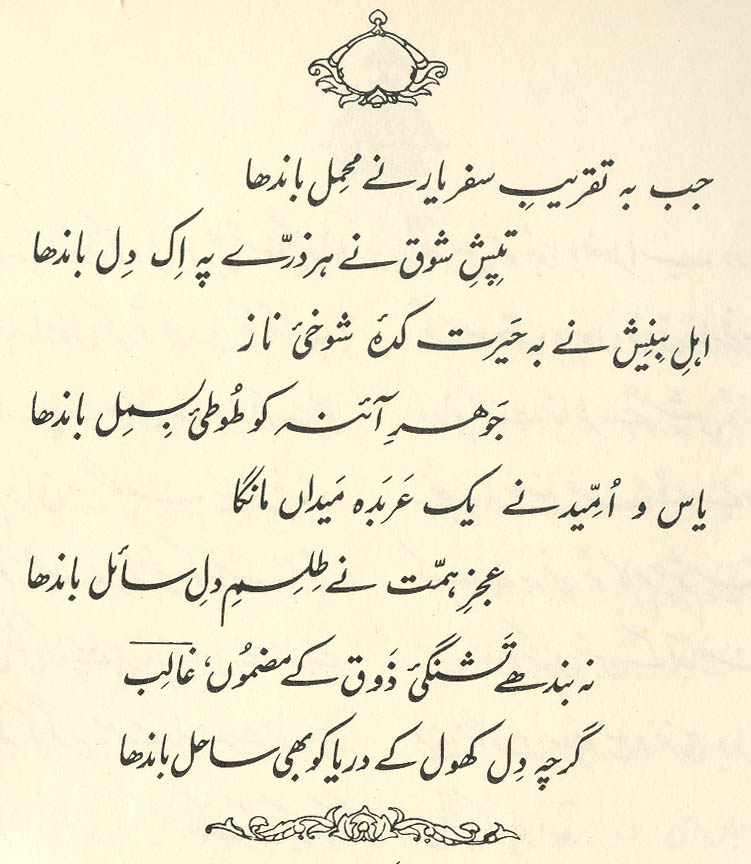
The thirst of the shore is well-known-- if he committed such an exaggeration as to drink up the whole sea, then the sea itself dried up and became a shore. And even then, the theme of the thirst of relish was not expressed. And to do some task 'with open heart' they call 'to use exaggeration in the task' []. (30)
== Nazm page 30

The themes of the relish of poetry, oh Ghalib, could not be versified/'bound' the way we wanted to versify them, although we unrestrainedly versified the sea as a shore. All the poets have constantly called the shore thirsty. Although it keeps the sea in its embrace, nevertheless it looks dry-lipped. To do some task 'with open heart' they call 'to use exaggeration in the task'. (59-60)
In this verse Mirza has shown the extreme of relish; just as in the following verse is the limit of the restlessness of ardor: 27,1 . (75)
Hamid and all the commentator I've used above have , instead of , in the first line, 'the thirst of taste/relish', as do many other divan s and commentators too. As always, I follow Arshi; in this case, I also like the meaning much better ( goes much better with 'ardor' than with 'taste'). Additional circumstantial evidence is provided by this verse's unpublished permutation, 29,6x .
This closing-verse is explicitly built around the process of poetic composition-- and doesn't it make a great ending for the ghazal? The poetic theme s-- and is one of the most basic technical terms in the ghazal world-- of the thirst of ardor didn't get 'bound' or 'set' (the intransitive ) into verse, even though we (or they, or poets in general) bound/set the sea itself as a shore. For more on the literary sense of , see 29,2 .
The shore is thirsty because it looks 'dry-lipped', as Bekhud Dihlavi points out, even though it 'keeps the sea in its embrace'. And just to complicate matters, the sea too is 'thirsty', because countless rivers constantly run into it, yet it is never satiated or overflowing, and is always agitated as though it wanted more. Although the thirst of the sea seems less significant in this verse than its wetness, it surely hovers somewhere nearby when the verse is read.
To convey the inexhaustibility of the thirst of ardor, the speaker has 'versified' ('bound') the whole sea itself, in all its paradigmatic wetness, as the always dry and insatiably thirsty shore. Although he thus pulled out all the stops, even this extravagant, limit-case hyperbole did not succeed in properly conveying the thirst of ardor.
In the juxtaposition of and there's an echo of the idiomatic discussed in 191,8 .
The idiomatic implies that something is done freely or unrestrainedly, but its literal meaning is 'having opened the heart'-- an elegant evocation of our great source of insight into the thirst of ardor. Or perhaps from the opened heart there rushes a huge flood of ardor, like a sea-- like the very sea that's used for comparison. Or perhaps the speaker makes this literary attempt only after 'having opened the heart', and thus having gained a wave of personal emotional force and insight.
Think of 27,1 , which records a similar example of incommensurability: the restlessness of the sea may (or may not) fit into a pearl, but Ardor complains of lack of space 'even in the heart'.
Compare 29,6x , this verse's less fortunate, unpublished sibling-- the same kernel enclosed in a different, less compelling shell.
graphics/seashore.jpg