Verse 31821ilbaa;Ndhaa
G5
In this meter the first long syllable may be replaced by a short; and the next-to-last long syllable may be replaced by two shorts.
1
Despair and Hope demanded a single field of conflict/dispute
2
Weakness of Courage arranged/fixed/versified the {enchantment / magic world} of the questioning heart
'Antipathy; dispute, conflict'.
'Asking; --asker, ... questioner; applicant, suitor, petitioner; beggar'.
tilism>>: 'A talisman; enchantment, magic; a mystery; mystical devices or characters; an image (or other object) upon which such devices or characters are engraved or inscribed (contrived for the purpose of preserving from enchantment, or from a variety of evils, &c.)'.
| References | |
|---|---|
| Arshi, Imtiyaz Ali | Ghazal# 8 |
| Raza, Kalidas Gupta | 321-322 |
| Nuskhah-e-Hamidiyah | 41-42 |
| Asi, Abdul Bari | 56-57 |
| Gyan Chand | 73-78 |
| Hamid Ali Khan | Open Image |
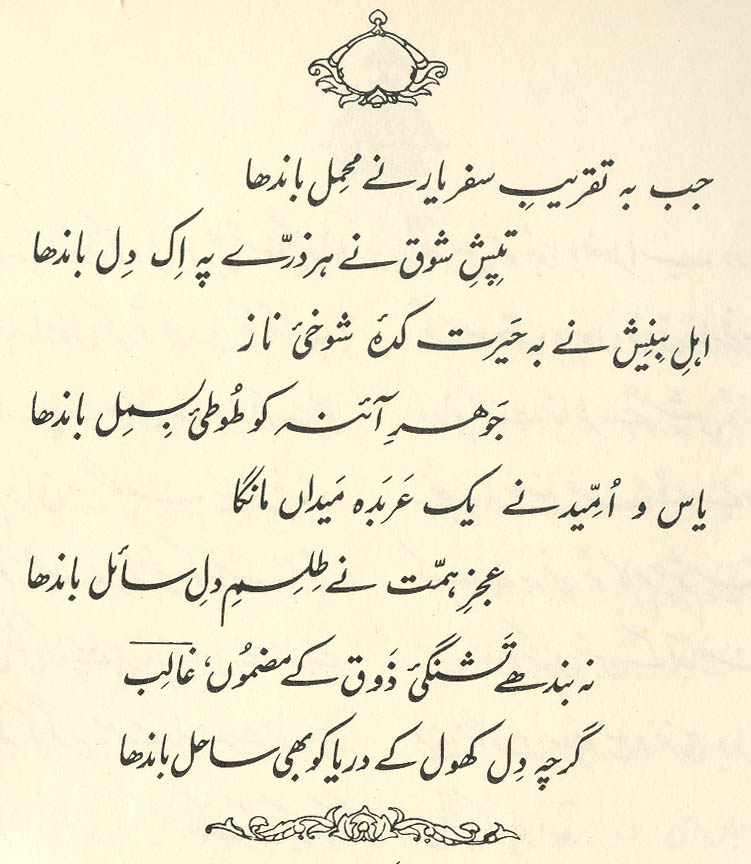
That is, weakness of courage has made a magic world in which the battle between Despair and Hope is heating up.... The conclusion is that the one who lacks courage remains enmeshed in hope and despair. (30)
== Nazm page 30

Urdu text: Vajid 1902 {29}
He has declared the questioning heart to be a magic world and a battlefield of Hope and Despair. The founder of this magic world is lack of courage, because this usually consists of a constant flow of questions. (30)
He says, Weakness of Courage 'bound' an enchanted world-- that is, made an enchanted world, in which Despair and Hope are fighting each other. Despair wants to conquer, Hope wants to be the victor. The meaning of the verse is that the person who doesn't have courage becomes a questioner and remains absorbed in Hope and Terror. That is, after asking a question, as long as he gets something, or the enchantment of hope is not broken by a flat refusal, the struggle between Hope and Despair constantly continues. (59)
Here is one of Ghalib's favorite patterns: one abstract statement in each line, with no indication of their mutual relationship. Is the second line a response to the 'demand' in the first, or is the first line a formulation of the 'questioning' in the second line, or are all the actions to be seen as independent behavior by three separate entities, and compared and contrasted as such?
The concept of a or enchanted world offers possibilities that surely Ghalib loved, since it's clear that he was very fond of such romance literature in both Persian and Urdu. The most important Urdu romance in the genre is the Dastan of Amir Hamzah , to which Ghalib refers in 22,7 . The narrative pleasure of a is that nothing within it is what it appears to be, and things can change their shapes from moment to moment. Within a , you don't get anywhere by straightforward behavior, such as by fighting demons with ordinary weapons. You can get things done in a only by gaining some special knowledge from a wise elder or an inscribed tablet. Once you have blundered into, or deliberately entered, a , you generally cannot escape. The only real escape comes from the 'breaking' of the , which destroys it entirely, but which can be accomplished only by a particular predestined hero.
Doesn't all this evoke the states of uncertainty and perplexity, the labyrinthine twistings and turnings, that are experienced within the , the 'questioning heart'? Perhaps 'Weakness of Courage' has created this deliberately, to prevent or defuse the deadly war between Hope and Despair. Instead of facing off vigorously on a 'single battlefield', Hope and Despair will then find themselves wandering in an incomprehensible, uncontrollable mystery. Or perhaps 'Weakness of Courage' spontaneously creates for itself this , as readily as Hope and Despair demand their own proper battlefield environment. (Compare the behavior of in 33,2 .) The verse is a magical mystery tour of human psychology in two small lines; or it's like an enchanted world.
Or perhaps 'Weakness of Courage' simply wants to substitute poetry for combat; for more on the literary sense of , see 29,2 .
graphics/armor.jpg