Verse 9x1821ilbaa;Ndhaa
G5
In this meter the first long syllable may be replaced by a short; and the next-to-last long syllable may be replaced by two shorts.
1
Hopelessness, in approaching/recommendng theme s of intoxication/hangover
2
versified/'bound' the 'lane of the wave' as 'the stretch/yawn of the shore'
'Approach, access; commending, recommending ... ; recommendation, mention; occasion, conjuncture; ... cause, means'.
'Intoxication; the effects of intoxication, pain and headache, &c. occasioned by drinking'.
'A narrow street, a lane, a narrow passage, an alley'.
'Stretching; yawning, gaping'.
| References | |
|---|---|
| Arshi, Imtiyaz Ali | Ghazal# 8 |
| Raza, Kalidas Gupta | 321-322 |
| Nuskhah-e-Hamidiyah | 41-42 |
| Asi, Abdul Bari | 56-57 |
| Gyan Chand | 73-78 |
| Hamid Ali Khan | Open Image |
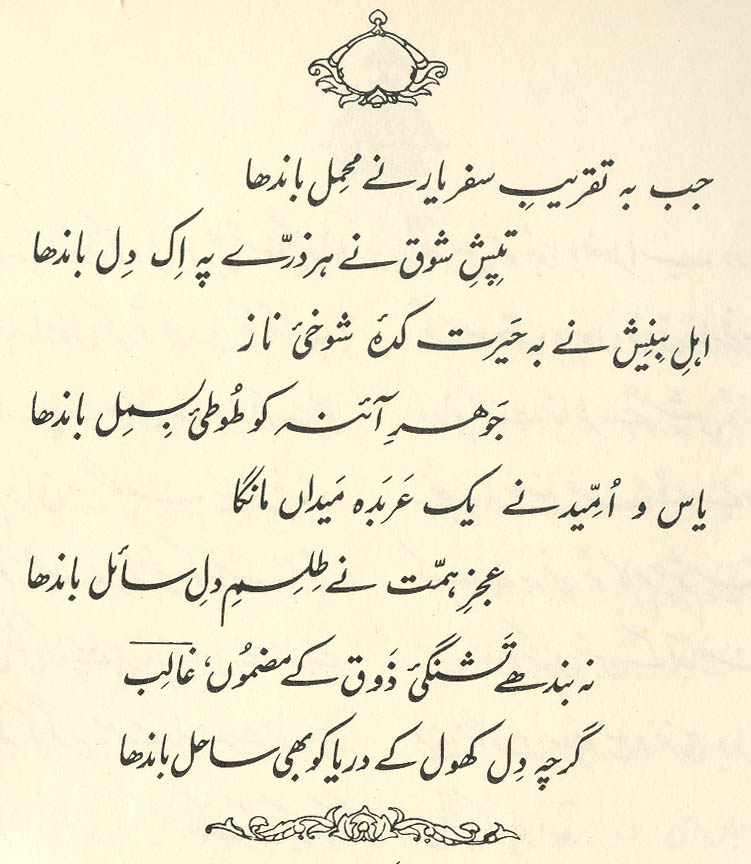
My despair, writing the theme of intoxication/hangover, considered it to be the 'lane of the wave'-- for it is the stretch/yawn of the shore. The 'lane of the wave' is the wave itself.
In my view, Mirza first composed this verse; afterwards, since there was scope in it, he composed it in different forms. Two of them are: 29,6x and 29,4 .
== Asi, p. 57
Because a wave is long and has turn after turn, it is given the simile of a lane. Here, what is meant is a 'wave of wine' []. = yawn, it is used as a metaphor for the stretch of the shore; a wave too has a similitude with a yawn, and necessarily has a yawn. The meaning is that there was hopelessness about obtaining wine, and the had gone beyond the limit; thus when he sat down to write the theme of , then in the preface he wrote down the 'lane of the wave' as the 'shore'. That is, although in the gathering of the Cupbearer an ocean of wine was rippling, the cup of my destiny seemed to me to be empty.
Another aspect can be that when he sat down to write the theme s of , then since a yawn is necessary in , then he dashed off the wave of wine as the yawn of the shore. But in this case the word 'hopelessness' becomes useless. 'Hopelessness' did this or that means that we, in a state of hopelessness, did this or that.
== Zamin, p. 40
is the abatement [] of intoxication, one sign of which is the coming of a yawn. The is the space between waves; that is to say, the wave itself. We are hopeless of obtaining wine. Thus we want to keep on presenting the themes of intoxication. Our thirstiness has declared even the shore to be thirsty, although it always remains wet-skirted. In 'proof' of the thirst of the shore we have declared the waves to be its yawning, which appears in the situation of wine not being obtained. Ghalib always uses for waves the simile of a 'yawn'.
== Gyan Chand, p. 76
For background see S. R. Faruqi's choices . This verse is NOT one of his choices; I thought it was interesting and have added it myself. For more on Ghalib's unpublished verses, see the discussion in 4,8x . This verse is from a different, unpublished, formally identical ghazal, 259x , and is included for comparison. On the presentation of verses from unpublished ghazals like this one along with formally identical divan ghazals, see 145,5x .
The 'lane of the wave' sounds as if it might be the curling, twisting crest of the wave, or else the long narrow trough between the tops of two waves (as Gyan Chand says). It is poetically versified, or 'bound', as the , or 'stretch, yawn' of the shore. Such a stretch or yawn is idiomatically identified with (a lessening of) intoxication, and a thirst or desire for more wine. For discussion of the and imagery, see 12,2 -- which is itself an excellent verse for comparison.
Thus the physical correlation is amusing and enjoyable: even the ocean waves themselves are imagined as dry and thirsty, the way a shore might be, and as bending and twisting (the way the shore does as well) as a form of the 'stretch' or 'yawn' that suggests a readiness for more wine.
On as 'to versify' see 29,2 . In the present case, who is doing the versification? 'Hopelessness', of course. It's introducing or advocating not intoxication, but poetic ' theme s' of intoxication; its excesses are thus literary rather than rakish. Gyan Chand thinks that the 'hopelessness' refers to the chances of getting any wine, but this seems trivial. Even when the lover has some trouble with the Cupbearer, or somehow doesn't get all the wine he wants, he never seems to be in a state of 'hopelessness' about it. The lover reserves his hopelessness for worry over larger matters: the favors of the beloved, or life in general.
This verse is not about the lover's vain, hopeless longing for wine, but specifically about how 'Hopelessness'-- or perhaps a poet expressing 'hopelessness'-- composes poetry. The ghazal world likes to see its themes writ large; within this world, hyperbolic exaggeration seems perfectly natural. Thus if the poet decides to write about hopelessness as a form of 'intoxication', there's no end to the extravagance of his imagery: the watery ocean waves themselves are effortlessly construed as a dry, thirsty shoreline. The physical world itself is at the poet's service-- why should he not let his imagination run wild along the 'lane of the wave'?
graphics/waves.jpg