Verse 21821aakaa
G9
In this meter the next-to-last long syllable may be replaced by two shorts.
1
I know this: that 'you-- and an answer to a letter!'
2 a
but/perhaps I am oppressed by a relish/taste that wears away the pen
2 b
but/perhaps I am oppressed by a relish/taste for wearing away the pen
'Wearing, rubbing; obliterating, effacing; worn, obliterated, old (used as last member of compounds)'.
'An answer'. (Steingass p. 231)
'Written... ; s.m. What is written; a writing; a letter, an epistle'.
| References | |
|---|---|
| Arshi, Imtiyaz Ali | Ghazal# 14 |
| Raza, Kalidas Gupta | 326 |
| Nuskhah-e-Hamidiyah | 57-58 |
| Gyan Chand | 91-92 |
| Hamid Ali Khan | Open Image |
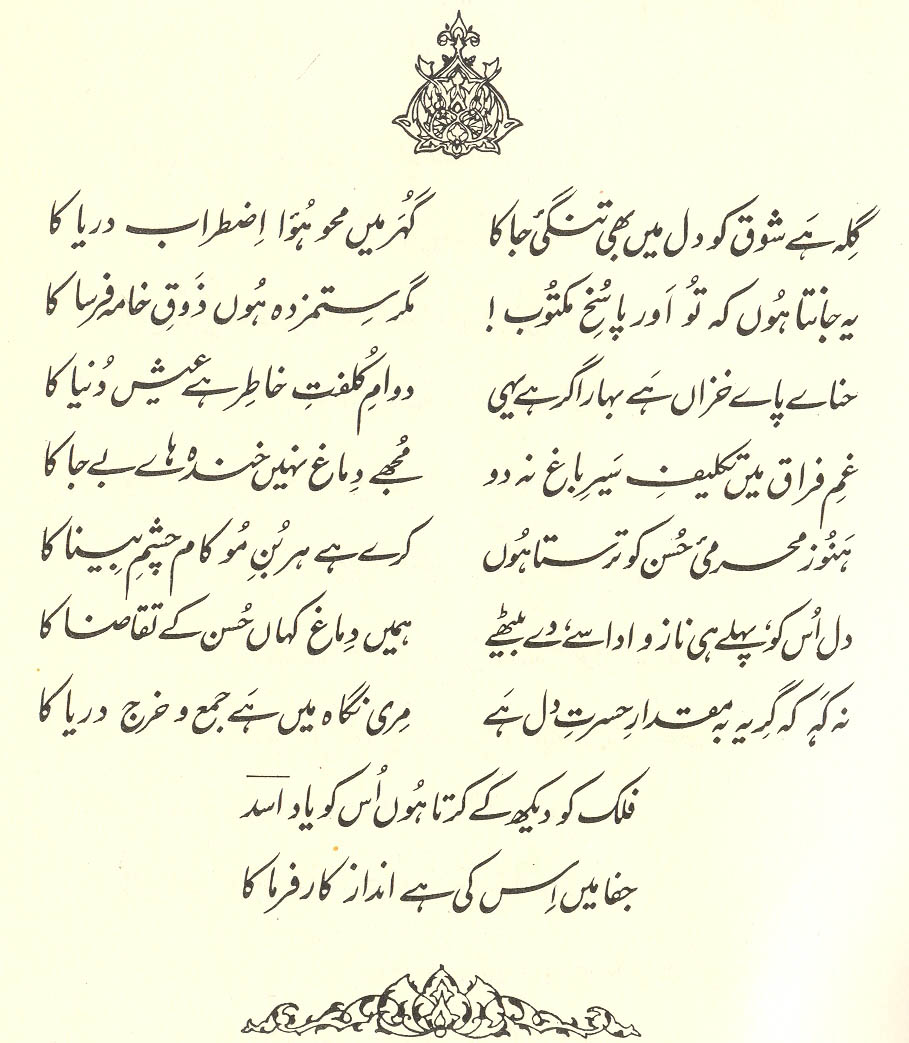
That is, you, and to write an answer! It's impossible. It's like . The word is omitted . (28)
== Nazm page 28

Urdu text: Vajid 1902 {27}
I know, and have understood very well, that up to Doomsday you'll never answer any letter of mine. But what can I do? I am helpless. The relish for the scratching of the pen compels me; for this reason, again and again I am sending you letters. Despite the fact that I've already ceased to hope for an answer. (56)
I am writing these letters again and again because the relish of writing something or other with the pen has compelled me to. And this tyrannical relish of writing has destroyed me. Otherwise, the hope of an answer has already been completely crushed. (92)
The first line is perfectly, delightfully, ruefully, colloquial: 'I know, I know-- to expect you to answer a letter!' The absurdity of such a hope is so patent that the speaker doesn't even need to spell it out in detail. (And even if the beloved does reply, as in 97,4 , the situation is not much better.) This colloquial 'you-- and' is a variant of Ghalib's more frequent 'I-- and' structure.
So what is it that keeps the lover writing? What kind of a morbid relish or taste does he have? And does he really have such a relish or taste at all? The piquant double sense of , as 'but' and also 'perhaps', keeps the question enjoyably open.
The more obvious reading is, he has a relish so intense that it wears away his pen (or, that causes him to have a worn-away pen) (2a). His passion for the addressee-- the intimate is used in the first line-- is such that it holds him in an irresistible grip and forces him into thoroughly irrational behavior.
Or, the versatility of the construction being what it is, the lover's morbid relish may be for wearing away the pen (2b). Just as he has abraded his heart into nothingness, just as his nerves are long gone-- so should his pen too be worn away; there's a kind of elegant symmetry to it. He's no longer thinking about the beloved at all, he's now fixated on the pen itself, and the sheer mechanics of wearing it away; as it gets more and more worn, he contemplates it with increased relish. After all, what could better evoke the state of his heart than a worn-out pen that has used itself up in writing ten thousand letters, all of them to her-- to her who will never answer a single one.
graphics/penletters.jpg