Verse 11821aanekii
G2
1
from the grief of the world, even/also if I {found / would find} leisure to lift my head
2
to look at the sky-- the approach/occasion of remembering you!
is, grammatically speaking, a perfect form, but colloquially in contexts like this the perfect is often used instead of the future subjunctive; ( GRAMMAR )
'Giving access (to), causing to approach, bringing near; approaching; approximation, proximity; approach, access; commending, recommending, mentioning...; occasion, conjuncture;... ceremony, rite; cause, means; appearance, probability; pretence, motive'.
| References | |
|---|---|
| Arshi, Imtiyaz Ali | Ghazal# 132 |
| Raza, Kalidas Gupta | 341 |
| Nuskhah-e-Hamidiyah | 181-182 |
| Hamid Ali Khan | Open Image |
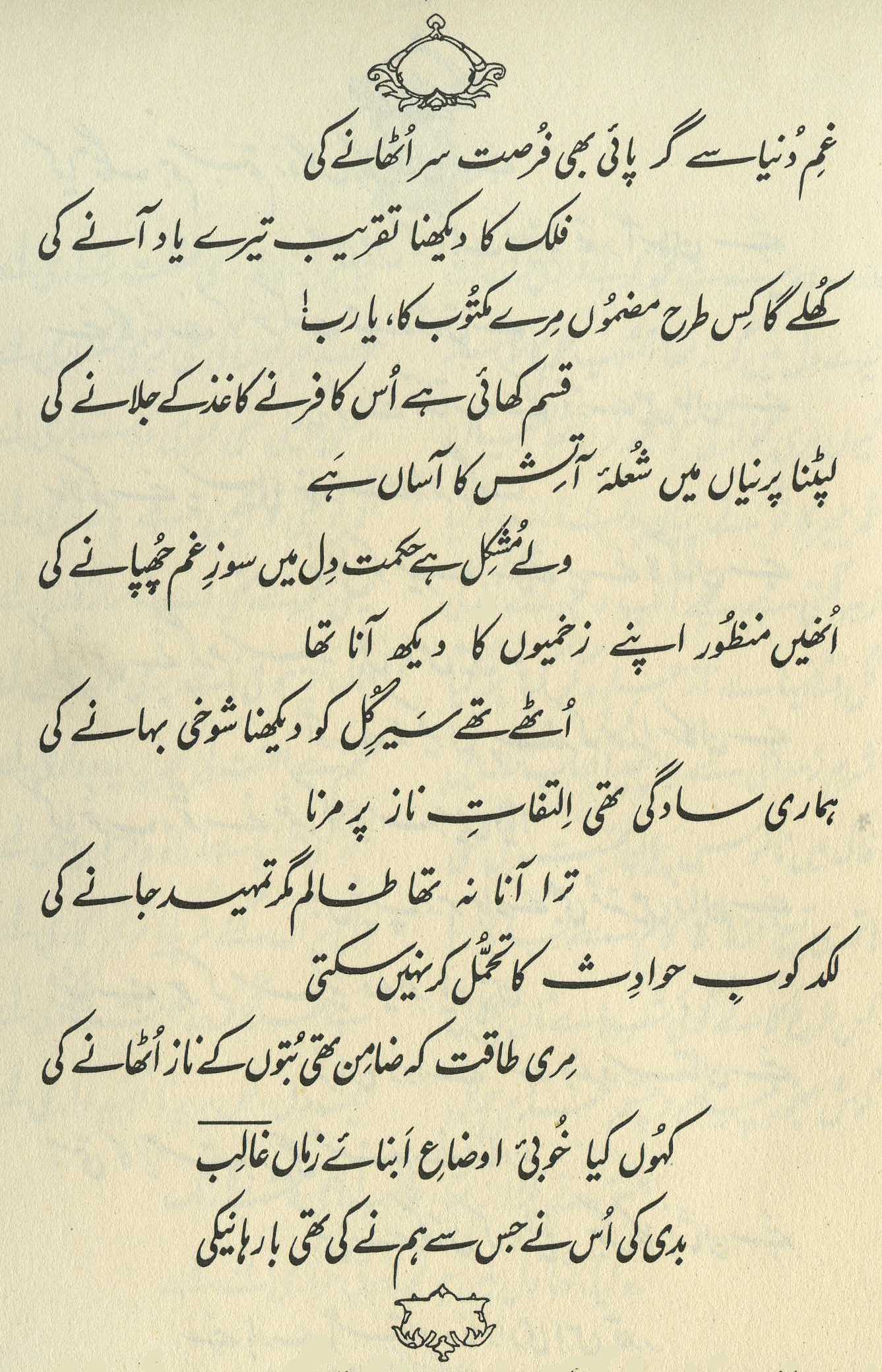
That is, when I get leisure to lift my head from the grief of the world, then the moment I lift my head my gaze falls on the sky. And since it practices oppression, the moment I see it, you come to mind. Now another grief begins. In short, under no circumstances is there any relief from grief.
==Urdu text: Yadgar-e Ghalib , pp. 154-55
That is, when he lifted his head from the grief of the world, he looked at the sky-- and there's the of remembering you. In the second line, 'is' [] is omitted . And the reason for the is that you always used to practice such cruelty that we used to remain staring at the sky. Now when sometimes by chance we look at the sky, you come to mind. The conclusion is that when the time came to lift his head from the burden of grief, then looking at the sky, he remembered the beloved, and again he was confronted by grief. (145)
== Nazm page 145

Force has been created in the verse by . And the meaning has been so increased: when do we at all get leisure to lift our head from the grief of the world; and if we even [] do, and we lift our head, then no sooner does our gaze fall on the sky, than we remember you. Because it too [] is cruel like you, or because the sky does its work in obedience to your gestures. We remember you-- and our heart begins to writhe in torment. That is, we are so unfortunate that we are immersed in both the grief of passion, and the grief of the world. (267)
This is such a marvelous verse of word-exploration that I can hardly even manage to translate the word it explores. In the definition of given above, almost every nuance of every meaning is beautifully appropriate to the context. Here are some of the possibilities:
='I look at the sky, and that causes me to remember you' (neutral report of facts).
='I look at the sky involuntarily, and at once I helplessly remember you.'
='I look at the sky deliberately, because then I remember you.'
='I look at the sky, because it's the nearest available approximation of what you're like.'
='I look at the sky, and the sky recommends to me that I remember you.'
='I look at the sky, and that act becomes a ritual, a formal occasion, for remembering you.'
='I seem to look at the sky, but it's only a pretense; I'm really remembering you.'
The commentators generally agree that looking at the sky is an involuntary, accidental thing that the lover can't help doing, and that it just adds uselessly to his wretchedness. But it's also possible that he does it deliberately. After all, the lover is enmeshed in the grubby, commonplace, time-consuming cares of the world against his will; his real obsession is the memory of the beloved, and to replace the former with the latter for even a moment is surely a great gain. (For a meditation on the available kinds of 'grief', see 20,7 .)
The commentators also generally agree that remembering the beloved is painful. It's true that the in the first line strongly suggests this. But it could also be read as a mere measure of time: the lover is reporting with pride, 'Whenever I manage to get so much as a single free moment, even just the time to lift my head-- I instantly look up at the sky, and devote the time to remembering you'. (This reading applies the to the amount of leisure, rather than to the fact of obtaining leisure.)
It's also not clear in the verse why remembering the beloved is painful. Is it because the good old days, in which she used to be in the lover's life, were so good that their loss is a misery? Is it because the bad old days, in which she tormented him, were so brutal that they're branded on his brain forever? Is it a matter not of ordinary pain at all, but of some other, ungraspable, indescribable experience? If the verse is read as addressed to the divine Beloved, then this latter is surely the case; and in fact then the verse becomes one almost of (ruefully amused?) piety. The second line, in its deliberate, verb-free simplicity, gives us no help whatsoever in narrowing the extremely wide range of meanings.
Justin Ben Hain points out (July 2014) that could also mean something like 'the gaze of the sky' (literally, 'the sky's looking', the way can mean 'my going'). When the lover looks up at the sky, does it look back at him? Is it watching him all the time, like a big blue eye, even when he's not looking? And is it the sky's implacable gaze that triggers the of remembering the beloved? The ' connection ' with the first line isn't as rich on this reading, but it's an enjoyable extra fillip.
This seemingly simple little verse is like clear water in which the bottom is too deep to be seen. For another meditation on the sky, the beloved, and memory, see 27,8 .
graphics/sky.jpg