Verse 61821aanekii
G2
1
it cannot bear/endure the kicks and blows of events/disasters
2
my strength, that was responsible for enduring the coquetry of idols
'Kicking, cuffing'.
'Accidents, occurrences; misfortunes, calamities'.
'Enduring patiently; patience, endurance; long-suffering, resignation, forbearance'.
'One who is responsible or accountable (for), a surety, guarantee; security, sponsor, bail, bondsman'.
| References | |
|---|---|
| Arshi, Imtiyaz Ali | Ghazal# 132 |
| Raza, Kalidas Gupta | 341 |
| Nuskhah-e-Hamidiyah | 181-182 |
| Hamid Ali Khan | Open Image |
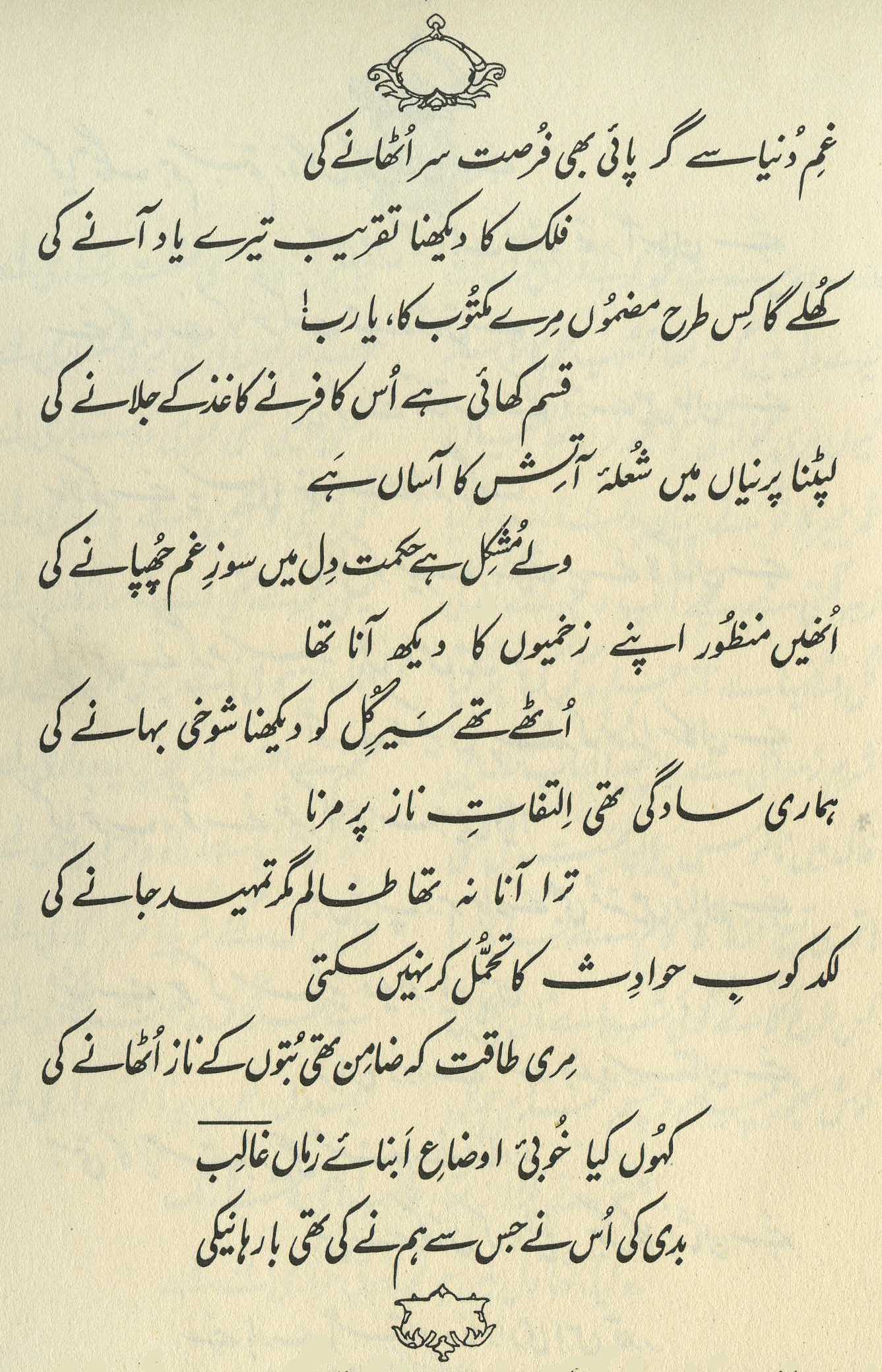
The meaning is that now there's such weakness that the burden of events can't be sustained-- and we are the same who used to endure the coquetry of idols! From this the meaning emerges that the coquetry of idols is, in the belief of the poet, greater than events and disasters. (146)
== Nazm page 146

He says, now we've become so weak that we are borne down even under the burden of events-- we who used to have the strength to endure the coquetry of idols. (202)
There was a time when we used to habitually endure the coquetry of idols; and now this time, when we don't even have enough strength left for the disasters and difficulties of the world! What a radical revolution has taken place! It's truly astonishing-- 'where is that strength, where is this weakness!' (268)
Why can the speaker's strength, which capably undertook to endure the coquetry of idols, now not patiently bear the kicks and blows of events/disasters? Here are some possible reasons:
=Because the coquetry of the idols took so much out of him that now he has no endurance or patience left for any further torments.
=Because the idols who tormented him with their coquetry were so lofty and powerful, that he can't stand to be persecuted now by lesser, commonplace, or even random, events.
=Because the idols tormented him delightfully through 'coquetry', while events torment him vulgarly through 'kicks and blows'.
=There's no 'because' at all; it's just an observation, framed for maximum contrast ('What a comedown-- I who used to be able to lift heavy suitcases, now can't even lift a matchbox!').
Bekhud Mohani invokes the classic idiomatic structure 'where [is] X, where Y?', as in the famous proverb . The point is that the two things named are so utterly incommensurable that they really can't even be mentioned in the same breath. That hyperbolic contrast is indeed what's at the heart of the verse. But Ghalib has cleverly offered us several hints about possible causes of this incommensurability, and (of course) has left us no way to choose among them.
In addition, the very punchy-sounding has a claim to ' fresh word ' status; this is its only occurrence in the divan .
The word is also excellent here, because it has the primary sense (see the definition above) of putting up with something ('I can't bear such scorn'), rather than of showing physical strength ('I can't bear such a heavy load'). It suggests a touchy impatience, rather than a helpless weakness. Another charm of the verse is the word , which can refer either to neutral, random happenings, or to disasters and calamities (see the definition above). The lover isn't even concerned with the difference; after his experience of the coquetry of the idols, the rest of it is all one to him-- and it's unbearable.
graphics/idol.jpg