Verse 71821aanekii
G2
1
what can I say!-- the excellence of the ways/habits of the sons of the age, Ghalib!
2
that one treated us badly, whom we'd many times treated well
'(pl. of ; — used in comp. only), s.m. Sons; people; tribes'.
'Situation, position; disposition; nature, tenour; description, character, complexion; —condition, state; —appearance, form, guise; —gesture, action; —conduct, behaviour; —mode of living or acting; mode, manner, fashion; —operation, performance, procedure'.
| References | |
|---|---|
| Arshi, Imtiyaz Ali | Ghazal# 132 |
| Raza, Kalidas Gupta | 341 |
| Nuskhah-e-Hamidiyah | 181-182 |
| Hamid Ali Khan | Open Image |
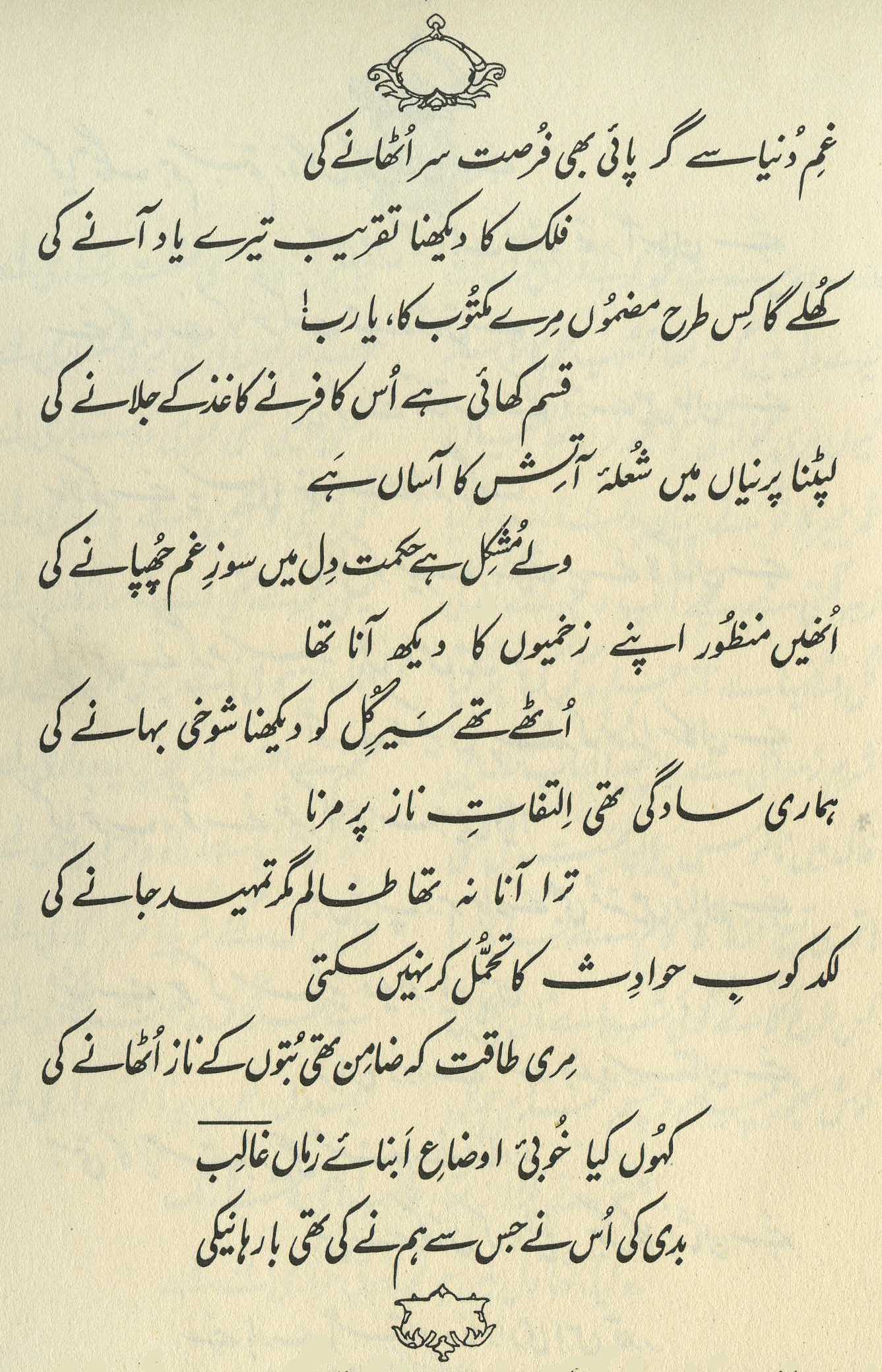
In all the previous verses of this ghazal, was part of the rhyme ; and in this verse, it's become part of the refrain . In the rules of rhyme they call this kind of rhyme ' contrived rhyme ', and they have counted it among the defects of rhyme. But artifice-loving [] poets consider it a verbal device . (146)
== Nazm page 146

This rhyme is called 'contrived rhyme'. If such a rhyme is used in one or two verses, then it is considered a beauty of poetry. He says, the sons of the age have come to have such ways that I can't even express their excellence-- the person whom I had many times treated well, treated me badly. In the first line, the word has been used sarcastically, and has the meaning of 'evil'. (202)
Don't ask about the excellence of the style of the worldly ones! A person treated us badly, whom we had not once but many times treated well. From this the author's astonishment is evident, as if he hadn't at all expected such treatment from anybody. (269)
What a contrast between the lines! The latter part of the first line is deliberately ornate, featuring two fancy Arabic plurals, from and from , and further adorned by no fewer than three constructions. It's a highly abstract general statement, making use as well of the inexpressibility trope ('what can I say'). For more on , see 15,11 . For more on , see 115,7 .
After such a setup (elaborate verbiage plus a claim to have no words), the second line cuts like a knife. What really hurts is not a vast, ponderous generalization about Modern Man. What really hurts is the way that one particular person has treated the speaker. After having received so much good, he or she gave evil in return! The vocabulary, the grammar, the structure-- everything is direct, stark, full of simplicity and pain. Perhaps Ghalib is indeed thinking of some one particular hurtful person or episode in his own life; but following the customary protocol of the ghazal world, he's made sure we will never know.
graphics/treatment.jpg