Verse 31816ezhai
G1
1
having seen the cheek/appearance of the rose, the face/aspect of the beloved came to mind, Asad
2
the ebullition of the season of spring is {desire/longing/ardor}-producing
'Appearing, showing or presenting itself, happening, befalling, occurring; intervening, preventing, barring; --an occurrence, accident, casualty; an obstacle, impediment, bar; --the side of the face, the cheek; --reviewer of an army or of a body of soldiers, a muster-master; general of an army'.
'Face, countenance; appearance, aspect; surface (of the earth, &c.); sake; cause, reason; colour, pretence'.
'Desire, strong inclination, longing, craving, yearning; love, fondness'.
| References | |
|---|---|
| Arshi, Imtiyaz Ali | Ghazal# 163 |
| Raza, Kalidas Gupta | 251 |
| Nuskhah-e-Hamidiyah | 246 |
| Asi, Abdul Bari | 240-241 |
| Gyan Chand | 374-375 |
| Hamid Ali Khan | Open Image |
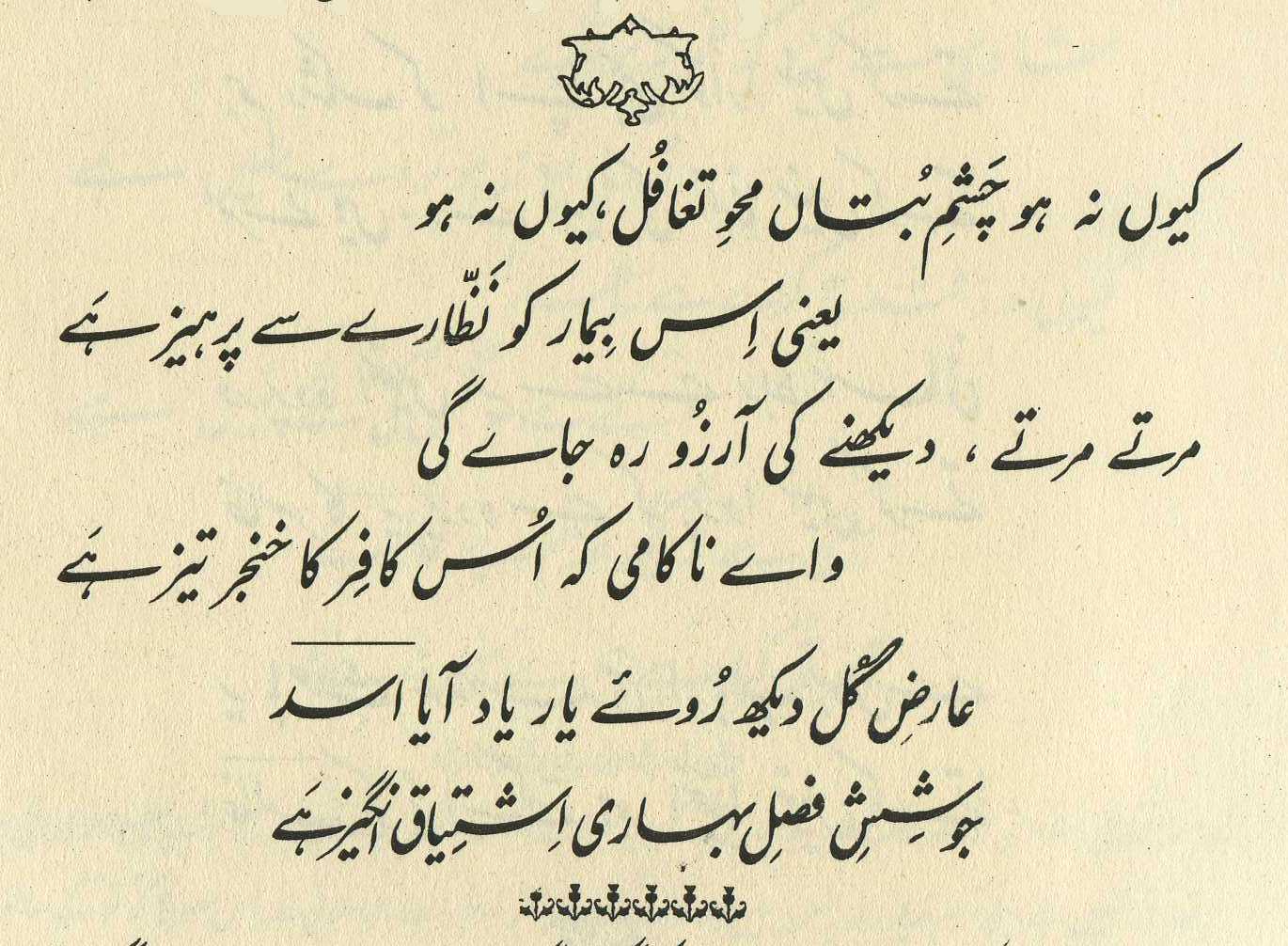
To see on an occasion for is proper in poetry, but the poet's weakness can be perceived. (224)
== Nazm page 224

He says, having seen the blooming flowers, oh Asad, we recall our friend's rose-colored cheek. The spring season is a producer of the turmoil of ebullition. (282)
Having seen the cheek of the rose, the beloved's colorful face came to mind. The turmoil of the spring season is ardor-producing.
If by the cheek of the rose we take the presence of springtime in the world to be intended, then the meaning will be that the colorful glory/manifestation of creation inclines us toward the glory/manifestation of the True Beloved.
[In reply to Nazm:] To use on an occasion for is now not proper, it is rejected [matruuk]. In Mirza's time and were considered equally correct. The poetry of his contemporaries testifies to that. There are so many examples of it that it seems to be the normal custom. Thus to call it 'the poet's weakness' is a proof of unawareness. (393)
The verse seems to pivot around the multiple meanings of (see the definition above). Perhaps when the lover saw the 'cheek/face' of the rose, the radiant face of the beloved came to mind. Or perhaps when he saw the rose 'appear' and show itself, then the beloved's appearance/aspect came to mind. Or perhaps he even saw the rose as a 'general' reviewing the troops of springtime, so that the imperious and imperial aspect of the beloved came to mind (compare 27,8 ).
Needless to say in this kind of verse, the second line with its multi-purpose (physical and metaphorical) words and , and its noncommittal grammar (which doesn't connect itself in any one specific way to lover, beloved, or rose), is broad and versatile enough to allow for all these readings, with room to spare.
There are also some nice energetic sound effects: in the first line, echoed by in the second line.
graphics/rosepetals.jpg