Verse 21816ezhai
G1
1
while dying, the longing to see will remain
2
alas, failure! --for that infidel's dagger is sharp!
| References | |
|---|---|
| Arshi, Imtiyaz Ali | Ghazal# 163 |
| Raza, Kalidas Gupta | 251 |
| Nuskhah-e-Hamidiyah | 246 |
| Asi, Abdul Bari | 240-241 |
| Gyan Chand | 374-375 |
| Hamid Ali Khan | Open Image |
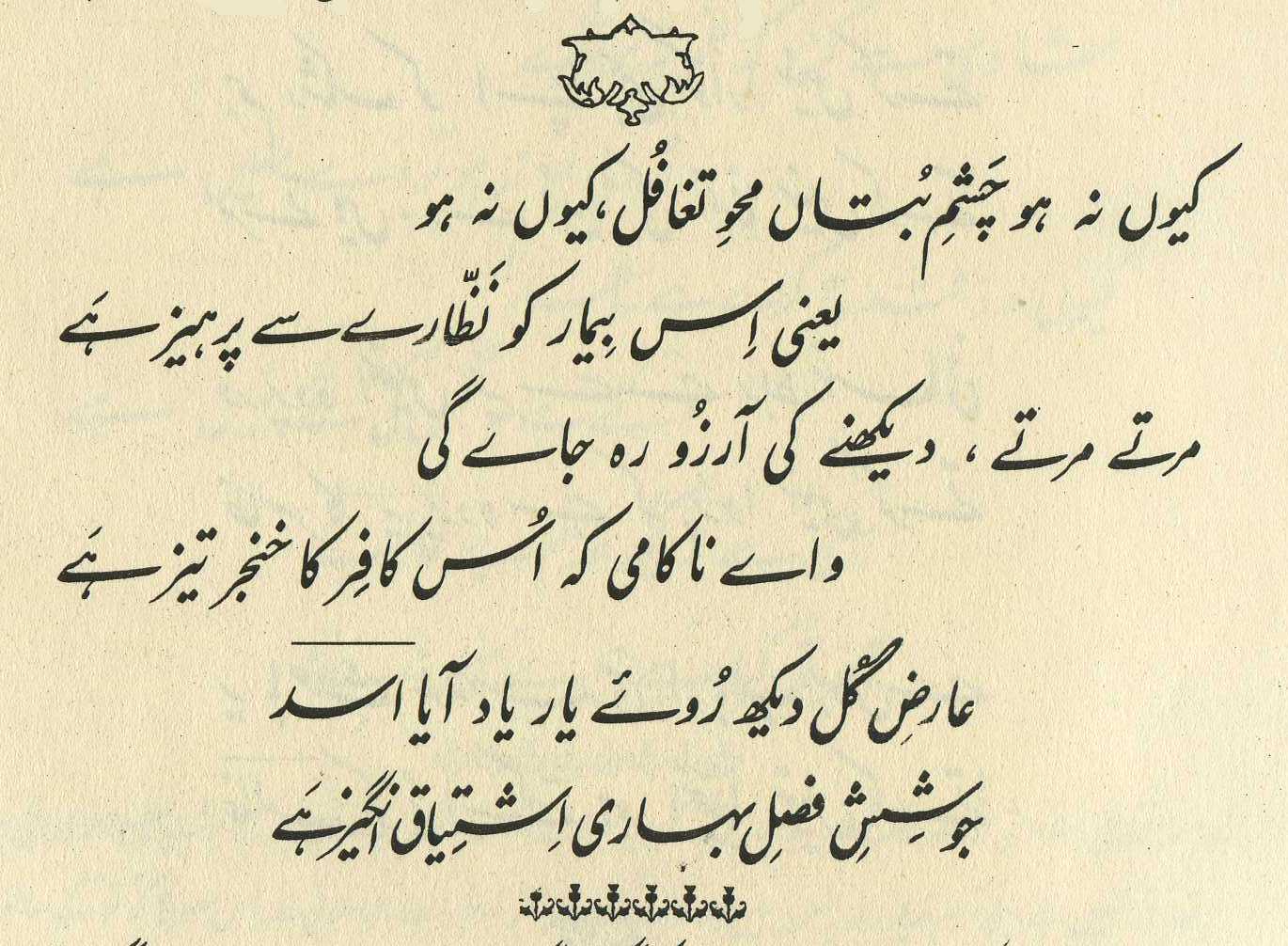
If only there were a dull knife for my murder-- so that however long it took to cut my throat, that's how long I would look at her. This is a much-used theme . (224)
== Nazm page 224

He says, 'Even while my breath is leaving me, the desire for sight won't be able to be fulfilled. Alas, failure! If only that infidel's dagger had been dull. If only she cut my throat bit by bit, with difficulty, then my longing for sight would be completely and perfectly fulfilled.' (282)
[Discussing Nazm's objection:] Undoubtedly this theme is not new. If Mirza created any freshness in it, it was only in the repetition of , or in not using 'murderer' or 'tyrant' in place of 'infidel'. When the word 'infidel' would be for the beloved, then in it a special mood is created, the pleasure of which only the heart knows. (393)
[Compare his discussion of Mir's similar M 296,12 .]
Well, this is clearly another mushairah verse. The first line could be preparing for the verse to go in some very abstract or emotional directions about how passion continues after death, in the grave, and so on; or it could turn into another 'beloved visits the dying lover' verse like 52,1 . Not until after a suitable delay, under mushairah performance conditions, are we allowed to hear the second line-- and of course the line reveals its own sense, and makes the verse suddenly interpretable, only with a 'sharp' thrust at the last possible moment.
The verse is also right on the edge of being what I call a verse of 'grotesquerie'. Can we really imagine the usual execution scene-- except with the lover's head being slowly sawed off with a blunt knife, while his blissful eyes remain fixed on the beloved's irritated face as she struggles with her inefficient dagger in a welter of blood? This is so improbable and repugnant that it's poetically counterproductive. Maybe we should imagine that she would stab him in the heart, repeatedly, effortfully, annoyed at her dull dagger, while he would smile beatifically at her even as he slowly collapsed, bleeding gracefully all over his shirt. Is that repugnant? Less so, no doubt. But the whole process of having to translate the verse into physical action like this is distracting at best, and off-putting at worst. And if we don't translate the imagery into physical action, where's the vitality, the specificity, of the verse?
Compare this verse to 20,4 , in which the beloved is imagined as a careless, amateurish archer-- the kind of beloved who would no doubt also use a dull knife.
graphics/dagger.jpg