Verse 13x[1816 and] 1821aarhai
G3
2
the yawn/gape is the glass for the wine of sorrow of intoxication/hangover
'Quality, nature, character; mode, state, condition, circumstances; account, statement, remarks, report, particulars; relation, story, news; — exquisite state, flourishing state, enjoyableness, deliciousness, exquisite enjoyment; a sight to be seen, a beautiful view, &c.'.
'Assault, attack; effort; impetuosity; — crowd, throng, concourse, mob; a swarm'.
'Arriving, attaining; causing to arrive (used as last member of compounds); quick of apprehension, acute, sharp, penetrating, skilful, capable, clever; — mixing or mingling (with); amiable; well-received, welcome'.
'Arriving, attaining; quick of apprehension, skilful, capable, clever; much, many'. (Steingass p.574)
'Intoxication; the effects of intoxication, pain and headache, &c. occasioned by drinking, crapulence, crop-sickness; headache or sickness (arising from want of sleep, &c.); languor; languishing appearance of the eyes (the effect of drinking, or of drowsiness, or of love, &c.); languishing look'.
'Stretching; yawning, gaping'.
| References | |
|---|---|
| Arshi, Imtiyaz Ali | Ghazal# 176 |
| Raza, Kalidas Gupta | 262-263,344-345 |
| Nuskhah-e-Hamidiyah | 266-269 |
| Asi, Abdul Bari | 267-268,269 |
| Gyan Chand | 391-392,392-394 |
| Hamid Ali Khan | Open Image |
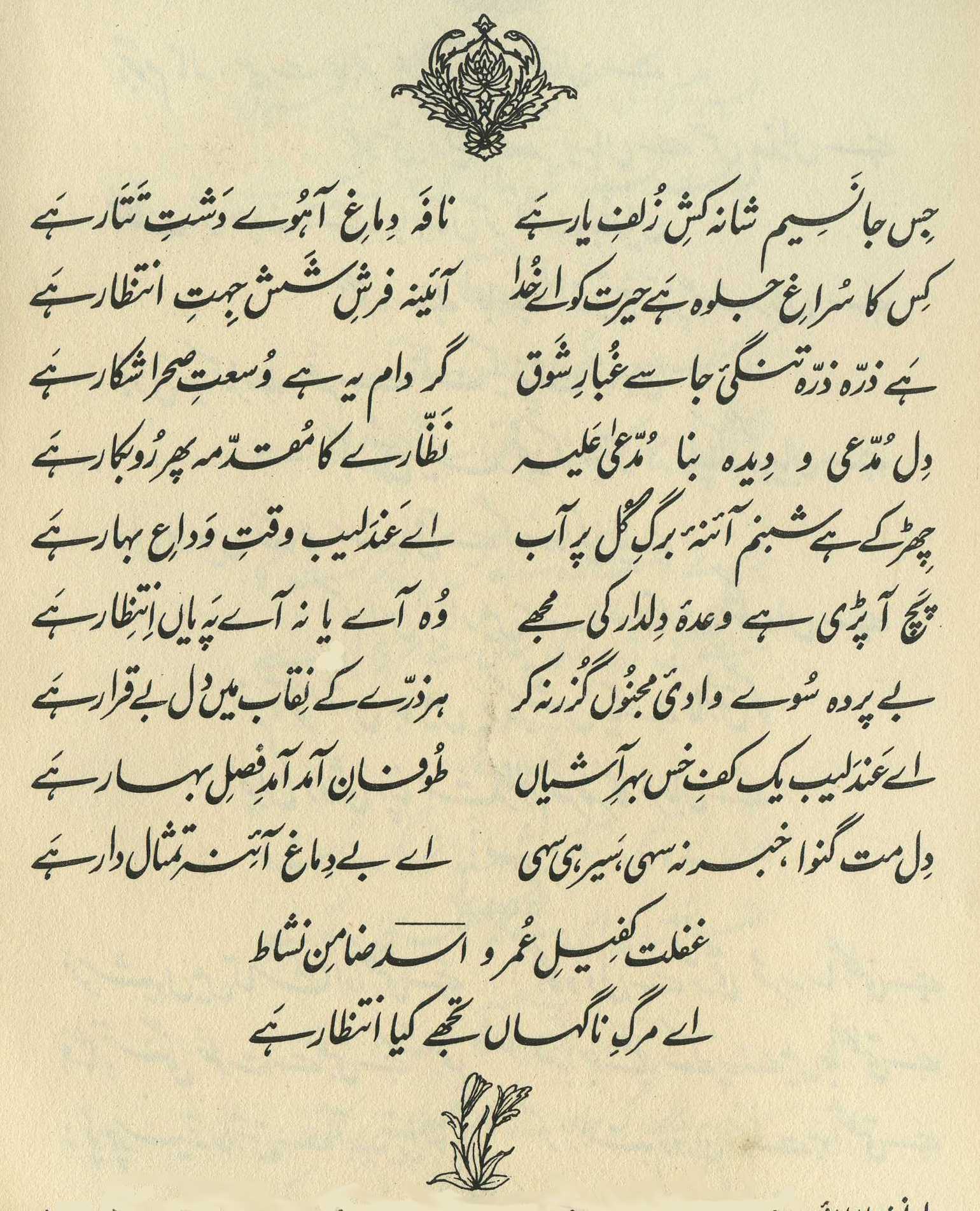
Oh Asad, what do you think of this mood?! It is extremely pervasive. Don't consider a yawn to be a yawn-- rather, it is a single glass filled with the wine of the sorrow and trouble of intoxication/hangover. This mood of the onrush of longing is extremely pervasive.
== Asi, p. 268
For 'yawn' he has given the simile of a glass, with regard to likeness of shape. Then he has called it a glass of the wine of the sorrow of intoxication/hangover-- that is, a kind of wine in which there would be the trouble of intoxication/hangover; and only/emphatically in the state of intoxication/hangover, a person yawns.
Then he has given to that yawn the simile of an abundance of longing; and he has called that mood 'pervasive', so that the simile with the yawn would be justified, since in it too is spreading/extension. That is, the onrush of the intoxication of longing is as extensive/outspread as the yawn of the sorrow of intoxication/hangover. The point is that the result of longing too is that same disaffection [] that occurs in the subsiding of intoxication.
== Zamin, p. 393
Oh Asad, in the onrush of longing there is the mood of pervasiveness. That is, when we felt quite a number of desires, then it seems that we had arrived at the sought-for destination. When we are yawning, that is not only/emphatically a sign of the lack of wine, but rather has the similitude of a glass, which is filled with the wine of the sorrow of intoxication/hangover. Granted that this intoxication/hangover is created by the wine of trouble-- but still, it's wine of a kind. Then how would we say that we are deprived of wine? In this way to desire wine has become to have continuous access to wine.
== Gyan Chand, p. 392
For background see S. R. Faruqi's choices . For more on Ghalib's unpublished verses, see the discussion in 4,8x .
For discussion and more examples of and , see 12,2 .
It's an 'A,B' verse, so we have to decide for ourselves how the two lines might be connected (cause? effect? parallel? contrast? etc.). But the imagery is at least somewhat clear, and the commentators spell it out. The 'yawn' or 'gape' that in the ghazal world signifies a readiness for more wine, is round like a glass, and thus is a suitable vessel for the 'wine' of the sorrow of 'intoxication/hangover'.
Here is a case in which the undecidably wide range of suffices in itself to make the 'mood' of the verse ambiguous. Is the mood of intense, pervasive longing something like intoxication, as Gyan Chand believes? Or is it more like the 'disaffected' quality of a hangover, as Zamin maintains?
There's also the unresolvable -based versatility of . Is it the '(wine of sorrow) of intoxication/hangover', or is it the 'wine of (sorrow of intoxication/hangover)'? The former sounds more like a kind of sorrow, and the latter more like a kind of wine.
Such shifting, hazy possibilities help make this notably a verse of mood -- not just because it contains the term, but because it enacts the effect.
graphics/wineglass.jpg