Verse 10[1816 and] 1821aarhai
G3
1
heedlessness/negligence, a security/pledge of a lifetime; and Asad , a guarantor/security of joy/flourishingness
2 a
oh sudden/unexpected Death, for what/whom do you wait?
2 b
oh sudden/unexpected Death, in what a way you wait!
2 c
oh sudden/unexpected Death, it's not as if you need to wait!
'A surety, security, bail, ransomer, hostage'.
'One who is responsible or accountable (for), a surety, guarantee; security, sponsor, bail, bondsman'.
t>> : 'Liveliness, sprightliness, cheerfulness, gladness, glee, joy, pleasure, exultation, triumph'.
t>> : 'Growing; being produced; springing up, appearing; —anything growing, or produced; —a product; a creation; —a creature'.
'Sudden, unexpected'.
| References | |
|---|---|
| Arshi, Imtiyaz Ali | Ghazal# 176 |
| Raza, Kalidas Gupta | 262-263,344-345 |
| Nuskhah-e-Hamidiyah | 266-269 |
| Asi, Abdul Bari | 267-268,269 |
| Gyan Chand | 391-392,392-394 |
| Hamid Ali Khan | Open Image |
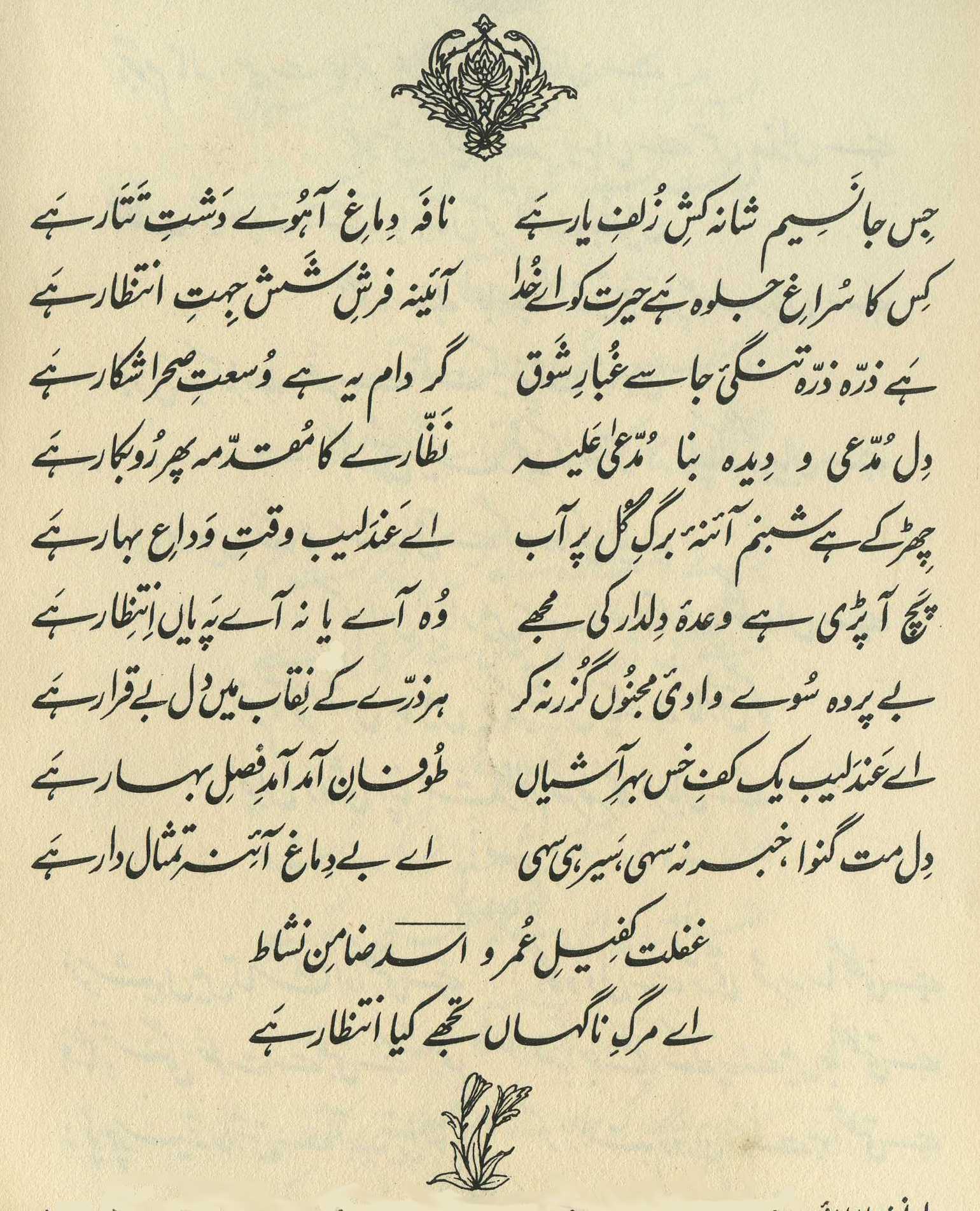
[See his reference to the second line of this verse in a letter cited in 150,1 .]
[1863, to Ala'i:] [After a description of his physical weakness:] I softly recite, time after time, this line of mine: [the second line of {228,10}]. Death, now where is your 'unexpectedness' []? (Arshi 281) ==Urdu text: Khaliq Anjum vol. 1, p. 406
[1863, to Ala'i:] [After a description of his physical weakness:] I softly recite, time after time, this line of mine: [the second line of {228,10}]. Death, now where is your 'unexpectedness' []? (Arshi 281) ==Urdu text: Khaliq Anjum vol. 1, p. 406
Asad has taken on the guarantorship of joy; that is, he considers that he will always spend his time in joy alone. And Heedlessness has undertaken the responsibility of his life; that is, no thought of the outcome ever comes at all. So why does unexpected death not come? It's as if the author has the belief that he who spends his lifetime in heedlessness and ignorance, and forgets about death-- he is the one to whom 'unexpected death' comes. On this basis he says to death, 'Come on, you wretch, what are you waiting for? That is, all the equipment/reasons for your coming are present, so what is the reason for your absence?' Here too in a Hindi sentence is a Persian conjunction-- look at how unattractive the Persian appears here! (257-58)
== Nazm page 257 ; Nazm page 258


He says, Heedlessness has girded up its loins as a pledge for the lifetime of Asad. And Asad has pledged himself to perpetual joy. That is, he has considered that life will always pass in luxury and ease. In this situation, not even a thought of the outcome manages to come in. Oh unexpected death, why don't you come? What are you waiting for? In my opinion, whoever would spend his life in heedlessness, and would forget his death, and not allow any anticipation of the outcome to come near him-- to him, unexpected death ought to come. (314)
His heedlessness takes a look at his absorbedness in luxury and enjoyment, and says, oh wretch, death is better than such a life. Such a heedless one deserves to have an unexpected death come, and not even give him the chance to repent. Exactly such people deserve unexpected death, because whenever death comes, because of their heedlessness it will seem to them to be nothing but an unexpected death. (470)
If 'heedlessness' is a 'security' or 'pledge' of someone's lifetime, this might mean one of several things:
=He undertakes to cultivate ignorance and heedlessness, as a condition of maintaining his life, the way people consent to ignore certain kinds of smaller evils because of larger issues at stake.
=He undertakes to hand over 'heedlessness' as a 'pledge', the way people pawn a valuable item in a pawnshop, so as to maintain his life.
=If he has a temperament inclined to heedlessness, that is a sort of guarantee or assurance that he'll be able to stay alive.
=If he has nothing better than 'heedlessness' to pledge or pawn in order to maintain his life, he's doomed to an imminent and sudden death.
Of course, we have no idea to which person or persons any of these situations may apply. And when we learn that Asad himself may be taken as a of joy, we don't know whether to treat the word as a synonym of (see the definitions above), or as a contrast to it, with a meaning more like 'bail-bondsman' or 'guarantor'. Nazm is probably right when he takes this to mean that Asad devotes himself entirely to joy; for a similar usage, see 12,1 . But it's also possible that he's the 'one who is responsible for' the very 'pledge' referred to in the first clause: he might be the bail-bondsman, and 'heedlessness' might be the bail. Then would the 'joy' be his own, or that of some other person(s) for whom he was providing a ransom or bail, or the abstraction of Joy itself? The makes it ultimately impossible to pin down.
We have no chance of resolving any of these questions for another reason as well: there's no verb in the first line, and of course no indication of the relation between the two clauses. Technically, the first line is a 'list' one ('A B and C D'); for more on such lists, see 4,4 . Are the two clauses parallel? Are they contrasted? Does one of them somehow follow from the other? And if so, which way does the causality go? It's also possible that 'Asad' is just a thoughtful, meditative self-address, so that the line could be also read as 'A is B and, Asad, it is C as well'. There's no way for us to choose among these complexities without help from the second line.
Unsurprisingly (this being Ghalib), the second line goes out of its way to further complicate the issues. It starts quite afresh in its grammar and vocabulary, so that the nature of its connection with the first line is left for us to decide. And through its clever use of the multivalence of , it adds several unusually piquant possible readings of its own. By now it's no surprise that all these readings work so richly, and so variously, with the possible permutations of the first line.
graphics/death.jpg