Verse 11835aarakhte the
G5
In this meter the first long syllable may be replaced by a short; and the next-to-last long syllable may be replaced by two shorts.
1
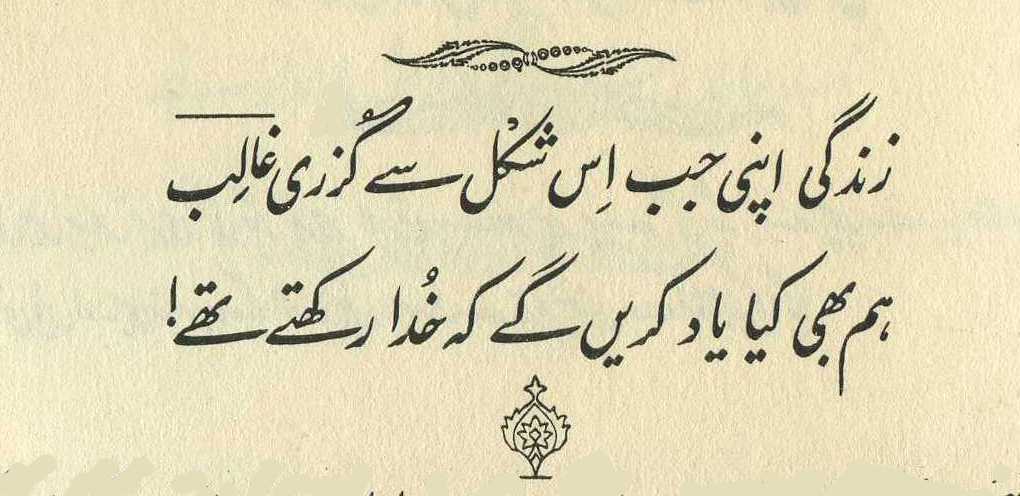
when our life passed wretchedly/'in this shape', Ghalib
2 a
will even/also we remember that we used to have a Lord ?
2 b
how even/also we will remember that we used to have a Lord !
2 c
as if even/also we will remember that we used to have a Lord !
| References | |
|---|---|
| Arshi, Imtiyaz Ali | Ghazal# 207 |
| Raza, Kalidas Gupta | 386 |
| Hamid Ali Khan | Open Image |
[1858, to Taftah:] Listen, Sahib! That person who feels an ardor for some pursuit, and without further ado he would pass his life in it-- the name of this is 'enjoyment/luxury' []. Your turning your attention toward poetry, is a proof of your refinement of spirit and elegance of temperament. And brother! The fame of this poetry-spreading of yours enhances my reputation too. In this art my condition now is that the path of poetry-composition, and my previously composed verses-- I've forgotten all of it. But indeed, one and a half verses of my Hindi poetry-- that is, one closing-verse and one line-- are still in my memory. Sometimes when my heart begins to sink completely, then five or ten times this closing-verse comes to my lips: {150,1}. Then when I feel very anxious and upset, I recite this line and fall silent: [the second line of 228,10 ].
Let no one think that I'm dying of grief over my own dismal and ruined state. The sorrow that I feel, I can't at all express; but I can give a hint of it. From among those of the English community [] who were murdered by the hands of those disgraced ['black-faced'] black ones, one was my patron [], and one was my kind advisor, and one my friend, and one my confidant, and one my pupil . Among the Hindustan is, some dear ones, some friends, some pupils, some beloveds. Thus every one of them was mingled with the dust. How harsh is the grief for one dear one! The one who would be a mourner for so many dear ones-- how could his life not be difficult? Alas! So many friends died, that now when I die there won't even be anyone to mourn for me.
[As the Qur'an says,] 'Verily we are for God, and verily to Him we shall return.' (Arshi p. 309)
==Urdu text: * Khaliq Anjum, vol. 1, pp. 280-81 *
==another trans.: Russell and Islam , pp. 152-53
is an idiom of which the meaning is, in a bad state. (161)
== Nazm page 161

Oh Ghalib, when our life passed in such bad circumstances, how will we say that we used to have a Lord? (216)
Then in the second line, Mirza has done a deadly feat.... That is, our situation is such that we can't even think that we are servants of the Lord. If He had created us, and were our Lord, then we wouldn't be ensnared in these difficulties. That is, not to speak of the Lord-- no master can wish such indignity on his slave. This is not a verse, but a masterpiece of poetry. (290)
Ghalib chose to include in the divan only this closing-verse . But if we rejoin this verse to 150,2x and 150,3x , the companions that originally preceded it, it takes on an intriguingly literary cast.
The speaker's life has passed 'in this shape'-- that is, no doubt, 'wretchedly', in an idiom that Nazm confirms. But still, there are many kinds of wretchedness: perhaps every miserable life is miserable in its own way. The clever use of 'in this shape' invites (or requires) the reader to speculate and imagine-- was it simply a matter of more misery, or unadulterated misery, or some special kind of misery?
The second line makes masterful use of the triple possibilities of . All three of the readings resonate wonderfully with the first line. Since the speaker's life has passed 'in this shape'-- then what?
=Perhaps he asks a genuine yes-or-no question (2a): Will he, or won't he, remember that he used to have a Lord? A plausible case could be made either way; he is mulling it over.
=Or perhaps he exclaims (2b): how yearningly he'll remember that he used to have a Lord, and how in those days he was much better cared for! Or else he'll remember it urgently, even if futilely, because he's desperate and wants to renew his connection ('there are no atheists in foxholes').
=Or perhaps he exclaims just the opposite (2c): he won't by any means remember that he used to have a Lord-- one who has abandoned him so long and so thoroughly that the Lord's very name is hard to recall. Perhaps, of course, he's abandoned the Lord too, so that the connection of loyalty and memory may have been broken on both sides.
And then the , with its alternatives of 'even' he (although one wouldn't expect it from him) versus he 'too' (since he'd do what everybody else does under those circumstances), creates additional possibilities; or else-- perhaps best of all-- it can be read as a colloquially punchy intensifier.
The question of time also looms large. The speaker seems to be looking back on his whole life, and describing all of it as wretched. So when was the time when he 'used to have' a Lord? Before birth (in some garden of Paradise)? In infancy? Or did he keep on desperately praying, even when he received no response? (The in the first line, rather than , makes it improbable that the perfect form of the verb is really working as a subjunctive, as it is in 111,7 and elsewhere.) And when will he do the future behavior described by , if not in some mystical afterlife?
The question only deepens when the reader reflects that the verb is actually , literally 'to keep' or 'to maintain' a Lord. It almost puts the Lord into the category of household possessions (one 'keeps' a car, after all). Think of the skeptical force of 93,2x , or 174,10 .
graphics/despair.jpg