Verse 9after 1816aariihai
G8
In this meter the first long syllable may be replaced by a short; and the next-to-last long syllable may be replaced by two shorts.
1
again the door of the courthouse of coquetry {is open / has opened}
2
there's a 'hot market' in the criminal-court
'Equity, justice, law; —a court of law or justice, assize, tribunal'.
'Activity or briskness in a market, brisk (or great) demand, good sale; high value or estimation (of anything)'.
'Of or relating to crime, (a court) for criminal cases'.
| References | |
|---|---|
| Arshi, Imtiyaz Ali | Ghazal# 188 |
| Raza, Kalidas Gupta | 300-01 |
| Nuskhah-e-Hamidiyah | 252-253 |
| Hamid Ali Khan | Open Image |
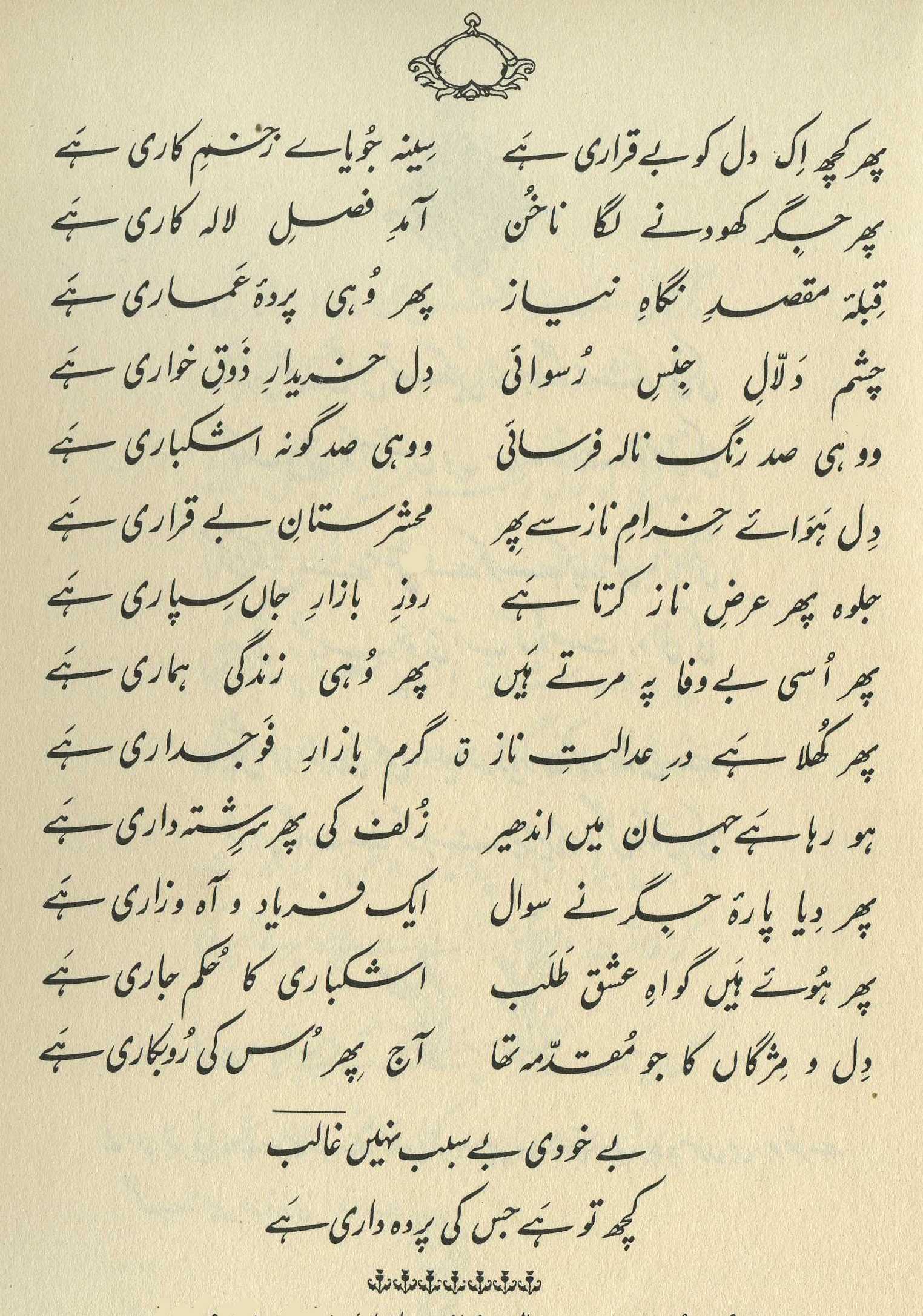
In this verse, is an extremely uninspired/'cold' [] word. (178)
[Commenting on verses 9-13:] In this verse-set , and and and and and -- all these terms are, to this day, rejected by the eloquent. The reason for the aversion is that these are not terms made by expert knowers of the language []. Although by necessity everyone is forced to say them, as yet they are not properly established, and the Urdu language has not accepted them. And even if you consider them to have entry into the language, then in those special meanings they are all Indian words []-- it will not be correct to bring them into a Persian construction [like the ].... The objection has always been raised against this verse of Atish 's
[someone's delicate/'running-water' bodice came to mind
when a bubble came next to another bubble]
-- that is, although the word 'bodice' [] is not Indian [], with the meaning of 'bodice' [] it is Indian, so why did he use it with a Persian ? [Further discussion and more examples along similar lines.] (178-79)
== Nazm page 178 ; Nazm page 179


He says, the recess [] is over. Again the lock on the door of the court of coquetry has been opened. Nowadays the bazaar of the criminal court has again heated up. The meaning is that as soon as rose-season comes, the turmoil of passion and madness begin to arise in people's hearts. (238)
[Rejecting Nazm's criticism:] Khvajah Atish , peace be upon him, says:
[the whole court is a witness to true love
my whole affadavit is enveloped in seals]
'Analysis' is beating its head against a wall, but the learned Commentator, with his 'judicial authority' [], is unwilling to listen to anybody.... Bestowing the honor of acceptance upon these words, Mirza has brought them into the language. [These terms] have assumed the aspect of learning []. [He provides another illustration, in which Atish uses .] (319-21)
means a court; it is Hindustani Persian. In Arabic and Persian it means 'justice'. In the time of the English there were three kinds: ....
She has again begun to use coquetry. With the sword of coquetry she will take the lives of thousands. And all those thousands will present their cases and have them registered in the court of coquetry. (376)
In these five verses [the court-related words] are words of one single . In poetry, a is not not considered a good thing. And here the words too of the are such as are not part of the language of the ghazal. (285)
All five of these verses are a verse-set. In these verses Ghalib has assembled court-related terms.... It's true that from these words, the verbal device of wordplay [] is conspicuous in this verse-set. But these words have no affinity with the language of the ghazal. (692)
Well, here in {164,9-13} we have a verse-set that really is a verse-set! Arshi presents it as one, and also it feels like one in every way. Nazm treats it as one, and so do almost all the other commentators as well. Moreover, every single verse in it contains , which means that enough of a context develops so that in the case of this verse-set can basically be read as 'again', without much need to invoke its alternative meaning of 'then'.
To my surprise, Nazm's objection to its 'un-ghazal-like' language is echoed by several more commentators, although less passionately and at less length. I join Bekhud Mohani in telling them they should lighten up. Not only are there plenty of counterexamples to their narrow, restrictive claims about classical ghazal language, but also, who are they to say what kind of terms the ghazal can and can't assimilate? Who's to tell Ghalib (or Shakespeare, that powerful coiner of dozens of neologisms) what words he can or can't use? In a two-line verse, after all, 'a fresh word is equal to a theme '. And Nazm himself knows this perfectly well: he has cited this very quotation in his discussion of 17,2 . His literary instincts seem to be pulled in several directions at once; his commentary on different verses expresses attitudes that are sometimes strikingly self-contradictory.
In the present verse, do both lines describe the same situation-- that the beloved is coquettishly holding 'court', and judging her lovers guilty of all kinds of offenses? Or do the lines refer to two different situations? After all, as Shadan observes, in Ghalib's day colonial courts came in three varieties, so that 'court' might be a general term, used for the coquettish, arbitrary, dictatorial salon of the beloved, while the rush at the 'criminal court' [] might refer to the cases of mad lovers doing crazy things and getting arrested in a whole different context (of actual criminal behavior).
Or, thanks to the versatility of the construction, the 'courthouse of coquetry' could even be the courthouse in which coquetry will be brought to trial, as Shadan proposes-- and since coquetry murders the lovers, this might well be an affair for the criminal court.
It's true, as Nazm sneers, that not much is done with the word . But then, this is the introductory verse of a verse-set, so it's entitled to be judged and enjoyed along with its companions. And (Nazm to the contrary) their technical, law-court language is indeed manipulated very cleverly and wittily.
Note for grammar fans: It's not possible in this context to distinguish , 'has opened' (present perfect), from , 'is in a state of having become open' (past participle with the colloquially omitted). But surely it doesn't make much difference here.
graphics/courtgavel.jpg