Verse 21849arko mai;N
G3
1
jealousy didn't allow that I would mention/'take the name of' your house
2 a
I ask each and every one, 'Which way would/should I go?'
2 b
I ask each and every one-- for which way would/should I go?
'To take the name (of); to call by name; to name, to mention; --to mention with praise, to praise; --to repeat the name (of a deity); to tell one's beads; --to name (one) in connection with (a crime, &c.), to accuse (of), to charge (with)'. (Plats p.1118)
| References | |
|---|---|
| Arshi, Imtiyaz Ali | Ghazal# 111 |
| Raza, Kalidas Gupta | 409-10 |
| Hamid Ali Khan | Open Image |
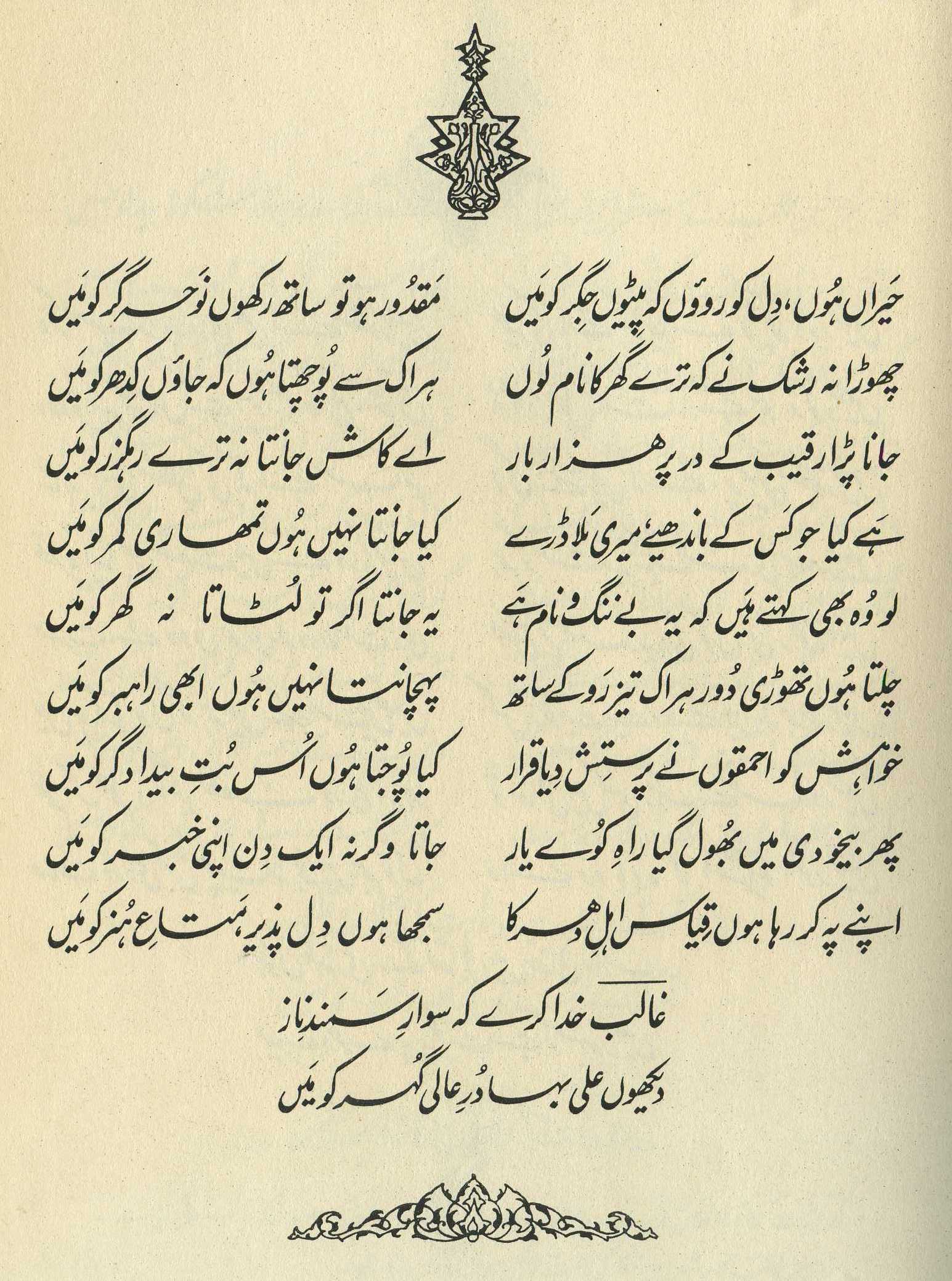
In a state of restlessness and great agitation, he says, . The meaning is that there's no such place where he would find peace and distraction from grief. In this verse the place-- that is, the street of the beloved-- is decided, but before the passersby [], he doesn't mention her name, because of jealousy. And because he can't find the address, he's begun to feel restlessness and agitation. Thus here has two meanings, and this is among the subtleties of the verse. (103)
== Nazm page 103

He says, jealously has made me incapable of asking some Other the address of your house, and from not obtaining the address my restlessness and agitation have increased so much that I can't stand not to inquire. Thus I keep asking every passerby where I might go. It's possible that I might find another seeker of you, someone like me, and he might be acquainted with your house, and might become my fellow-traveler. (154)
Jealousy doesn't at all permit me to ask the address of your house. To everybody I am saying, which way is the road? That is, because of jealousy I don't mention your name in front of anybody. People are such that they consider me a madman. He's shown a picture of an extraordinary situation. (200)
I know your address but don't know how to get there; at the same time I can't think of asking someone, for I would only feel envious if he happens to know the way to your house. As a matter of fact, I fear that I am the only who does not know how to get there; the world knows, and this only overwhelms me with envy.
== Naim 1972, p. 22
Jealousy doesn't permit the lover to mention-- not just her name, but even the 'name', or address, of her house! Or rather, it doesn't permit him to 'take the name' [] of the house. This 'take the name' is a phrase much more highly charged in Urdu than in English. (We have an echo in phrases like 'to take the name of the Lord in vain'.) To 'take the name' of someone is to invoke, to praise, to accuse, even to worship. The lover's passion is so intense (and bizarre) that in front of ordinary mortals he is unable to sacrilegiously 'take the name' not only of the beloved, but even of the beloved's house. For another example of such self-thwarting jealousy, see 152,7 . For more discussion of the complexities of , see 53,4 .
And yet since the beloved is so radically inaccessible, he doesn't know where her house is. In many traditional parts of South Asia, to this day, the normal way of finding addresses is to go into the general area and start asking people. This has the advantage and/or disadvantage of plugging you into the local gossip network-- 'who are you? who is that person to you []? why do you want to go there?' The local people become a mediating presence, a sort of supervisory system: if they choose to help, they can not only provide you with an exact address (or even an escort to the door), but can offer you other valuable information as well. If they don't choose to help, they can baffle and thwart you at every turn.
The lover thus continues to try to use this system, since it's the only one he has. But of course, he can't use it effectively. He stops every passerby on the street and asks, quite fruitlessly of course, 'Where should I go?' This is the obvious reading, (2a), in which acts as a quotation introducer.
But can also act as a general clause introducer, as in (2b). On this reading, 'in which direction would/should I go?' becomes a question the lover asks himself, or asks of the listener(s) as he reports on his plight. And once a question like 'in which direction should I go?' has been set up, it can always be read not only straightforwardly but also as a negative rhetorical question, implying that there's nowhere the speaker can go; this is what Nazm is describing when he speaks of the question having 'two meanings'.
The ultimate case in point for all identity questions is surely 46,7 , which frames the act of inquiry [] so cleverly that it elicits a bewildering variety of possible responses. The present verse doesn't want to go that far-- is a more limited question than , and the grammar is not as intricately interlinked. But the comparison suggests some of the kinds of depth Ghalib builds into these open-ended future-subjunctive questions.
In this verse, the lover can't find the beloved's house; in the next verse, 99,3 , he knows all too well how to find her.
From a panoramic Delhi view by Maz'har Ali Khan, 1846:
graphics/panorama5.jpg