Verse 31849arko mai;N
G3
1
I was compelled to go to the Rival 's door a thousand times
2
alas-- if only I didn't know your road!
| References | |
|---|---|
| Arshi, Imtiyaz Ali | Ghazal# 111 |
| Raza, Kalidas Gupta | 409-10 |
| Hamid Ali Khan | Open Image |
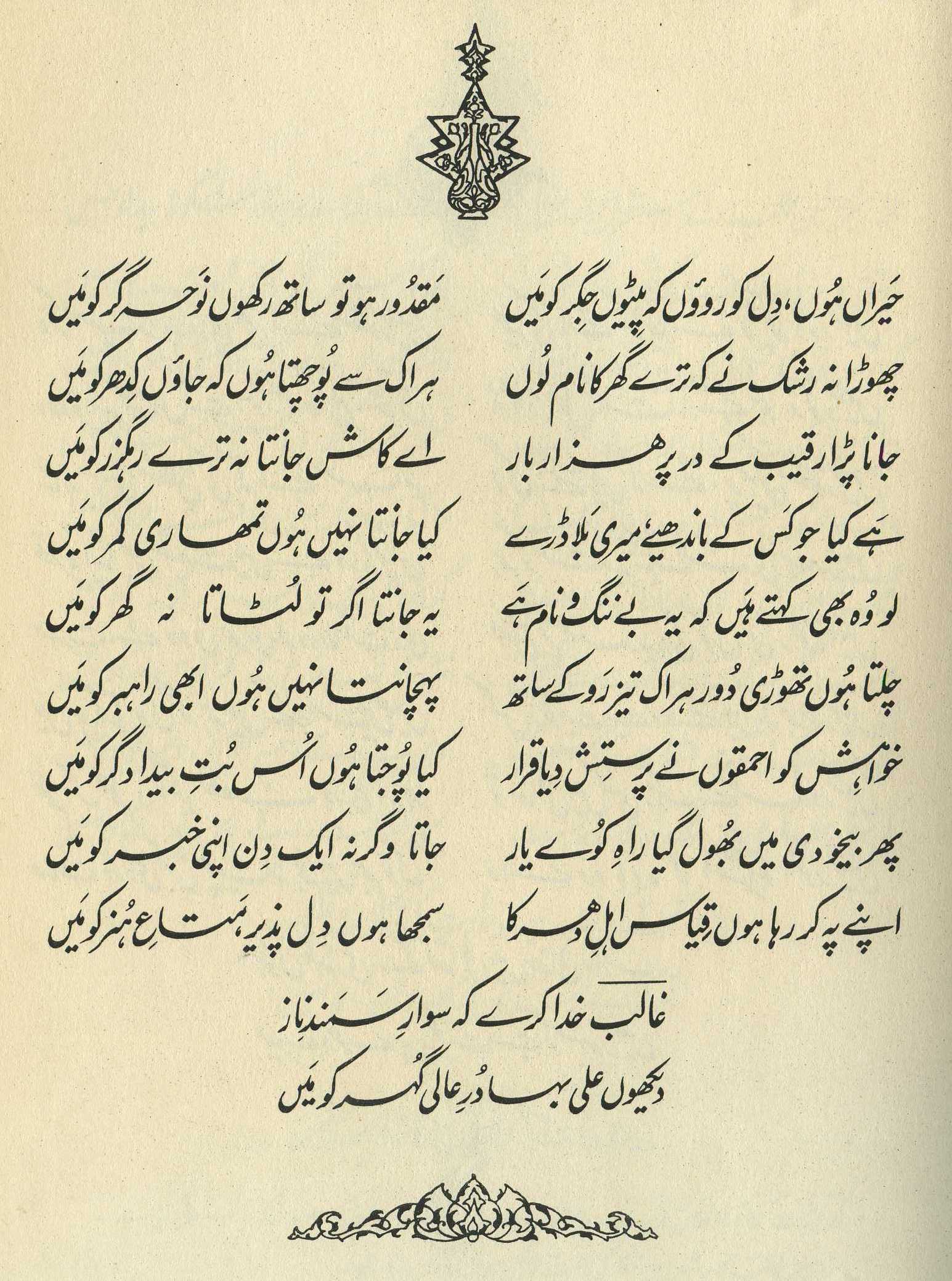
He was forced to go to the Rival's door because the beloved's comings and goings were in that very one's house. (103)
== Nazm page 103

Alas, what an ill-fortuned day it was when I became acquainted with your street! Oh, if only I didn't know your street! That is, if only I hadn't become a lover of yours. I was forced to go to the Rival's door a thousand times.
[Or:] You constantly stay in the Rival's house. Thus when we came to your door, then it was as if we came to the Rival's door. This meaning is certainly to some extent subtle, but that effectiveness [as of the previous meaning] doesn't remain in it. Momin too has well said,
[how my prostration before that footprint debased me!
I went measuring my length on the ground, even/also in the street of the Rival] (200-01)
'Your road'-- implied meaning: your customary road; the path that you usually take.
== Naim 1972, p. 23
Consider 'door' and 'road'. The longing is, if only I didn't know your road! And the complaint is that it was necessary to go to the Rival's door a thousand times. In order to join these different things, the commentators have supposed that the beloved is constantly at the Rival's door. Or the Rival has made the beloved's house his home. But those explanations don't fully account for 'road'. Acquaintance with the beloved's road-- that is, street-- doesn't logically imply that in order to meet the beloved he would have to go to the Rival's door. [Bekhud Mohani has rightly pointed out the symbolic meaning of 'knowing your street' as being your lover.]
Bekhud [Mohani]'s commentary is fine, but in addition, other interpretations are possible. For example, if we don't take 'road' as 'street' [], we can take it as only 'path' []. Since the beloved passes along this path, on which the Rival's house is, and if access to the beloved's house itself is impossible, then the lover will be forced to go to the Rival's doorway and stand there, hoping to see the beloved. A second interpretation might be that the path to the beloved's house goes by the Rival's house. Thus in order to meet her or even to see her, he's forced to pass by the Rival's door. A third interpretation can be that every person in your street is my Rival; thus to pass through that street is as if being forced to pass by the Rival's doorsay. A fourth interpretation can be that in order to meet you, meeting the Rival is a condition-- as if the Rival is a middleman. Thus access to your door comes after going by his house.
[to go] and [to know] have an interesting resemblance [] as well, and it creates between the two words a new kind of connection . The going took place because of the knowing. Thus both words are metaphor s for each other.
== (1989: 141-42) 2006: 160-62
We have to wait until Faruqi's commentary to encounter even a mention of the conspicuous wordplay between and , despite the fact that these verbs are so prominent, and are linked more closely than just by sound, as Faruqi points out.
Other sounds effects haunt this verse as well, to an unusual degree. Of the twelve vowels in the first line, ten of them are short or long sounds. Then there are the mutually echoing and , and the other sounds: . The effect is rhythmic and stark, curtailing the phonetic range the way the lover's movements are curtailed. An especially good effect is created by , with its two rhyming sets-- and with its first and last words subliminally forming , which has among its meanings 'house, dwelling' (Platts p.510).
In fact the wordplay feels like the chief pleasure, the focal point, of the verse. Speculating about why exactly the lover has to go by the Rival's door is not very thrilling; it cannot hold the attention for very long. Things would be different if the question were a more compelling one, or even offered some rewards in the form of wit or irony or an unexpected punch. But as far as I can see-- no such luck. None of Faruqi's theorized explanations really strikes much of a spark. The moral is that a verse can be open-ended without being truly exciting. (We Ghalibians are a tough crowd, and it's Ghalib who has made us so.)
In the previous verse, 99,2 , the lover can't find the beloved's house; in this verse, he knows all too well how to find her.
graphics/delhi1857.jpg
