Verse 81849arko mai;N
G3
1
again/then, in self-lessness, I forgot the road to the street of the beloved
2
otherwise, I would have gone, one day, to inquire about myself
| References | |
|---|---|
| Arshi, Imtiyaz Ali | Ghazal# 111 |
| Raza, Kalidas Gupta | 409-10 |
| Hamid Ali Khan | Open Image |
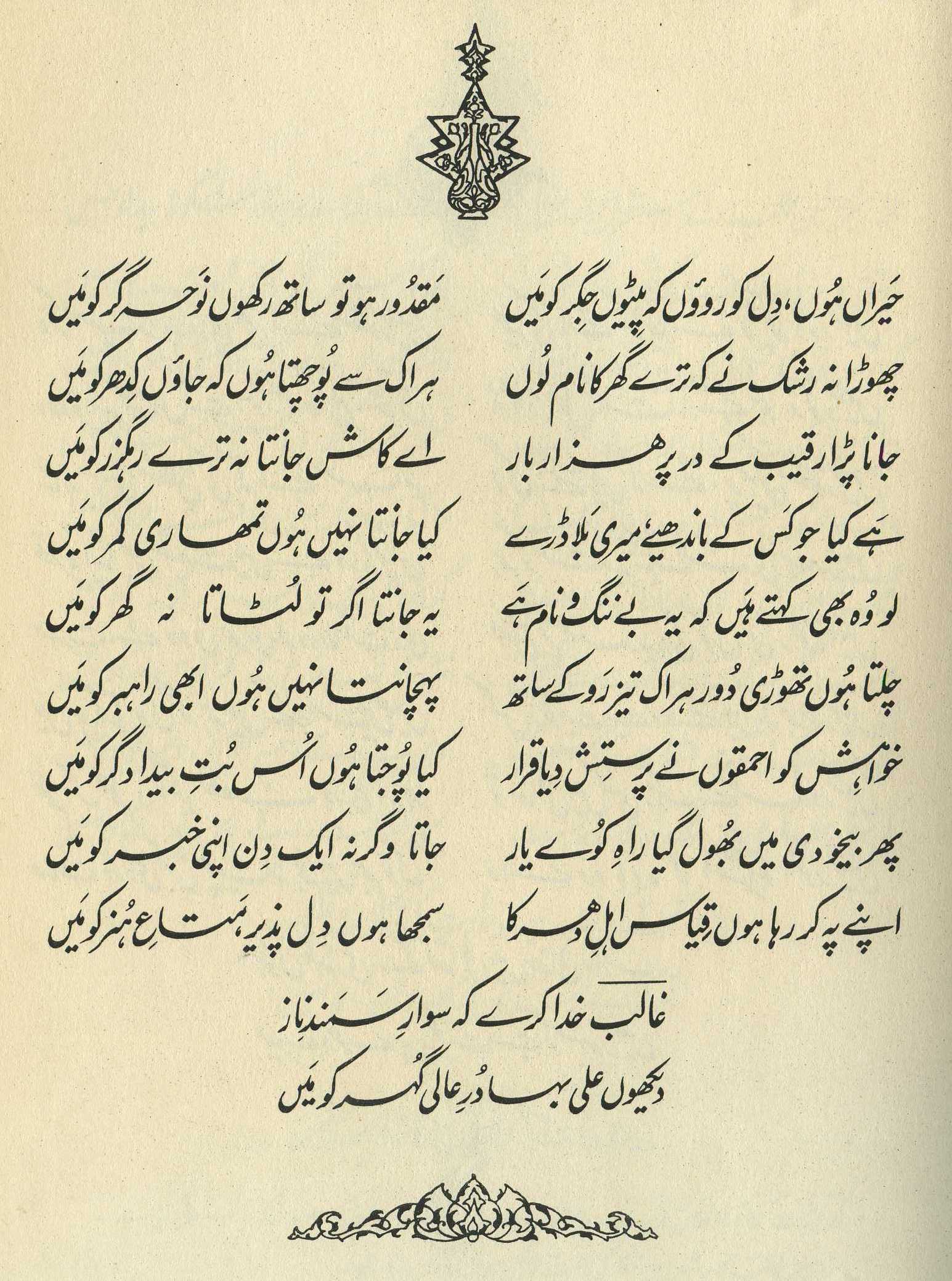
That is, since I have gone out of myself, I would hardly have gone anywhere else! A number of times I must have gone-- that very place is so heart-attracting that anyone who goes there doesn't turn away again. I too am probably there; for this reason I'm not myself, and because I'm not myself I've forgotten even the road itself. Otherwise, I would have gone there one day to inquire about myself. (104)
== Nazm page 104

Since leaving the street of the beloved, we haven't really been ourself. In a state of self-lessness, we wandered arounded, buffeted on all sides. Sometimes we became unconscious, sometimes we become conscious. We had the intention to go to the street of the beloved and inquire about our lost heart and our looted consciousness and senses. But what can we do? For in self-lessness, we forgot the road itself.... The word tells us that this today is no new thing; rather, we have often formed the intention, but in self-lessness couldn't find the road of the street of the beloved. (202)
In this verse doesn't mean 'again', but rather 'then' []. [Nazm] Tabataba'i and Asi have alluded to this point. But there's another point as well. In the second line the phrase 'one day' is very meaningful. In sentences like 'One day I would go there', and so on, 'one day' suggests a kind of carelessness and lack of interest. That is, for a task toward which the temperament would not be deeply attracted, or of which there would be no immediate need, the phrase 'one day' is used....
It's as if I was born to go to the street of the beloved, and lose or absorb my existence there. Now, when that has happened, I am so to speak at peace-- rather, if from there I have brought away self-lessness, and have left my self there, then that's very good, there's one worry the less. Now, what happened to me there-- the beloved would know, or the people of her street. The word 'self-lessness' is quite central, because it is both an authorization for my not knowing about myself, and the cause of my losing information about myself. It's a fine verse.
== (1989: 143) 2006: 163-64
Bekhud Mohani tells us firmly that here means 'again', while Faruqi equally confidently announces that it means not 'again' but 'then'. As usual, I think it's meant to have both possibilities. After all, it's very appropriate for a verse like this, which is about a state of confusion and (self-)forgetfulness, to have things happen both ineluctably, one after the other, and also repeated ly, with the same ineluctable pattern recurring many times. For more on the versatility of , see 4,5 .
The phrase -- literally, 'the road of the street of the beloved'-- is piquant as well. Why do we need both a road and a street? A simple, commonsense solution would be to read the phrase as meaning 'the way to the street'. Another reading would see the phrase as embodying a kind of confusion, to represent the voice of a self-less person who is entirely bewildered by maps and street directions. And of course the could also be abstract and mystical: the similarly doubled phrase 'path of the road of oblivion' [] occurs in both 10,12 and 92,3 . Could the 'road of the Beloved's Street' thus refer to the lover's own form of the mystical path?
This one also reminds me of 161,8 , which is a simpler take on the same situation. I wanted to say the same 'plight', but it really doesn't seem to be a plight. As Faruqi points out, the use of 'one day' conveys a marked casualness and lack of urgency. The lover is used to the paradoxes and dilemmas of heart-lessness (as in 7,5 ), so why should he be fazed by self-lessness? In this verse at least, he clearly isn't. Which makes sense. If there's no 'self' around to be upset by it, then what's the harm of losing one's 'self'?
graphics/lost.jpg