Verse 51849arko mai;N
G3
1
look-- even/also she says, 'This one is shameless/disgraced'
2
if I had known this, I wouldn't have caused the house to be plundered/'looted'!
'Shameless'.
'Without name, character, or reputation; inglorious'.
| References | |
|---|---|
| Arshi, Imtiyaz Ali | Ghazal# 111 |
| Raza, Kalidas Gupta | 409-10 |
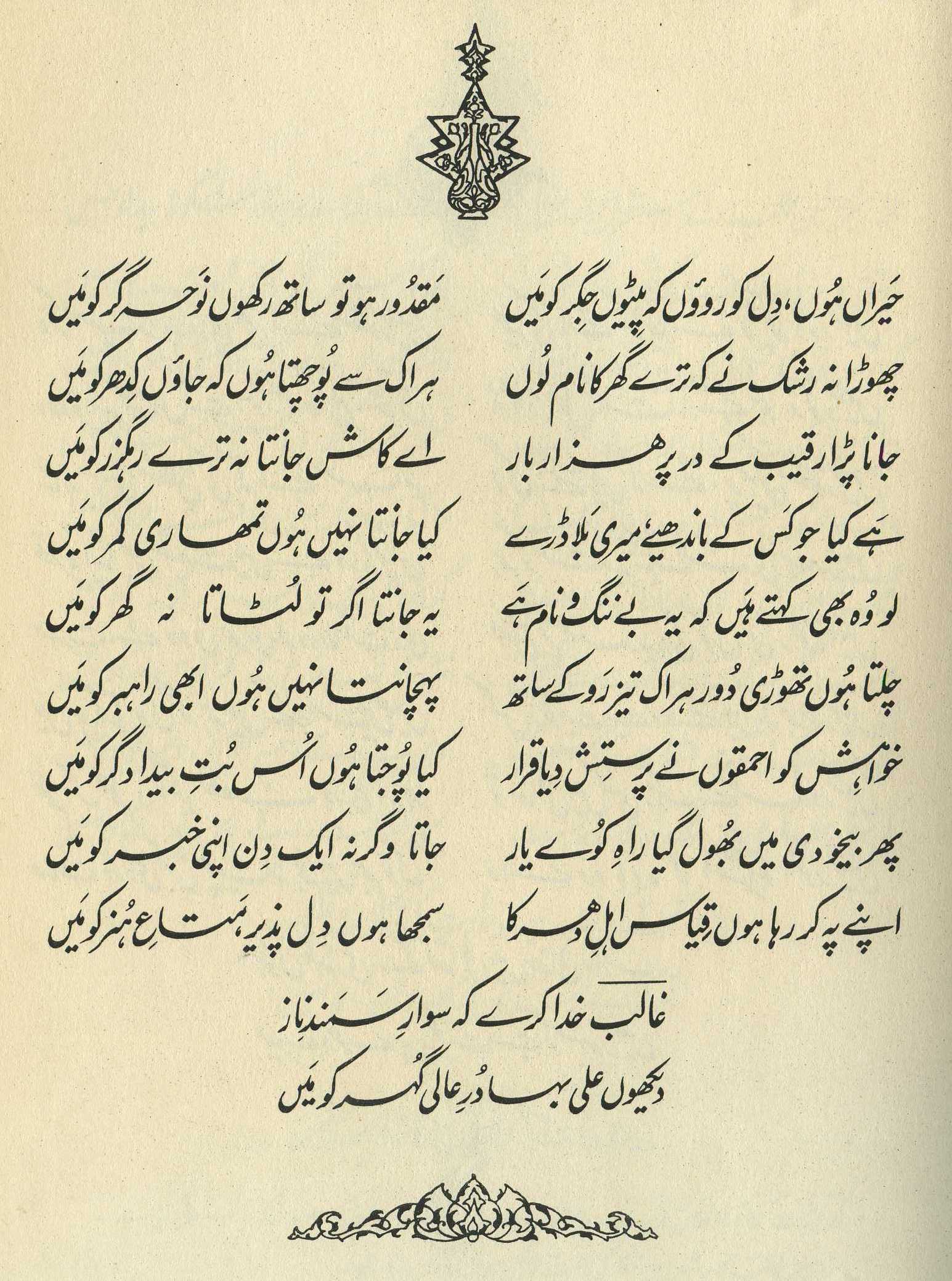
| Hamid Ali Khan | Open Image |
That is, the one for whose happiness I destroyed myself-- look at the spectacle, that she herself is displeased with my destroyed condition! (103)
== Nazm page 103

If someone else said it, then fine. She too says, this is a disgraced wretch. If I had known it, then I wouldn't have caused my house to be looted. That is, the person for whose happiness I reduced myself to nothingness-- she too considers me vile! By 'look' [lo] the expression of amazement is intended. (201)
'Look' [] is for the expression of surprise and regret. (273)
As the commentators point out, to be condemned by everybody else is no more than the lover's normal experience. But to be condemned by her too, or even by her! The little word can also have an effect simply of emphasis or reinforcement; it is one that Ghalib used very cleverly; for more on this, see 36,9 .
What she actually says is that 'this [one]' is a shameless, disgraced wretch. The use of instead of the more common gives extra immediacy; it points directly at the wretch himself, who is present and listening. And it sets the lover up to begin the next line with the same word, almost throwing it back in her face-- if he had known this, he wouldn't have reduced himself, for love of her, to the very state for which she now condemns him.
For her he has reduced his house to ruin; the 'house' can be meant literally, as in 10,7 , or of course metaphorically as the physical house, the body, which is wrecked when the heart is broken, as in 5,2 . Or, since the verb is , 'to cause to loot', it's possible that he might have actually invited in the beloved herself to do the looting; which makes it all the more unjust when she then sneers at him for his wretched, disgraced, and 'looted' condition.
graphics/ruinedhaveli.jpg