Verse 71849arko mai;N
G3
1
'desire/wish', fools have established to be 'adoration'!
2 a
as if I 'worship' that cruel/unjust idol!
2 b
do I 'worship' that cruel/unjust idol?
'Wish, desire, will, inclination; request, demand'.
'Adoration, worship, devotion, observance'.
'Honour, worship, respect, reverence, veneration, homage (to superiors), adoration (of the gods); idol-worship, idolatry'.
| References | |
|---|---|
| Arshi, Imtiyaz Ali | Ghazal# 111 |
| Raza, Kalidas Gupta | 409-10 |
| Hamid Ali Khan | Open Image |
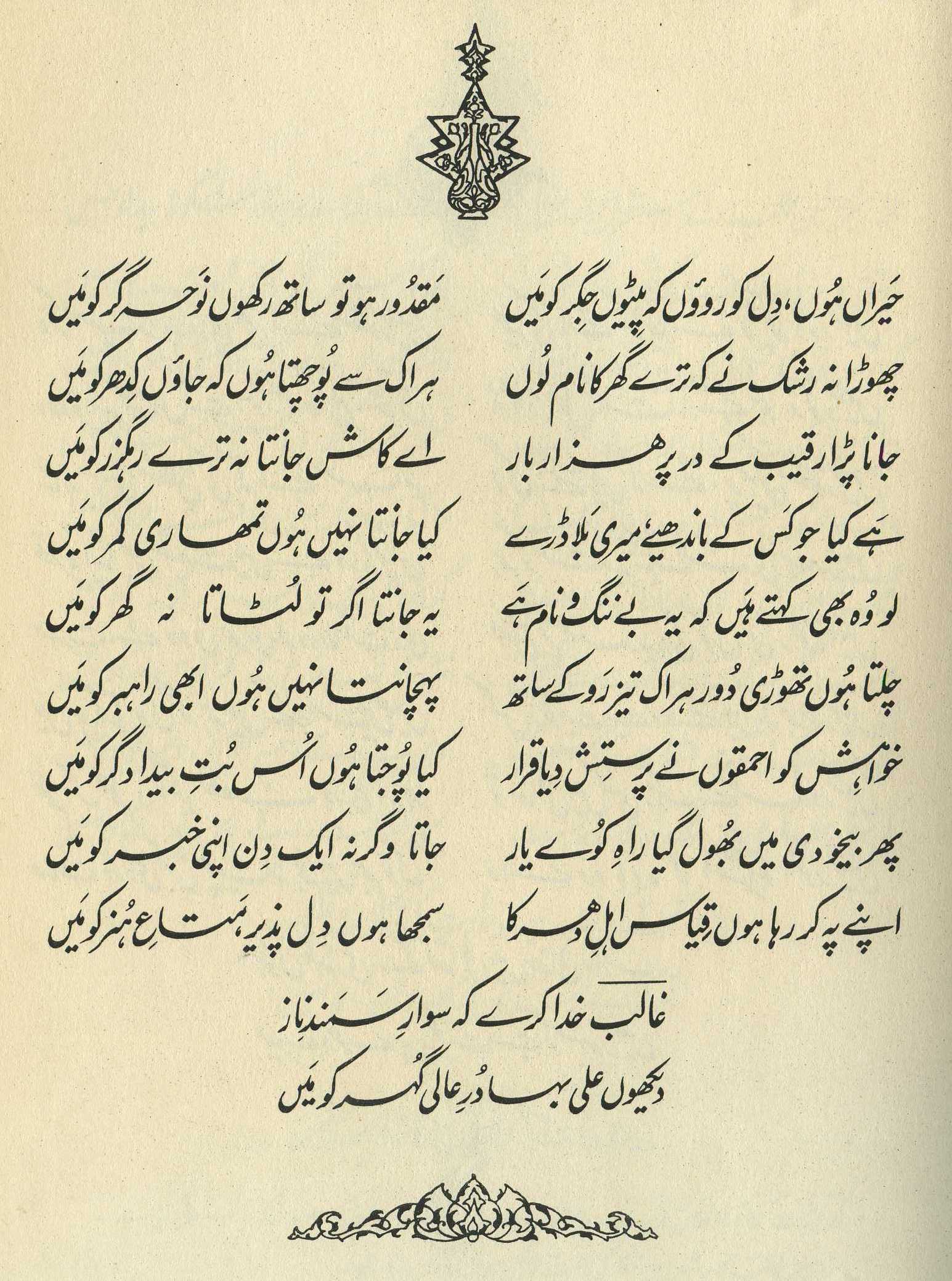
The subtle meaning of this verse is that the poet asks in amazement, do I worship her?-- as if he doesn't know whether going before the beloved and expressing his submission reaches the level of 'adoration', or remains within the limits of 'longing'. And in addition to amazement, another aspect is that of reproach as well. (104)
== Nazm page 104

Fools have considered longing to be worship []. I long for union with her. I don't consider her an object of worship. In this verse two words are worthy of attention: and ....
If we consider to be a question, then the sense will be that although his obedience and submission have reached such a limit that people have begun to consider it 'adoration', nevertheless he himself is unaware of his own state, and asks in amazement, do I worship her?....
Indeed, in this verse there are certainly these points: that 'worship' [] is that which is performed before a lord who is considered worthy of 'worship'. In it there should be no place for fear of hell or ardor for heaven. Thus the weakness and submission that are caused by longing cannot be called 'adoration'. Can a tyrant ever be worthy of 'worship'? (202)
From this style of expression it's clear that he himself doesn't know whether going before that cruel one and expressing submission reaches the level of 'adoration'. This thought in the verse is truly subtle. (196)
[If we look closely at the first line,] a general statement has been made, that what is called 'worship' is not worship, but 'longing'. Doesn't the plain meaning emerge, that when people 'worship' their object of worship, it isn't worship but only a form of longing, which fools have called 'worship'? And Ghalib has said exactly this in another verse as well: 93,3x .
That is, idol-house and Ka'bah are not centers of worship, they are aspects of the insistence of longing.... The speaker is not trying to refute some charge that has been made against him; rather, he himself is making a charge against people.... The basic thing is longing, for the fulfilment-- or rather, even the expression-- of which, worship is one means....
[In short,] I have enough intelligence to understand the difference between longing and worship, but people who, despite having my counterexample before them, consider that longing is worship-- what can we call them! In the verse, from what has been said about them it can be seen that they are not hypocritical/infidel [] or deceitful, they are only deceived.
== ( 1973: 180-84 )
It's not surprising if the adorable 'idol' [] receives adoration, or worship, or something of the sort. But with all the ambiguities and wordplay in this verse, anything she gets will be diluted by unresolvable question marks. If there was ever a verse about uncertain definitions of words, this is surely it.
In the first line, we learn that 'fools' define 'desire, wish' [] as 'adoration' []. Then the second line drops 'adoration', replacing it with 'worship' []. But what distinction-- if any-- is being made? Is it relevant that comes from the Islamic (and Persian) side, while comes from the Hindu (and Indic) side, so that the former is offered to the true god while the latter is offered to an idol? Is it relevant to the distinction, as Bekhud Mohani maintains, that the beloved is cruel/unjust, or is that merely one of her many normal epithets that happens to be applied here?
Or of course it's possible that no real distinction is being made at all, and the lover just happens to use a different word for the same concept-- see the definitions above, to verify how substantially the two words overlap. (My translating one as 'adoration' and the other as 'worship' is really just for convenience, so we can readily tell them apart in English.) On this reading, the verse would simply show us the poor lover's lack of self-awareness (he claims not to adore/worship her, but we know better).
Finally, there are the familiar but always powerful possibilities of . The second line may be an indignant repudiation of the foolish equation expressed in the first line (2a); or it may be a thoughtful, uncertain meditation on the subject (2b). As usual, Ghalib leaves the reader twisting slowly in the wind-- and he makes sure the wind is blowing from as many directions as possible.
graphics/durga.jpg