Verse 10after 1821aaho jaanaa
G5
In this meter the first long syllable may be replaced by a short; and the next-to-last long syllable may be replaced by two shorts.
1 a
so that the wonder of the desire for polishing would {'open' / be revealed} to you
1 b
so that the wonder of the cleansing/polishing air would {'open' / be revealed} to you
2
look at, during the rainy season, the becoming green of the mirror
'Disappointment; wonder, astonishment, amazement, surprise, a miracle'.
'A polisher, furbisher; (in Hind. and Persian) polishing, polish, cleaning (arms or tools); furbishing; --a polishing instrument'.
'Green, verdant; fresh; flourishing; raw, unripe; grey-coloured or iron-grey (a horse); of a bluish hue; black, dark'.
| References | |
|---|---|
| Arshi, Imtiyaz Ali | Ghazal# 36 |
| Raza, Kalidas Gupta | 355 |
| Hamid Ali Khan | Open Image |
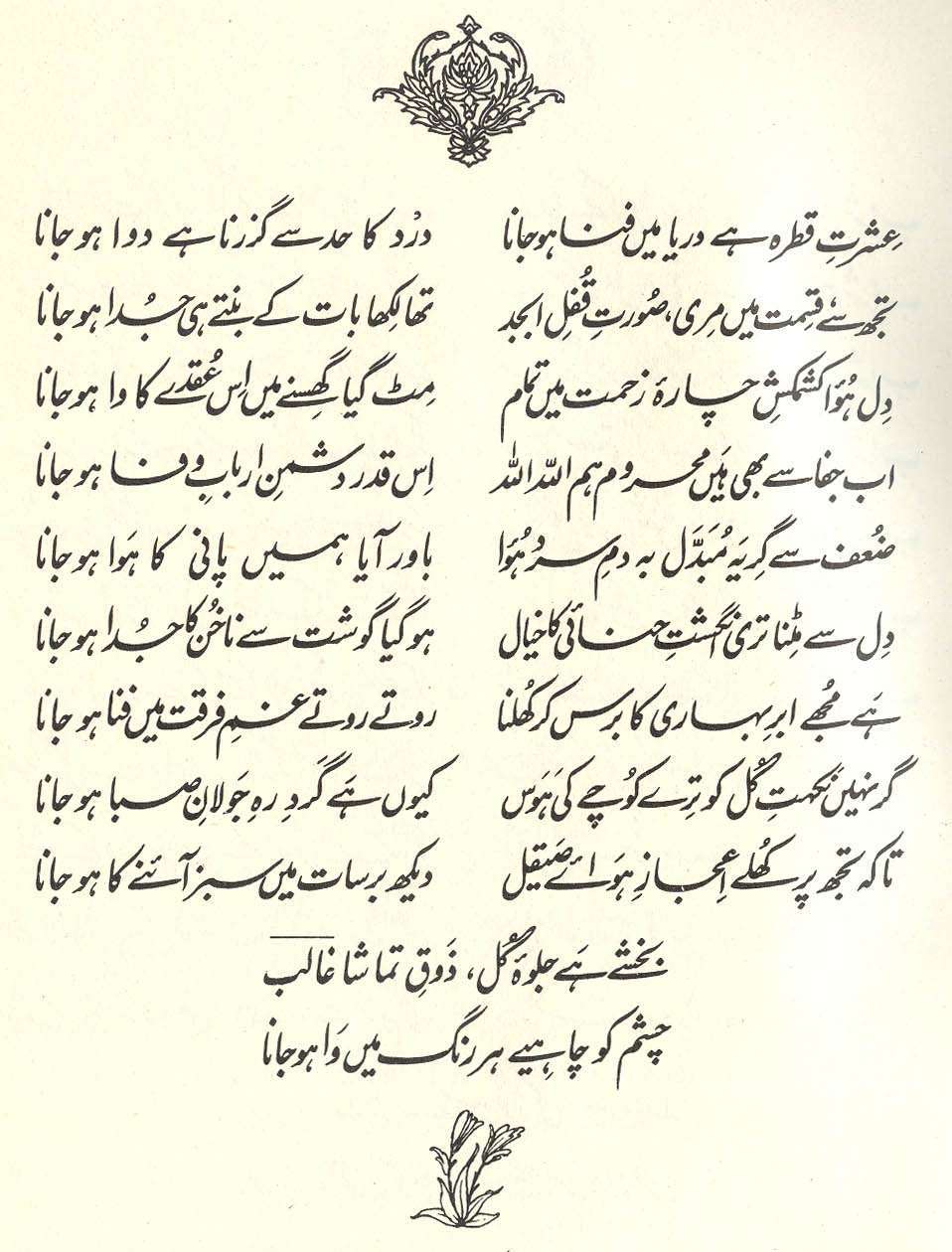
In the rainy season, verdigris [] develops on a metal mirror-- as if it's greenery which the cleansing air has created.... The conclusion is that ardor is something that has an effect even on metal. (44)
== Nazm page 44

Urdu text: Vajid 1902 {48}
The poet's point is that nowadays the miracle of desire has increased to such a degree that in desire [] too the same effect and miraculous power has come to exist, as is in the real air []. (47)
From the air of the rainy season, verdigris [] appears on a metal mirror. Mirza Sahib says, by way of an example, that the effect of the spring season is apparent not only in the garden and the wilderness, but rather, even a metal mirror is influenced by it. The meaning is that one ought to find rest and enjoyment in the air of spring. (86-87)
Solution 1: If you want to see the miracle-working power of the air of spring, then look how in the rainy season even a metal mirror becomes green. That is, the spring air is something that has the power not only to bring about growth in plants, and vitality in animals, and enthusiasm and increased beauty in humans. Rather, even a hard thing like metal is not deprived of its benefit and effect-- the color of spring has overspread it too.
Number 2: The longing to create color and form afresh, and the desire for a renewal of ardor, show us miracles. If you want to understand this problem, then take a look at a metal mirror. In the rainy season, verdigris [] runs over it so that it will again shine brightly after polishing. (110)
Most of the commentators have chosen to read as meaning 'desire, affection', and have interpreted the verse like this: 'The mirror is a metaphor for the lover, and the polisher is the beloved. The mirror longs for polishing (that is, union with the beloved. But polishing takes place when the mirror would be stained with verdigris. The desire for polishing is so intense that in the rainy season the mirror spontaneously becomes green. In this way it arrives in the hands of the polisher. It is a miracle of the intensity of longing that the mirror's heart becomes substantiated.'
The mirror can also be considered as a metaphor for the beloved. In this case, the meaning would emerge that the beloved has such a longing for union that she abandons her mirror-bodiedness and allows verdigris to form, so that the polisher's hands would fall on it and would make it bright again. The mirror can also be a metaphor for the heart-- that is, the human heart fills itself up with inner impurities, so that the polishing of God's attention may again come upon it.
In all these readings, the 'proof' is that in the rainy season verdigris appears on the mirror and it becomes green. But this same idea can also become a basis for objection. Because the mirror will long for polishing at the time when it would be stained with verdigris. When the mirror wouldn't be stained with verdigris at all, then what would a 'longing for polishing' mean? The reply can be given that since the polisher is in the capacity of the beloved or the desired one, and the polisher gives attention to the mirror only when it would be covered with verdigris, then through its intensity of emotion the mirror makes itself verdigris-covered. It's impossible to do sufficient justice to this ' delicacy of thought '....
If is taken to mean 'breeze', as Bekhud Dihlavi has done, then one very subtle/enjoyable point is created, although Bekhud has not alluded to it. This point is that the rainy season indeed polishes the face of the earth, but this polishing is not of a white glittering or shininess. The polishing done by spring is that greenness that silently appears and fills in brownness, colorlessness, the ugly earth, with greenness. The polishing breeze has such an intensity of effect that even the metal polish-marks of the mirror can't help but be affected by it, and the mirror too becomes green. The simile of greenery for polish-marks on metal Ghalib has used elsewhere: 217,2 . The meaning of 'polishing breeze' also has an affinity with in the previous verse [ 48,9 ]: 'the glory/appearance of the rose'-- that is, the spring season (=the rainy season), has been mentioned in it.
Both verses have layer upon layer of wordplay and affinity , but the commentators have usually not mentioned it, because (except for Bekhud Mohani) the rest of them are followers of [Nazm] Tabataba'i's idea that affinity and wordplay are nothing worthy of esteem. The truth is absolutely the opposite, because through affinity and wordplay the verse's beauty of meaning is enhanced, and the verse is established as a 'verbal artifact' [an English term, then glossed as ].
In any case, now let's consider the wordplay: ; then, ; then, ; then, (as in 'open air'); then, ; then, ; then, ; then, [=to be open], ; and the delight on top of delight is that one is being invited to look at a green mirror-- that is, a mirror in which nothing can be seen. And instead of looking into a mirror, one is asked to look at the mirror. The glory/appearance of the rose and the rainy season; spectacle and greenness, breeze and greenness, eye and becoming open, spectacle and look-- in short, it's a mirror-chamber in which the mind loses itself.
== (1989: 61) 2006: 76-78
This verse marks the end of a two-verse verse-set that includes {48,9-10}; for discussion, see 48,9 . The two verses are united by their emphasis on the importance of 'seeing' the natural world-- with, of course, the right kind of revelatory vision.
This is another of Ghalib's many 'mirror' verses. For further discussion of verdigris on mirrors, see 47,1 . For more on the 'rainy season', see 48,7 .
Faruqi shows how can be read with remarkable sophistication and effectiveness as either 'desire' (1a) or 'air, breeze' (1b). If we read 'desire for polishing', we have the mirror as an ardent lover, doing anything necessary to solicit the beloved's attention, no matter how harsh or painful the form that attention will take. And if we read 'cleansing air', we have the radiant greenness of the rainy season showing its creative, revitalizing power-- even on a metal mirror. (For more on , see 8,3 .)
Truly, it's a subtle and sensuous verse. The two readings of the first line are so striking, and so strikingly different, and yet they both work most remarkably with the second line. Here is Ghalib being Ghalib. For more on such 'double activation' of words like , see 120,3 .
The meaning of as 'disappointment' (see the definition above), which presumably comes from the root meaning of , 'to lack strength', is one that I've never encountered; and the only other time in the divan that the word appears, in 208,2 , the sense is certainly 'miracle, wonder'. But if we do take 'disappointment' as a secondary meaning in the present verse, that too-- such is the 'miracle' of Ghalib's word-sense-- works elegantly with the second line. For the greening or discoloration of the mirror can as readily signify a failure, a weakness, a disappointment of desire, as it can signal a passionate desire for polishing, or the verdant 'greening' of springtime.
Though it doesn't insist on it, the verse also offers a double instance of ' elegance in assigning a cause '. Did you think you knew why mirrors go green in the rainy season? Well, think again-- here are two new causes, both of them witty and revelatory.
graphics/verdigris.jpg