Verse 21816aataahai mujhe
G5
In this meter the first long syllable may be replaced by a short; and the next-to-last long syllable may be replaced by two shorts.
1
the temper of a sword, from another fountain-head?!-- 'known' [to be impossible]!
2
I am that [kind of] greenery, such that 'poison-water' causes me to grow
'A gem, jewel; a pearl; essence, matter, substance, constituent, material part (opp. to accident), absolute or essential property; skill, knowledge, accomplishment, art; excellence, worth, merit, virtue; secret nature; defects, vices; --the diversified wavy marks, streaks, or grain of a well-tempered sword'.
'Fountain-head, source, a spring, fountain'.
'Dirty, stagnant, or envenomed water; rennet for curdling cheese; water in which fruits have been macerated, their bitterness being left behind; an aquatic herb'. (Steingass, p.630)
'Water; water or lustre (in gems); temper (of steel, &c.); edge or sharpness (of a sword, &c.); sparkle, lustre; splendour; elegance; dignity, honour, character, reputation'.
| References | |
|---|---|
| Arshi, Imtiyaz Ali | Ghazal# 170 |
| Raza, Kalidas Gupta | 253-54 |
| Nuskhah-e-Hamidiyah | 258 |
| Asi, Abdul Bari | 263-264 |
| Gyan Chand | 385-386,520 |
| Hamid Ali Khan | Open Image |
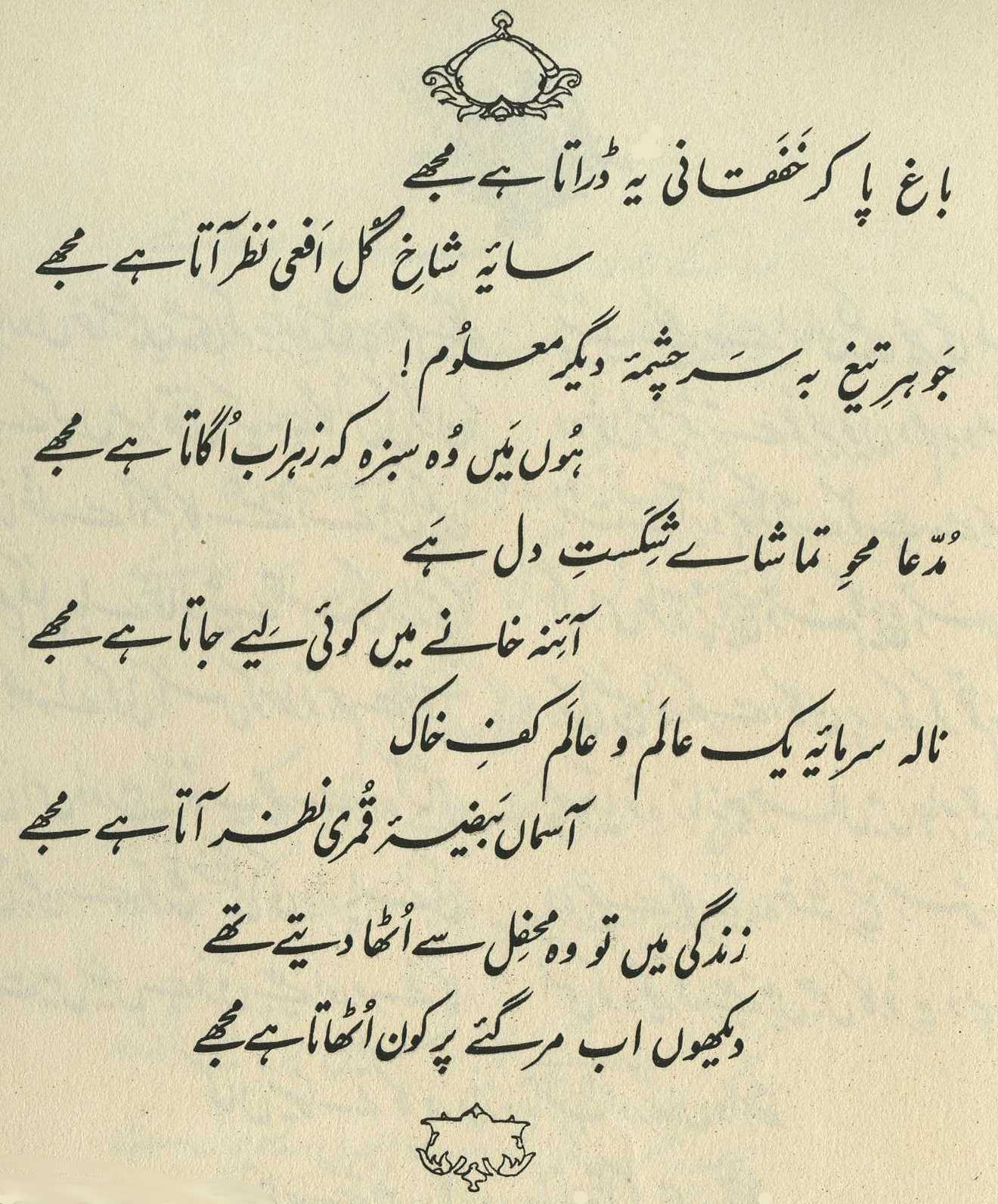
By is meant grief and anger; that is, my composition is from grief and anger. Then in addition he boasts that the temper of a sword is in the sword alone; at any other fountain-head, where is this greenery? The late author was heedless here-- in Iran, language-knowers also use for urine; he ought to have avoided this word. (245)
== Nazm page 245

He says, 'The way the temper of a sword is brought out by the sprinkling of , in the same way I am that greenery whose nourishment has been on grief and anger'. The meaning is that in my composition are grief and anger. ( 306)
[Disagreeing with Nazm:] Yes, yes, language-knowers call urine too . But not urine alone. From the innovation of Hazrat the Commentator it's necessary that a word that has a number of meanings, one of which is bad, ought to be avoided in speaking in its other meanings as well. But in truth this recommendation is in no way worthy of acceptance. Not to speak of the poetry of the elders, it has not been followed in the hadiths of the Prophet or the verses of the Qur'an either....
The poets of Hind, especially Mirza's contemporaries, use this word freely/casually. [An example by Momin :]
zahr-aab de;N agar tirii daulat ke daur me;N
((umr-e ;xi.zr ho zindagii-e jaavidaan-e te;G
[if they give it during the era of your reign
it will be the lifetime of Khizr , the immortal life of the sword]
[An example by Zafar :]
[do not give to the sword of the glance, through anger
it will not be good if a wound would befall the heart!]
[He goes on to give further discussion, and an example from Nasikh.] (445)
[See also his comments on 48,10 .]
There's no subtlety in the meaning of the verse. The verse is good, but considering Ghalib's standard, it's not of very high rank. By the 'temper' [] of a sword is meant those round marks that are present in high-quality steel. By way of affinity to the brightness/'water' [] of a sword they give for it the simile s of 'ocean', 'fountain', or 'rivulet'. Thus Mir has a line [the second line in M 947,2 ]:
[the rivulet of his sword too-- what-all it caused to flow away!]
Thus if the sword is a fountain, then its temper/water has become greenery. That is, the temper is that greenery that can grow up only by the edge of the sword. The greenery, with regard to its form and color, has similarity to a 'quenched' sword [that has been immersed in water as part of the tempering process], as in Ghalib's verse 109,7x .
In the verse under discussion the meaning of is grief and sorrow. Thus the meaning of the verse becomes that the way the greenery of 'temper' can grow up only on the edge of a sword, in the same way I am that greenery that grows up on poison-mixed water (that is, grief and sorrow). That is, my existence itself is indebted to grief and anger and sorrow. Ghalib has also created in this another aspect of thought: that the way the temper of a sword exists because the sword exists, in the same way my existence is due to grief and anger.
== (1989: 340-43) 2006: 369-72
A sword has 'water' for two reasons. For one thing, it has or 'temper', one meaning of which is 'gem', and jewels have 'water' as a criterion of quality; in English too we speak of 'a diamond of the first water'. A sword also has water because it has (see the definition above), which includes the 'temper (of steel, &c.); edge or sharpness (of a sword, &c.)'; for more on this, see 193,2 . Faruqi adds the association of with the water in which a sword has been immersed to 'quench' it as part of the tempering process.
The idiomatic negative use of , literally 'known', to mean 'known not to exist' or 'known not to be possible', is quite common; for more on this, see 4,3 .
The controversy over as being used in Persian to mean 'urine', and whether this association affects the verse, looms large to the commentators; Faruqi too discusses it at length (pp. 341-43). It points up perhaps one of the few ways in which we latecomers have an advantage: many of us don't think distractingly of that meaning because we aren't familiar with it.
Bekhud Dihlavi speaks of 'the way the temper of a sword is brought out by the sprinkling of '; if 'poison-water' can refer to acid, then apparently he's more or less right about the metallurgy: the boundary or 'temper line' between the extremely hard (but brittle) edge of the blade and the softer (but more flexible) center can be brought out by being ' polished or etched with acid '. It's easy to imagine that might also be used to refer to some kind of acid used in the sword-making process. Bekhud Mohani's verses from Momin and Zafar both seem to share that view.
But Steingass gives quite a different meaning, and the 'greenery' and 'fountain' imagery support Steingass (see the definition above). So it seems that is 'doubly activated': the verse insists that we think of it both in terms of stagnant water, and in terms of sword-tempering.
As Faruqi points out, 109,7x shares the same nexus of imagery.
graphics/stagnantpond.jpg