Verse 11816aataahai mujhe
G5
In this meter the first long syllable may be replaced by a short; and the next-to-last long syllable may be replaced by two shorts.
1
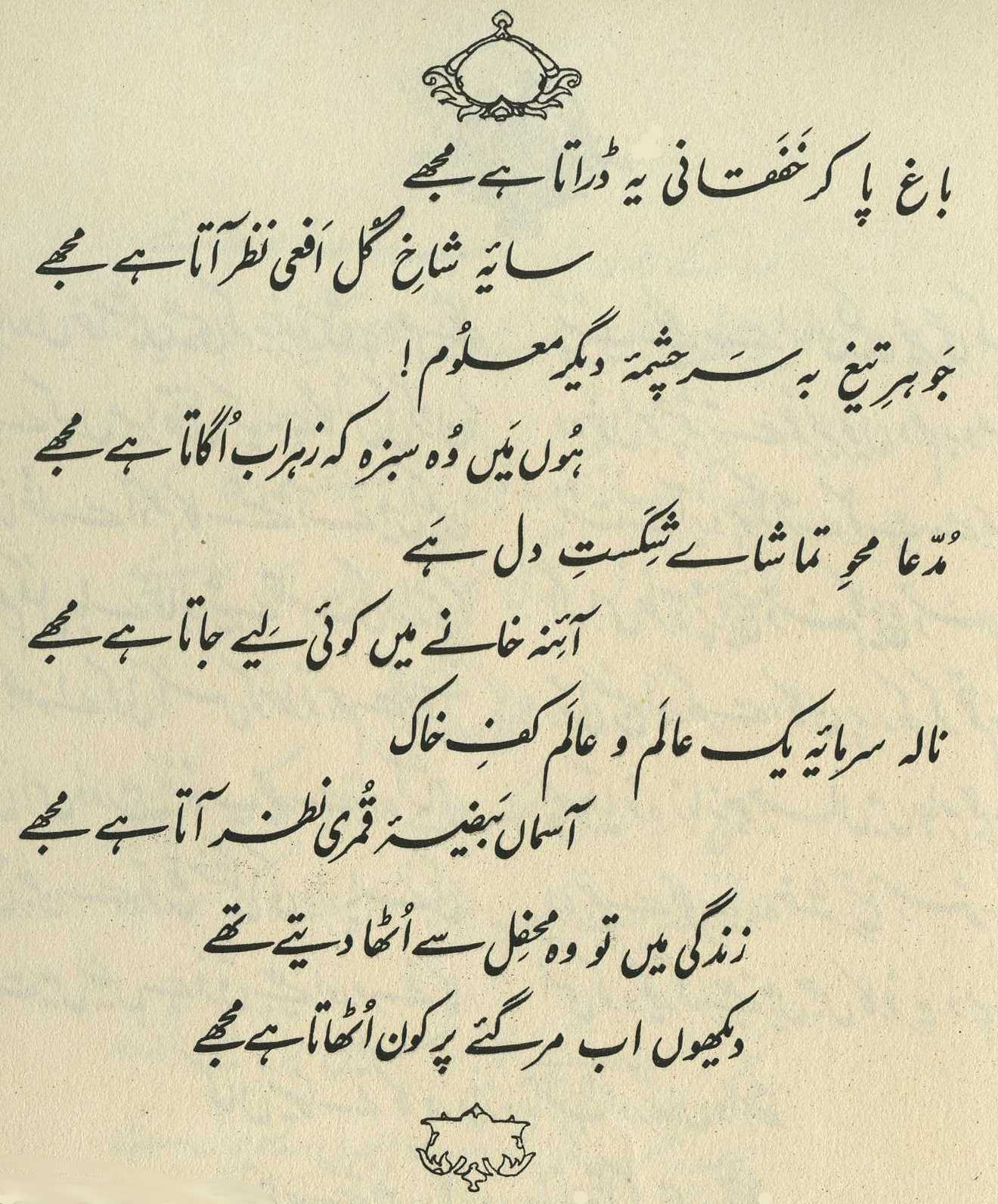
the garden, having found me heart-palpitation-inclined, frightens me to such an extent
2
the shadow of a rose-branch appears [to be] a serpent, to me
'Fluttering, palpitation (esp. as a disease of the heart); hysterics'.
'(adj.) Subject to palpitation (of the heart)'.
'adv. In this, herein; here; — to the extent or degree (that), to this degree'.
| References | |
|---|---|
| Arshi, Imtiyaz Ali | Ghazal# 170 |
| Raza, Kalidas Gupta | 253-54 |
| Nuskhah-e-Hamidiyah | 258 |
| Asi, Abdul Bari | 263-264 |
| Gyan Chand | 385-386,520 |
| Hamid Ali Khan | Open Image |
The reference of 'this' is to the seeing of a serpent. Besides the excellence of the simile , there's the freshness that he has declared the heart-palpitation to be a cause of fear-- contrary to most poets, who say that 'the garden, in the memory of face and curls, frightens me'. (245)
== Nazm page 245

He says, 'When the garden found me to be of a palpitation-inclined temperament, since then it has kept intimidating me. As if the shadow of the rose-branch appears to me to have become a serpent.' A palpitation-inclined [] man, because of his illusion, usually feels fearful. The meaning is that in the garden the freshness and moisture of the flowers has a heart-attracting effect, and the outcome of love always becomes life-destroying. (305)
In this verse such a picture of madness has been made, that it's inexpressible. The kind of fear that can pervade a palpitation-inclined one [] who has seen a serpent, and the situation that can prevail in his heart and mind-- that is being made apparent through words. Then, what estimate can be formed of the terror at that time, when it's considered how many rose-branches there must be in the garden, and how many serpents must appear! ....
This verse is, according to the terminology of the poets of Sanskrit and Hindi, in the 'terrifying mood' []. (443)
It's a strange, haunting verse, and surely one of mood . Why is the lover so panicky and neurotic about being in the garden? Perhaps because he has snuck in through the garden gate without the beloved's permission, or climbed over the wall like a thief: thus he is jumpy and nervous, constantly imagining danger on all sides. Or perhaps he has with great difficulty, after infinite begging and pleading, obtained the beloved's permission to visit the garden; he feels himself to be a presumptuous, unwelcome intruder, so that everything in the garden rejects and threatens him.
Or perhaps passion has driven the lover into such crazy paranoid madness that even in the serene and restful surroundings of the garden he feels constantly under threat from all directions. For if he simply has a 'heart-palpitation-inclined' temperament, he might habitually invent his own threats and fears and difficulties even where there aren't any. It's this hysterical temperament that causes him to feel that the garden itself is seeking, malevolently, to terrify him. Or, since paranoids have enemies too, perhaps the garden really is deliberately trying to terrify him? Or, more concretely, might there even really be a snake or two lurking there, in the shadow of the roses?
In any case, the garden and/or his own hysteria is doing a pretty good job of reducing him to panic. Not to speak of approaching the rose itself, he's terrified not even by the 'branch' on which it grows, but by the very 'shadow' of that branch. He doesn't mention the thorns that grow on the branch; perhaps they don't even signify, compared to the frightful serpent of his imagination.
Bekhud Mohani points vaguely to an Indic connection, and certainly it's hard not to think of the famous Sanskritic philosophical 'serpent and rope' illustration. We see a rope and think it's a serpent; this shows the contingent nature of the 'reality' we live in. Our senses provide us with a 'real' (impression of a) serpent, but the only thing there is the rope that we have misperceived and misunderstood. Thus the illusions created by the power of should give way to insight into the nature of , etc. But of course, there's no reason to think that such serpents and ropes were part of Ghalib's mental universe, much less that they figured in the creation of this verse.
Note for grammar fans: Nazm is troubled by that in the first line, and feels that he has to read it, implausibly, as though it were (that is, by showing him a 'serpent'). But in fact the use of to mean 'to this extent' is a common idiomatic expression (see the definition above); many examples of it are linked on the GRAMMAR page.
graphics/shadowsnake.jpg
graphics/TheSerpentAndTheRope.jpg