Verse 9x1816aataahai mujhe
G5
In this meter the first long syllable may be replaced by a short; and the next-to-last long syllable may be replaced by two shorts.
1
I am, and eternal amazement/stupefaction-- but/perhaps the relish of imagination
2
with the magic-spell of the gaze of coquetry, torments me
| References | |
|---|---|
| Arshi, Imtiyaz Ali | Ghazal# 170 |
| Raza, Kalidas Gupta | 253-54 |
| Nuskhah-e-Hamidiyah | 258 |
| Asi, Abdul Bari | 263-264 |
| Gyan Chand | 385-386,520 |
| Hamid Ali Khan | Open Image |
My situation is that I have become entirely amazement, and remained so forever. But my ardor, equal to the magic spell of the gaze of coquetry, is working a spell on me and is always tormenting me. That is, imagination keeps giving me hope of union and is making me weak.
== Asi, p. 264
In this verse the place was more suitable for than for . We cannot say whether Mirza himself wrote , or whether it's an error of calligraphy. In the present situation, the meaning is that I would remain fallen into a state only of absorption, but the relish of imagination reminds me of her style of gazing makes me restless and causes me to writhe. And if it is , then it is this: that I was sitting down in despair, but the relish of imagination, and so on.
== Zamin, p. 384
In the Arshi edition is , which is an error of reading, or perhaps an error of calligraphy. Here it is a place for ('longing, grief'). I have a perpetual longing to meet the beloved. In longing, the waiting person is transported, therefore there's no writhing [with impatience]. But my passion-practicing imagination keeps diverting me: 'One day or another the beloved's glance of coquetry will certainly come your way, so don't become despairing'. In this way my imagination creates a restlessness inside me. In Ghalib's handwritten divan , is entered.
== Gyan Chand, p. 385
For background see S. R. Faruqi's choices . For more on Ghalib's unpublished verses, see the discussion in 4,8x .
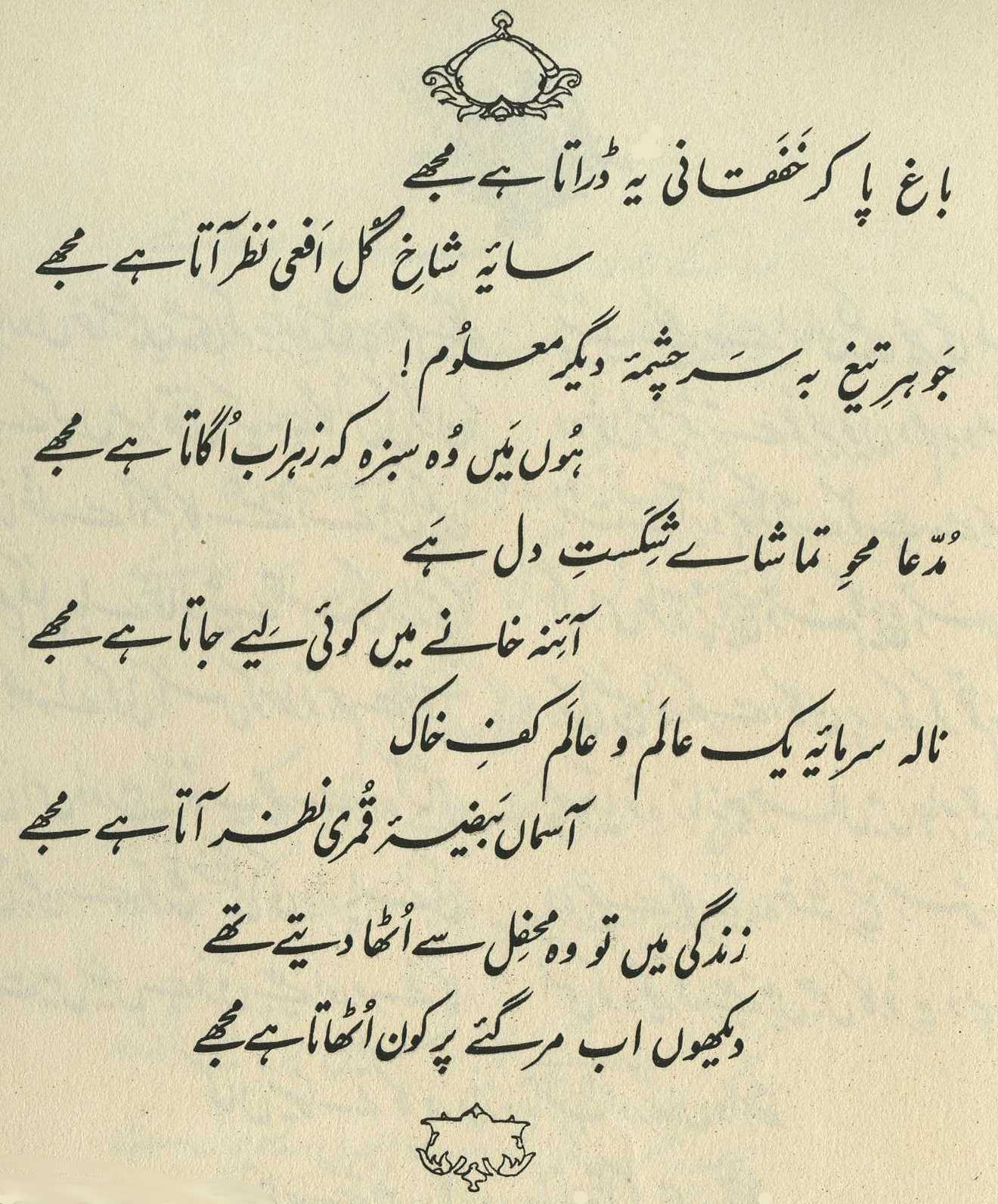
I follow Arshi's reading as always (as does Raza too in this verse), but since and can seem to differ mostly by a couple of dots, just out of curiosity I checked in the , and found very clearly calligraphed. If life were longer and I had time to be a proper textual scholar, I'd track down every early manuscript and go over all these small matters to my own satisfaction. Things being as they are, I prefer to trust Arshi and Raza (as serious people in the field generally do) and devote myself to actually grappling with the poetry instead.
It's clear that unlike Arshi, most commentators and others who write about Ghalib have not done their scholarly homework in this respect. Nazm sometimes speculates quite casually that some error of calligraphy must have occurred, apparently without feeling any need to verify such an idea. And here Gyan Chand speaks of a 'handwritten divan' without providing any details. On the whole, however, it's striking how few such small textual problems and questions really exist. (Anybody who's ever worked with bhakti poetry finds it a remarkable luxury that Ghalib scholars actually can know, almost always, what the poet actually did write.)
The 'I and X' structure tends to be emotive and exclamatory; compare 5,6 , which begins exactly the way the present verse does. But what exactly is the emotion? On the nature of , see 51,9x . Then the multivalence of opens up, as it does so often, the very different logical relationships of 'but' or 'perhaps'. Then the phrase opens up still more possibilities (is it a relish that is created by imagination? a relish that longs for imagination? a relish that itself is imagination?). And then, adds further flexibility: does the relish do the tormenting 'by means of' the magic spell, or 'accompanied by' the magic spell? And finally, the 'gaze of coquetry' offers its own -generated array of choices.
But then, can we really tell? And in a verse so abstract and vague, does it really matter? This is another verse that doesn't seem like a huge loss to the published divan .
graphics/veilgaze.jpg