Verse 31816aataahai mujhe
G5
In this meter the first long syllable may be replaced by a short; and the next-to-last long syllable may be replaced by two shorts.
1
purpose/intention is absorbed in the spectacle of the breaking of the heart
2
someone, taking me along, goes into a mirror-chamber
'Asserted as a claim, claimed, sued for; alleged; pretended; meant; --what is claimed, or alleged, or pretended, or meant; desire, wish; suit; meaning, object, view; scope, tenor, drift; --object of search, stolen property'.
| References | |
|---|---|
| Arshi, Imtiyaz Ali | Ghazal# 170 |
| Raza, Kalidas Gupta | 253-54 |
| Nuskhah-e-Hamidiyah | 258 |
| Asi, Abdul Bari | 263-264 |
| Gyan Chand | 385-386,520 |
| Hamid Ali Khan | Open Image |
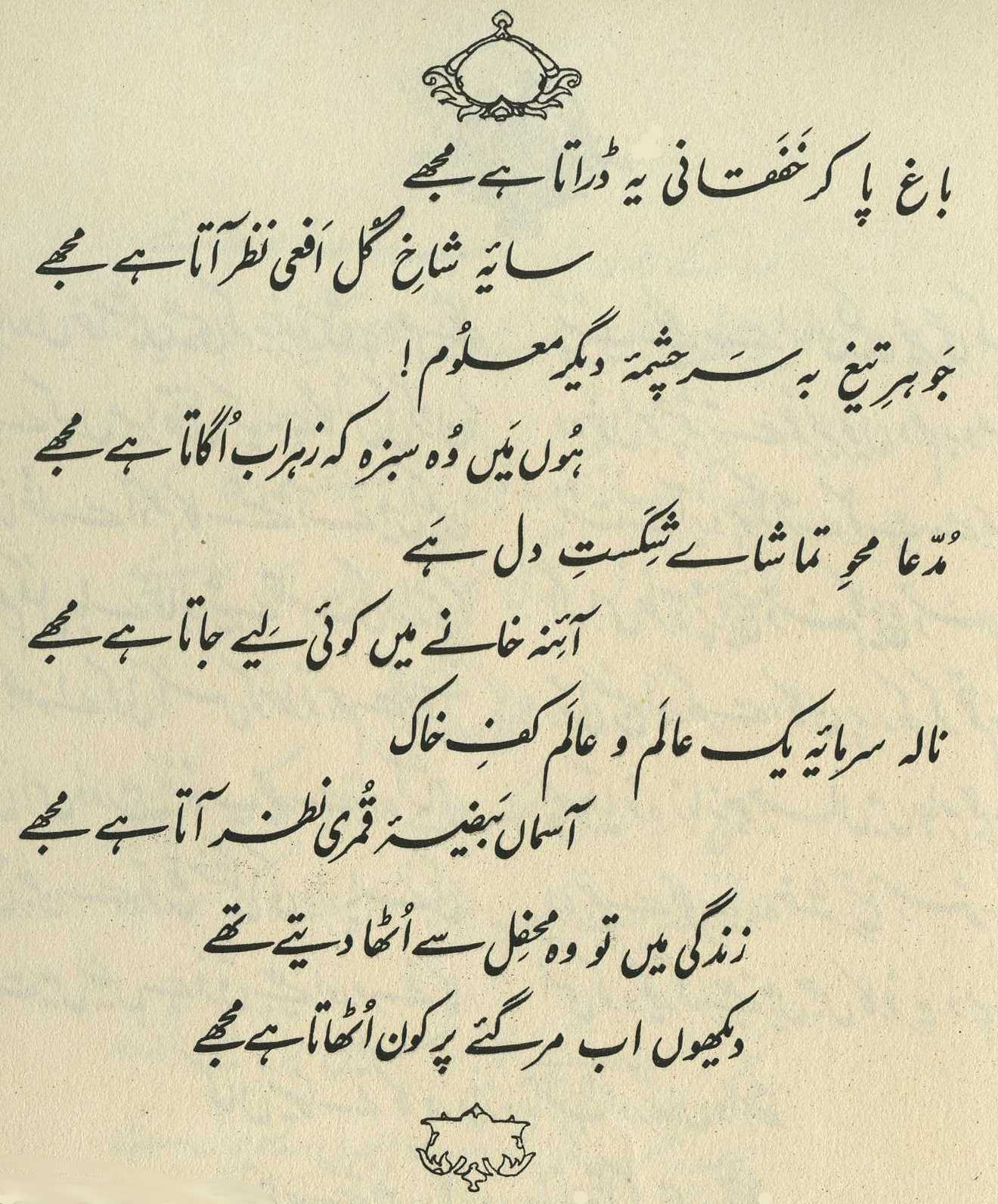
When from the attainment of a purpose the heart broke, the purpose was looking at the spectacle of the broken fragments of the heart. And the heart was a mirror; when it broke, then many mirrors were created and they became a mirror-chamber. This style of verse is not accepted/approved []. (245-46)
== Nazm page 245 ; Nazm page 246


He says, the difficulties and harshnesses of my purpose have broken my heart, and my purpose has become a spectator of the broken fragments of the heart. When the heart was established, then it was a mirror; the mirror, having broken, has created many mirrors, and for this reason my bosom has become a mirror-chamber. (306)
Mirza Sahib says that because of the non-fulfillment of my purpose, in extreme sorrow and grief my heart broke into fragments. And since they always construct the heart as 'broken', from the broken heart many mirrors came into being, and assumed the form of a mirror-chamber. Thus now the 'purpose' is absorbed in watching the spectacle of this broken-heartedness, and I feel as though someone is taking me into a mirror-chamber so that I too would be able to view the spectacle of those broken fragments. (446)
What the commentators say is all very well, but who is this mysterious 'someone', and what is he or she doing in the verse? All the rest of the ideas and imagery could perfectly well have been deployed without the 'someone'. Is the semi-personified 'Purpose', absorbed in the spectacle of mirror-fragments, dragging the speaker along with it? Is the speaker now so detached from himself that when his 'Purpose' is busy elsewhere, the rest of his psyche feels like an alien being that drags him around? Is the breaking of the heart so devastating that the inner self becomes fragmented as well? Does the mirror-chamber show him another reflected or refracted self that may seem to have more volition than he himself does? Does his shattered, fragmented heart itself become a mirror-chamber?
This verse, in short, becomes an inscrutable 'fill-in' one; we can (and must) decide on our own reading of the and the , and-- since it's an 'A,B' verse-- of the relationship between them, and between the two lines.
On the subject of breakable glass mirrors versus polishable metal mirrors, see 8,3 . And for more on mirror-chambers, see 10,5 .
Note for grammar fans: The verb grammar of the second line would be , someone [in a state of] having taken me [along], goes. This kind of is a one-shot action with continuing effects, like .
graphics/mirrorchamber.jpg