Verse 2after 1821aaho jaanaa
G5
In this meter the first long syllable may be replaced by a short; and the next-to-last long syllable may be replaced by two shorts.
1
with/from you, in my destiny/'division', like/'with the aspect of' a combination lock
2
was written-- at only/emphatically the moment of succeeding/'clicking', to become separated
'Division, distribution, partition (of a thing); a division (of a province, &c.); a section, head, category; (in Arith.) simple division; a portion, share, lot; fortune, fate, destiny; divine decree'.
'1. The first of a series of eight words comprising the letters of the Arabic alphabet in the order in which they were originally disposed (agreeing with that of the Hebrew and Aramaic). 2. The arrangement of the Arabic alphabet according to the occurrence of the letters in the said eight words. 3. The numerical value of the letters in this arrangement of them. 4. The alphabet'.
'To be snccessful, prove a success, answer well; to gain credit or honour, to prosper, flourish'.
| References | |
|---|---|
| Arshi, Imtiyaz Ali | Ghazal# 36 |
| Raza, Kalidas Gupta | 355 |
| Hamid Ali Khan | Open Image |
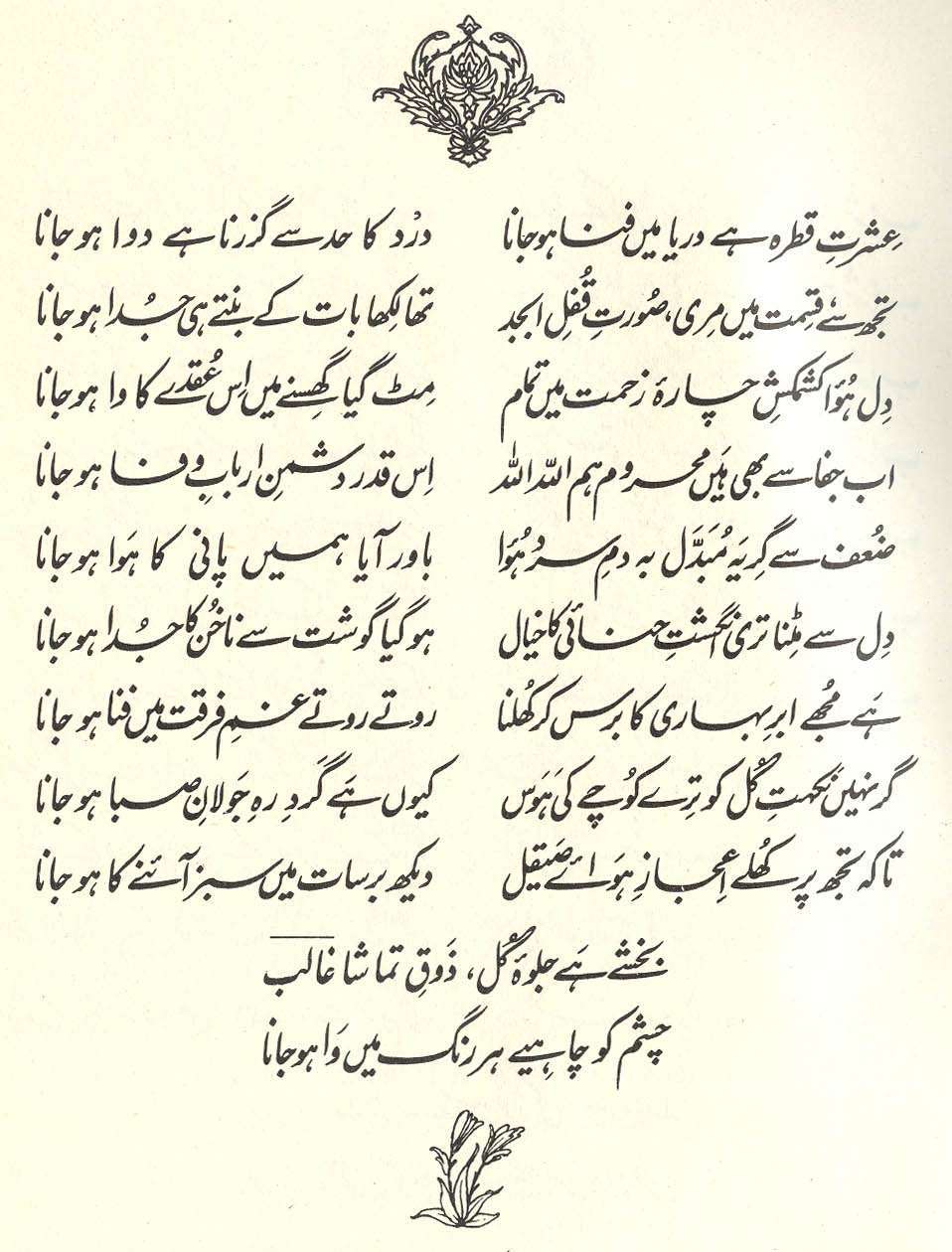
'From you' is related to 'to become separated', and 'in my destiny' is related to 'was written', and 'becoming separated' refers to the opening of a lock. When the letters are arranged to form that word which the maker has prescribed, then the combination lock opens. And they say for 'for a plan to come to fruition'. (43)
== Nazm page 43

Urdu text: Vajid 1902 {48}
Mirza Sahib says that the storehouse of his destiny was only this much: that when a connection of the heart would be made with you, then separation would occur. (85)
This simile is peerless. And this verse is a collection of hopelessnesses. If a person expects to fail in some task, and does fail, he doesn't feel as much vain longing, as much regret, as much suffering, as [he does] if the task is done and he is ruined by it. (108
This is another excellent mushairah verse: see 14,9 for further discussion of this concept. The lover and the beloved are like a combination lock: after some effort and care, they 'click'-- and then instantly they are drawn apart. The offers the pleasure of the proverbial ' fresh word ', but it doesn't stop there, since its action too is so enjoyably suitable to the lover's plight.
Within the verse, the maximum possible distance has been placed between , 'from you', and , 'to become separated'. Moreover, has the appropriate root meaning of 'division, partition', as well as its usual meaning of 'share, lot; fortune, fate' (see the definition above).
Urdu has the idiomatic X , 'to achieve a rapport with X'. Luckily, modern American English has (or not too long ago had) 'for X and Y to click', a similar idiom that could hardly be improved on. The English idiom even has the fortuitious ability to evoke the sound of an opening combination lock. How Ghalib would have enjoyed that!
One other combination-lock verse: 203,2 ; a more general padlock verse: 104,3x .
Note for chronogram fans: If you're curious about the system, here's more information .
Note for grammar fans: It seems best to take as short for , 'was [in a state of having been] written'. Otherwise, we'd be obliged to assume an omitted subject: , 'X had written'; this seems awkward, because there's no suitable subject indicated in the verse, and the reversed word order of the verb would feel clumsy.
Ghalib's combination lock always makes me think of Donne's ' A Valediction Forbidding Mourning ', with its image of the drawing-compass ; though far more hopefully worked out, Donne's is just as deliberately clunky and quotidian. Donne says of his and his beloved's souls that hers is like the fixed foot at the center of the circle:
Such wilt thou be to me, who must,
Like th' other foot, obliquely run;
Thy firmness makes my circle just,
And makes me end where I begun.
graphics/lock.jpg