Verse 11816aariikaa
G2
1
lightness/refinement without denseness/impurity cannot produce glory/appearance
2
the garden is the verdigris on the mirror of the spring breeze
taafat>> : 'Slimness, slenderness, delicateness; fineness, thinness, tenuity, subtility; neatness, elegance, grace, beauty; purity; delicacy, point; deliciousness, exquisiteness; pleasantness, facetiousness, wit'.
'Density, thickness, grossness; abundance; fulness, repletion; foulness, impurity'.
'Manifestation, publicity, conspicuousness; splendour, lustre, effulgence; displaying a bride (to her husband) unveiled and in all her ornaments'.
'Verdigris; rust'.
| References | |
|---|---|
| Arshi, Imtiyaz Ali | Ghazal# 19 |
| Raza, Kalidas Gupta | 153 |
| Nuskhah-e-Hamidiyah | 64-65 |
| Asi, Abdul Bari | 66-67 |
| Gyan Chand | 100-101 |
| Hamid Ali Khan | Open Image |
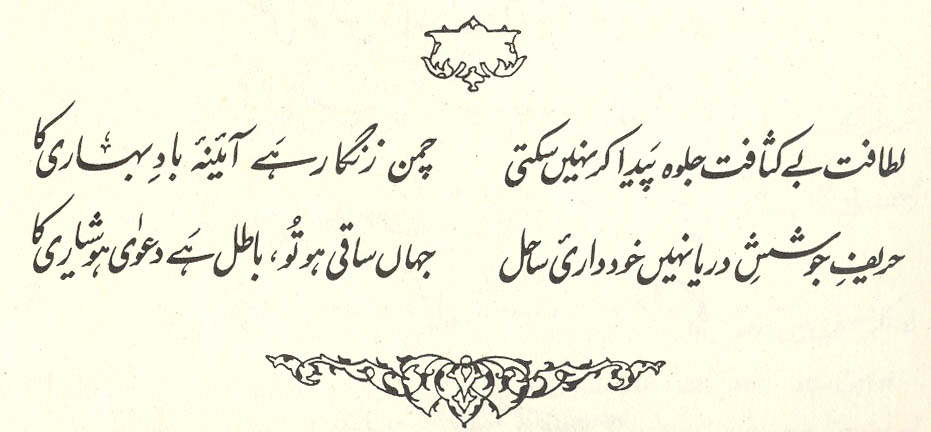
That is, when verdigris appeared on the mirror of the spring breeze, then greenery came into being. This is an allegory of the fact that glory/appearance cannot be incorporeal and without relationship to substance. (42-43)
== Nazm page 42

Urdu text: Vajid 1902 {47}
He says, until lightness is mixed with impurity, it cannot have the ability to produce glory/appearance. In the second line is an illustration [] by way of proof of this idea. That is, the glory/appearance of the spring breeze occurs by means of the garden, as if the garden, with respect to its greenness, is the verdigris of the mirror of the spring breeze. The meaning is that the impurity of verdigris of the garden is the cause of the glory/appearance of the purity of the spring breeze. (85)
As long as there's no impurity, the glory/appearance of lightness can't be seen. That which you consider to be a garden is not a garden-- rather, it's the verdigris on the mirror of the spring breeze. That is, the effects of the spring breeze can be seen. By itself, the spring breeze is not a thing that can be seen. People say that they've seen the spring; their opinion is incorrect. (106)
Compare 63,1 . (170)
This ghazal in its divan form has no opening-verse ; in its original form, its opening-verse was 47,3x .
The spring breeze is so pure and ineffable that it's invisible. It's like a mirror so bright and lustrous that it can hardly be seen at all, and can only act as a pure reflector. Only when the metal mirror contains some verdigris or rust do we actually notice it as a mirror, and not simply see what is reflected in it. The cloudy green of verdigris, as Nazm points out, has a fine affinity with the greenery of the garden.
At least, this is the best I can make of the metaphor. But I'm not entirely satisfied. What does it mean to imagine a metal mirror that is so light or clear or pure as to be invisible? How can it fail to still look like a piece of metal? And since it would presumably then be an ideal reflecting surface, why can't it produce through what it reflects? If what is desired is its own rather than that of what it reflects, then why is the garden part of the spring breeze's own intrinsic , rather than (as seems more logical) part of what it reflects? Should we then say that the green garden-verdigris on the breeze-mirror is what alerts us to the fact that not just the spring breeze but the whole physical world is a mirror, presumably of God's presence?
Ghalib certainly knew glass mirrors, as can be seen indirectly in 34,2 , when he insists that this particular verse refers not to a glass but to a metal one. If we were permitted to think of a glass mirror, I would love to imagine that the garden is the metallic backing that turns the transparent glass of the breeze into a reflective mirror. Although I know this is my own invention, I still can't help but like it.
ABOUT : Clearly the word (see the definition above) requires us to imagine a metal mirror, one that would have on it some verdigris , in the form of a rusty greenish patina. (Verdigris is what gives the Statue of Liberty its present color.) Other verses about such verdigris: 48,10 (in the 'rainy season'); 60,10 , which uses the term ; 63,1 ; 113,10x , which plays on ; 217,2 , about verdigris on the edge of a sword; 221,4x , about the of a mirror; 254x,2 , with a 'veil of '; 320x,4 , mirrors with no ; 392x,2 , on an iron pen
Here's a look at a bronze mirror covered with (from the Khurasan region, c.1200's, about 10" in diameter): * the back * and the front:
graphics/mirrorfront.jpg
Here's an Ottoman mirror, from the early 1800's-- * the back * and the front:
graphics/mirrorfront2.jpg
And here's how beautiful verdigris can be:
graphics/verdigris.jpg

