Verse 11816ilhai aa))inah
G3
1 a
from sun to sand-grain-- heart(s); and a heart is a mirror
1 b
from sun to sand-grain, heart upon heart is a mirror
2
{from / by means of} the six directions, a mirror confronts the parrot
'Fronting, confronting; opposing, contending; opposite; --comparing; collating; --corresponding, matching; resembling, like; --in opposition (to, - ); in front (of), over against; face to face (with), in the presence (of); --in comparison (with)'.
| References | |
|---|---|
| Arshi, Imtiyaz Ali | Ghazal# 128 |
| Raza, Kalidas Gupta | 223-24 |
| Nuskhah-e-Hamidiyah | 176 |
| Asi, Abdul Bari | 204 |
| Gyan Chand | 314-316 |
| Hamid Ali Khan | Open Image |
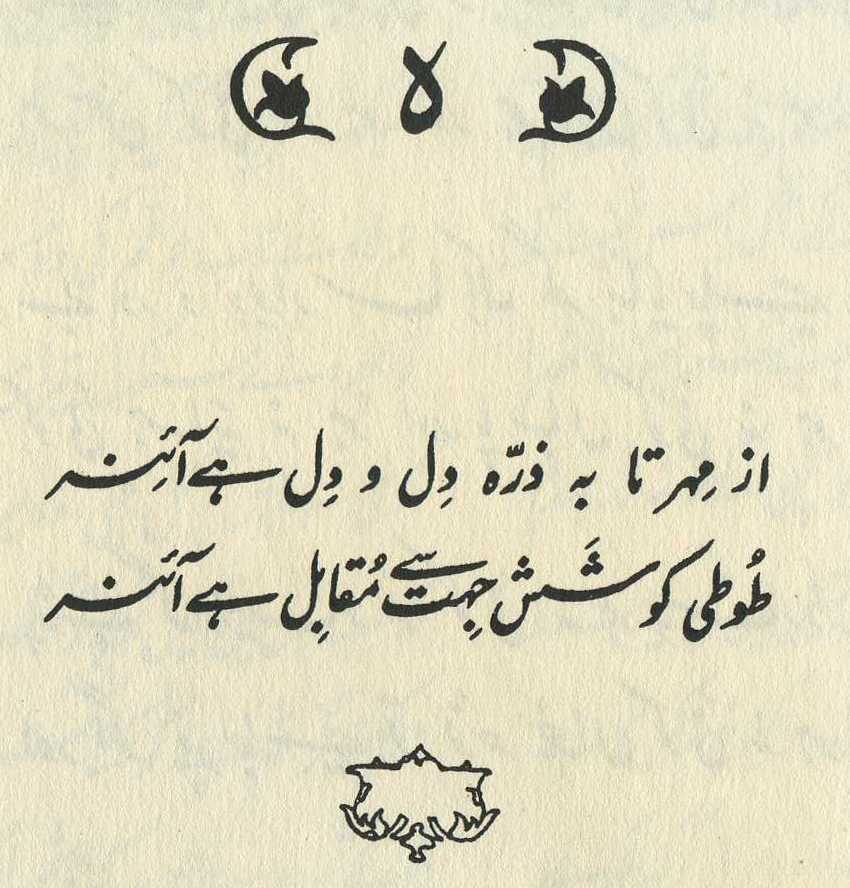
That is, in the world face and face, and heart and heart, are mirrors to each other-- that is, one sees his aspect in the other, and the other in the one. The gist is that the whole world is unified in its being, and is one, and they are not alienated from each other. One sees himself in another, as when someone would look in a mirror. When this is the situation, then whichever direction a parrot would look, a mirror is present before him. And the parrot is only a metaphor ; the point is that individual who would see the unity, and in a state of mystic absorption would raise the song . (138)
== Nazm page 138

= Six directions: north, south, west, east, down, up.
The parrot, seeing himself in a mirror, considers it another parrot, and speaks well. By 'parrot' is meant the mystical knower.
From the sun to the sand-grain-- that is, everything in the world-- is a heart, and the heart is a mirror. Thus the parrot sees a mirror in every direction. That is, the world is a mirror-house, in which the mystical knower sees his own face in every direction.
[Or:] It's the Lord's power alone, which in every direction is seen in a new aspect, and is called by a new name. Otherwise, the reality of everything is one. (258)
The meaning is clear: that from earth to sky, in everything is the same radiance that is in the heart. Things are made of sand-grains, and every sand-grain glitters in the light.... The sand-grain's being illumined, and its changing with the state of the light so that its glitter decreases or increases, gives it similitude with the heart's being illumined and its beating. Accordingly, on the one hand every sand-grain is a heart, and the heart is a mirror-- thus every sand-grain is a mirror. Ghalib has used the theme of the comparison of the heart and the mirror a number of times: 29,1 ; 228,7 . Accordingly, up to this point the matter is settled: all creation is made up of sand-grains, and the sand-grains act as hearts, and the heart is a mirror. Since all creation is made up of mirrors, wherever the parrot turns, he will see mirror after mirror....
Now please consider the verse from a new angle. What's the affinity between a parrot and a mirror? This is the fundamental question. And the answer to it is that when they teach a parrot to speak, then they place him before a mirror. The teacher is behind the mirror. The parrot sees his reflection in the mirror, and considers some bird of his own species to be before him, and and considering the hidden person's voice to be the voice of his fellow-bird, he tries to imitate it.
Thus it's clear that in order to teach a parrot to speak, they place him in error. And this error is produced by means of a mirror. But if this error were not to exist, then the parrot would not learn to speak. In the first line it's been said that all of creation speaks by means of mirrors. Now assume that there's a parrot in that hall of mirrors. The parrot sees its reflection in every direction, and hears different kinds of voices, because the creation is always full of different kinds of noise. The parrot, seeing its reflection and hearing voices, becomes eager to speak.
Now we've learned that the parrot is in reality a metaphor for the poet. Between the parrot and the poet are various kinds of affinities. The poet is called a parrot. It can also be said that the poet says all the things that the Lord causes him to say.... The parrot too says all the things that the teacher teaches him. Like the parrot, the poet too speaks when he is moved by circumstances. Thus the basic interpretation of the verse is that in every direction the poet sees nothing but hearts-- that is, nothing but mirrors. What is a mirror? It is a tool for seeing. This sight may be deceitful (because in the mirror is only a vision, not the real thing).
But the poet, having seen those visions, enters the world of speech. Just as the parrot sees its reflection in the mirror and learns to speak, so the poet sees, with his imaginative eye, visions in the mirror of creation, and becomes absorbed in poetic composition. Thus this verse is not mystical, but rather conveys the theme of the psychology of the creative act, and the poet's responsibility for his own identity. The poet is like a parrot-- seeing his own image, he sees the whole world.
== (1989: 242-44) 2006: 264-66
ABOUT THE HEART AS MIRROR: One of the fundamental metaphors in Persian and Urdu ghazal is that the heart is a mirror (another is that it is, or contains, a knot, as in 8,2 ). For a specific example, see 12,4x . Sometimes the heart is a glass mirror (which can then be most effectively 'broken'); these verses tend to be later, because of the slow development of good glass-silvering technology , but by Mir's day the image was certainly available. Much more commonly, however, the heart is a metal mirror. In this case it needs to be polished frequently (especially in monsoony South Asia), in order to scrub off the accumulated 'dust' or (metaphorically) vexation (see for example 27,9x and 335x,9 ) and verdigris [], and bring out a sufficiently high shine for reflectivity. This process leaves 'polish-lines' [] that can be considered 'eyelashes', so the mirror can also become an eye. Through enduring the pain of polishing, the heart-mirror, most crucially, becomes able to reflect or mystically 'see' the light of Divine glory. Sometimes it fails: in 349x,2 , the mirror is implicity reproached for being able to show only a mere 'reflection'. There's also the petrified phrase describing disturbance or anxiety, , literally 'dust of the mind/heart'; on this see 431x,7 .
Ghalib uses mirror imagery all the time; the mirror is probably his number one favorite image. I have hyperlinked every 'mirror' verse in the divan on this website in 8,3 . (I have linked only explicit uses; there are other implicit ones as well, of the kind noted above by Faruqi (see for example 228,9 ); and there are a great many in the unpublished verses as well, most of which I have not linked.) If one goes through the 'mirror' verses, it's striking what an array of extravagant things the verses identify as mirrors, and how few verses specifically invoke (as does the present verse) the heart as a mirror. My theory is that this is because Ghalib always wanted to avoid the beaten track (as Hali reminds us in 230,5 ); so when everybody expected the heart to be the mirror, the verse could well be made to ricochet off, with energy redoubled by the hearers' surprise, in some entirely new direction.
This verse feels to me like one of mood . It feels like 105,2 . The mystery, the seductiveness, is especially in the first line. The first line has a flowingness of its own, with a sensuously strong amalgamation of (increased by the meter, which causes it to be read 'di-lo-dil'). The clear semantic separation into two independent clauses as in (1a), on which the commentators agree, is logically irreproachable of course. Still, it doesn't accord with how the verse either sounds or feels.
The reading I love for the first line is 'from sun to sand-grain, heart upon heart is a mirror' (2b). Heart after heart? Heart and heart? Depths of heart? Something more compelling, anyway, than simply a full stop and a fresh sentence that just happens to begin with the same word that the last one ended with. Also, I like to imagine only one mystically extended heart-mirror, reaching from the sun to the sand-grain, rather than a zillion little tiny ones; and here the grammar is with me (though it's not against the usual interpretation, either).
But perhaps my reading wouldn't even make much difference, since either way the first line is almost uninterpretably abstract, and whatever specificity the verse has is contained in the second line. Here, Faruqi's explanation works excellently, although the verse seems to apply the mirror-training process not only to poets, but to everyone-- or at least, everyone with a 'heart'. I can't add a thing to it, except to emphasize the verse's sensuous texture, which is (to me at least) even more compelling than its striking parrot-speech metaphor.
For other parrot-and-mirror verses, see 29,2 . For other such evocations of the 'six directions', see 41,4 .
http://www.flickr.com/photos/eva8/53066419/ graphics/parrot.jpg